• Skip to main content
  • Skip to primary sidebar
  • Skip to footer

Mosaic MennonitesMosaic Mennonites

Missional - Intercultural - Formational

  • Home
  • About Us
    • Our History
    • Vision & Mission
    • Staff
    • Boards and Committees
    • Church & Ministry Directory
    • Mennonite Links
  • Media
    • Articles
    • Newsletters
    • Video
    • Audio
    • Bulletin Announcements
  • Resources
    • Conference Documents
    • Missional
    • Intercultural
    • Formational
    • Stewardship
    • Church Safety
    • Leaders’ Resources
    • Request a Speaker
    • Pastoral Openings
    • Job Openings
  • Give
  • Events
    • Delegate Assembly
    • Youth Event
    • Conference Calendar
  • Mosaic Institute
  • Vibrant Mosaic
  • Contact Us
  • 繁體中文 (Traditional Chinese)
  • English
  • Việt Nam (Vietnamese)
  • Español (Spanish)
  • Indonesia (Indonesian)
  • Kreol ayisyen (Creole)

Blog

What might you want to do someday as a result of today?

June 29, 2023 by Cindy Angela

by Marco Güete

Routine and habit intertwine and shape our daily lives. This includes our work, ministry, food, exercise, entertainment. Routine and habits are created and learned; it all depends on our interest and purpose.  

Personally, I found walking for exercise very boring and didn’t like it. One day everything changed. Russ Eanes, former Executive Director of MennoMedia, mentioned that he was planning on walking 800 km in Spain. I became interested and then researched, read books, listened to podcasts, and watched a movie on the subject. Eventually, my desire to do the Camino de Santiago and to walk 800 km (500 miles) in Spain was born.  

I set a date to walk the trail and established a routine of walking six miles three times a week, regardless of the weather. I decided to walk to train myself and to establish a routine, which later became a habit. As a result of my new walking habit, I have been inspired with this question, “What might you want to do someday as a result of today?” by Greg McKeown in his book, Essentialism. 

“Ultimately, your habits matter because they help you become the type of person you wish to be,” said James Clear, an author who writes about decision making and habits. “They are the channel through which you develop your deepest beliefs about yourself. Quite literally, you become your habits.” Walking became my habit. 

On May 16, 2023, I left my house in Sarasota, FL and arrived in Astorga, Spain, 25 hours later. I slept less than two hours on the trip. I was again dazzled by the beauty of the city’s architecture dating back to the 15th century. The year before, I had finished the second part of 260 km in Astorga. The next day, after a comfortable night’s sleep and a hearty breakfast, I was ready to start walking the last series of 14 stages, which was 260 km, to reach Santiago de Compostela. 

Wearing hiking boots, a backpack, a wide-brimmed hat, and a waterproof jacket, I took my first step on May 18, with the temperature at 38 degrees Fahrenheit. That day and the following, the legs walked automatically. James Clear said, “A habit is a behavior that has been repeated enough times to become automatic.” 
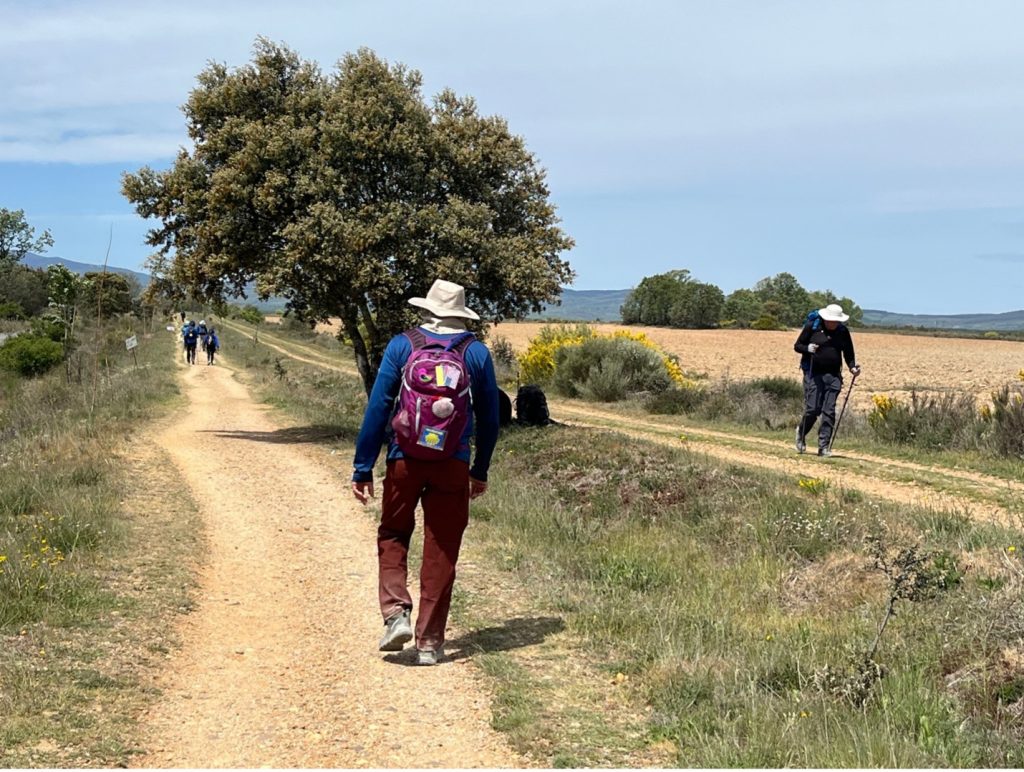
I completed the Camino Frances de Santiago in three years, walking approximately 266 km each year. This path is the most popular and traveled by walkers from almost all over the world. The first year a pastor friend accompanied me, and the following two years I walked with my wife. She also trained alongside me. 

One of the beauties of the path, apart from the landscapes, is the relationship and communication with other walkers. We are all doing the same: walking through plains and mountains; crossing rivers in the rain and the sun; feeling hot or cold; eating and drinking almost the same.  
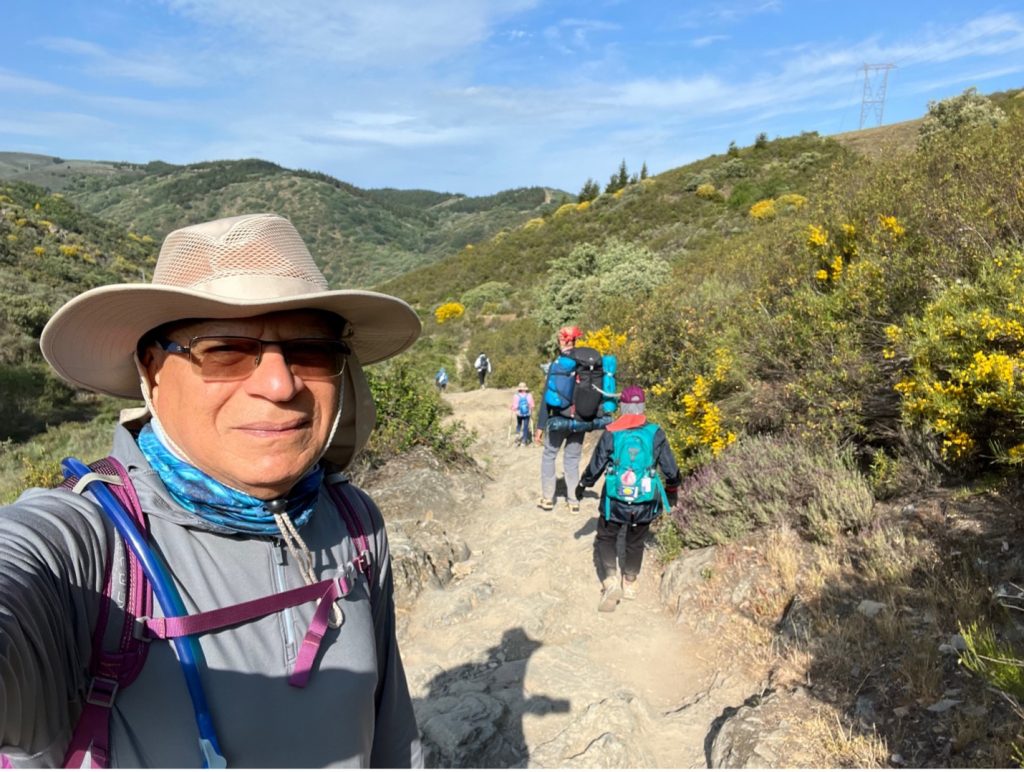
On the Camino, we walkers are all the same, regardless of race, profession, culture, or language. We become friends and   greet each other with the phrase: Buen Camino.  This is a time when we become more human and more spiritual, and where we can see God’s creation in ourselves without prejudice. 

I walked with two purposes: the first to achieve my personal goal and to raise funds for the Instituto Biblico Anabautista (IBA). The purposes were fulfilled with the help and love of God and his Spirit, to whom I give glory and honor. 

The opinions expressed in this content are those of the author and may not reflect the official policy of Mosaic Conference.
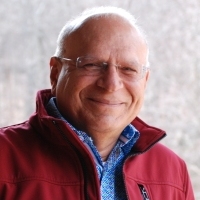

Marco Güete

Marco Güete is the Leadership Minister for Florida for Mosaic Conference.
Filed Under: Articles, Blog Tagged With: Marco Güete

How Do I Walk the Second Mile? 

June 1, 2023 by Cindy Angela

by Brooke Martin

How do I disciple and walk with someone whose perspective, theology, or experience is not my own, or is different than the majority of people in my congregation? I know I am supposed to love them, but how? What if this is a person whose identity conflicts with my church’s view but they are an active part of the congregation, looking to me as their pastor or youth leader? 

In a culture that dismisses anyone with a different understanding than our own, we can quickly lose track of our call to be Third Way people. Jesus taught that there are not just two options in times of disagreement or conflict; instead, he encouraged his followers to seek out a third way, to completely change the dynamic of disagreement. 

Jesus illustrated this concept with the example of “walking the extra mile.” The law stated that a soldier was allowed to make a civilian carry his heavy pack for one mile only. Jesus told his followers to walk the extra mile. Imagine the soldier turning at the mile mark, anticipating a glare of disdain as the civilian shucked the heavy load. Instead, as the soldier turns to the civilian, the one who is called to the Third Way, continues to walk with the load. Do they make eye contact or have a clarifying conversation? Both the soldier and the civilian would change from their usual ways of thinking and engage differently during this next mile. The power dynamic has shifted: the situation and their relationship with one another has changed. 

At Spruce Lake’s Engage Conference for youth leaders, I experienced a modern-day example of Third Way living when I listened to the storytelling of Art Pareira, the Director of Community Care for ReVoice. I anticipated that Pareira would share his list of why he was right and others were wrong; instead, I had a “second mile” experience. Pareira’s call to youth leaders was to not stop at the first mile but to continue walking with their youth to a deeper level of care and consistency.  If we just focus on our duty to fulfill our understanding of God’s law, we miss the opportunity to journey deeper and further towards where Christ is calling us on the “second mile.”  

As a celibate gay man, Pareira lives and ministers out of his own experience and theological perspective, naming that he takes “hits” from all sides, not being progressive enough for some or conservative enough for others.i Still Pareira continues his call to walk on. Pareira understands and accepts others may have different theological understandings, and he respects those differing convictions.  He does, however, call Jesus-followers not to stop there but to continue as shepherds who are willing to walk beyond the first mile. In the second mile, he calls for the caring of people and encouraging consistency in ethical living across all sexual orientations. 

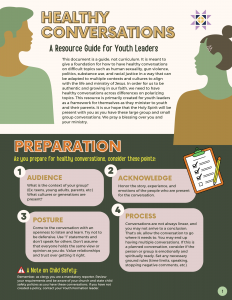
With this “second mile” mindset, the Mosaic Youth Formation Team has created a Healthy Conversations guide for youth leaders and others who desire tools for conversations across differences of all kinds. We pray this guide will be a resource and encouragement so that, together, we can continue the journey of faith formation by walking beyond the first mile into the holy second mile of truly loving our neighbors. 

Introducing the Healthy Conversation Guide

This document is a guide, not curriculum. It is meant to give a foundation for how to have healthy conversations on difficult topics such as human sexuality, gun violence, politics, substance use, and racial justice in a way that can be adapted to multiple contexts and cultures to align with the life and ministry of Jesus.

Download Now


Also available in a print-friendly version

iArt Pareira has chosen a celibate lifestyle because of his belief affirming that God intends marriage to be a covenant between one man and one woman for life. This belief is also affirmed by Spruce Lake Ministries. 

The opinions expressed in this content are those of the author and may not reflect the official policy of Mosaic Conference.


Brooke Martin

Brooke Martin is the Youth and Community Formation Pastor for Mosaic Conference. Brooke lives in Telford with her husband, Nathaniel, and their two children.

Filed Under: Articles, Blog Tagged With: Brooke Martin, formational

A Trip to the Mountains

May 18, 2023 by Cindy Angela

by Michelle Ramirez

Often, the view you least expect is the one that ends up impressing you the most. That was the key learning that stayed with me when returning home from a recent youth trip.  

Early in March, I was blessed to be invited to speak at a youth event at my cousin’s church in Raleigh, NC. When I learned about the event, I was excited, but aside from knowing that it involved youth and that I would be speaking, I knew nothing else.  

When I arrived in Raleigh, I learned that the event would actually be taking place in Gatlinburg, TN, and we had to drive there from North Carolina. As someone who grew up going on road trips, this excited me even more because I know the best part about road trips are the views along the way.  

I had met the youth from North Carolina before, and they knew me as well, but this event provided an opportunity to get to know them even better. The event started with a sermon on the importance of placing God as the foundation and how important it is to see God in everything around us.  

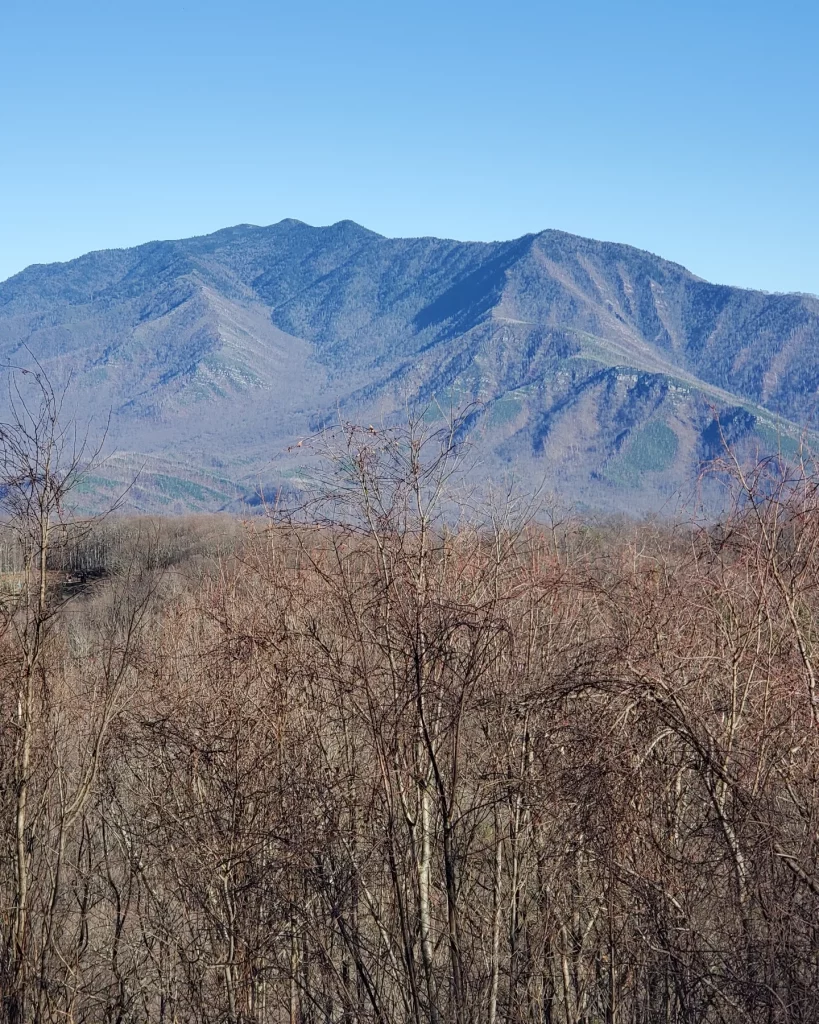
The mountains near Gatlinburg, TN. Photo by Michelle Ramirez.

I reminded the youth that just as God created each one of us, He also created the huge mountains, and our foundations need to be secure to grow so tall. The next day was even better, as we had the opportunity to go and explore the Ober mountains in Gatlinburg. The view from the mountains was truly astonishing, compared to flat Florida. I was surprised to see the world wasn’t so flat; although my ears were constantly popping, which wasn’t so pleasant. 

After returning from the mountains, it was time for my second sermon, which focused on being vulnerable with the Lord and being open to doing things God’s way and not the world’s way. I gave an opportunity for all the youth to speak and share what they were feeling and thinking.  

As the youth were speaking, I realized that just like the mountains, each one had a perspective or view I wasn’t expecting. I had known who these young people were, but I was blessed to have the opportunity to get to know them further and to experience the beauty in them that was waiting to be seen. This reminds me that often the prettiest view isn’t always what we see on the outside, but rather seeing the Love of God every one of us has on the inside. 

The opinions expressed in this content are those of the author and may not reflect the official policy of Mosaic Conference.


Michelle Ramirez

Michelle Ramirez is the Youth and Community Formation Coordinator for Florida for Mosaic Conference.

Filed Under: Articles, Blog Tagged With: Michelle Ramirez

Prayer as Surrender

March 22, 2023 by Conference Office

by Josh Meyer 

Franconia Mennonite Church recently engaged in a month-long series on prayer. We spent four weeks considering the purpose, posture, power, and practice of prayer. It was a rich and meaningful time, marked by biblical teaching and practical application. I was reminded once again that prayer is much more than bringing to God my list of wants, desires, and needs. It is a radical act of worship that reminds me who I am, who God is, and what life is all about.   

In short, prayer is surrender. 

Prayer is a radical act of worship that reminds me who I am, who God is, and what life is all about.   

[1] Prayer is surrender to the reality that there is someone more ultimate than you.

It’s natural for each of us to shrink our field of hopes, dreams, and daily concerns down to the small turf of our personal wants, needs, and feelings. Prayer is surrender to the worldview of the first four words of the Bible, “In the beginning, God…,” and as such, it reminds us of our rightful place. 

[2] Prayer is surrender to the reality that you need help. 

Prayer means humbly confessing that we are not autonomous, self-sufficient beings. We were not designed to live independent, detached lives. Prayer reminds us that we cannot be what we were made to be or do what we have been called to do without the personal, gracious, and continuous intervention of the One who made us. 

[3] Prayer is surrender to the reality that there is wisdom greater than yours. 

Prayer confronts us with the fact that we are not as smart as we tend to think we are. There is so much we don’t know or understand. Prayer reminds us that life is not found in our limited understanding, but in surrendering our lives to the care of the One whose understanding spans from before origin to beyond destiny and includes everything in between. 

[4] Prayer is surrender of your right to live as you choose. 

Prayer is bowing our knee to the reality that there is a limit to our personal freedom. This chafes against the rugged individualism of our culture. Yet Scripture reminds us that while “it is for freedom that Christ has set [us] free,” we are not to use our freedom primarily to indulge our own desires; instead, we’re called to use our freedom to serve others in love (Gal 5:1, 13-14). Prayer reminds us to consider not only our own interests, but also the interests of others (Phil 2:4). 

[5] Prayer is surrender of your hopes to God’s grace. 

Prayer is remembering that there is no hope in life and death that does not result from the grace of God. In prayer, we give up our hope in the self and place our hope in Christ.   

May you experience the Presence of Christ in a particularly deep and meaningful way as you surrender yourself in prayer.   


Josh Meyer

Josh Meyer is a Conference Leadership Minister and the pastor of Discipling and Preaching at Franconia Mennonite Church.

Filed Under: Articles, Blog Tagged With: Josh Meyer

The Power of Handwriting

February 2, 2023 by Cindy Angela

By Sue Conrad Howes 

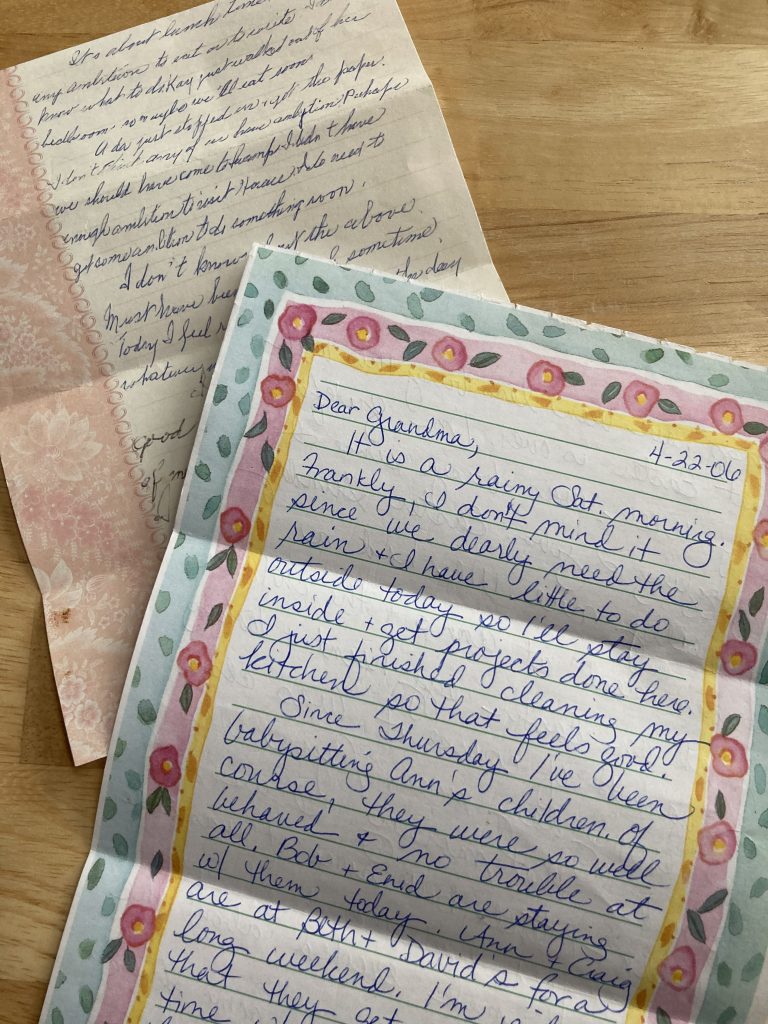
You could count on it like the rising of the sun. From the week I left for college in 1988 to her death in 2008, my grandmother wrote me a weekly letter.  It was one of the most reliable things in my ever-changing life.  Based on rough calculations, Grandma wrote me well over 1000 letters on her lacy stationery with her fancy penmanship.  

My relationship with my grandma had always been strong, even before the letter writing, but it grew stronger as a result of the letters. Ignoring the advent of email during this time, I also hand wrote letters to Grandma. I was, perhaps, not quite as dedicated as she was, but we had a wonderful correspondence that crossed generations, theological differences, and geographical distances. I became a better person because of these letters, learning from her wisdom, but also knowing how to express my changing self to someone who had always been so present in my life.  

A letter from Grandma under a letter from Sue in 2006. Photo provided by Sue Conrad Howes.

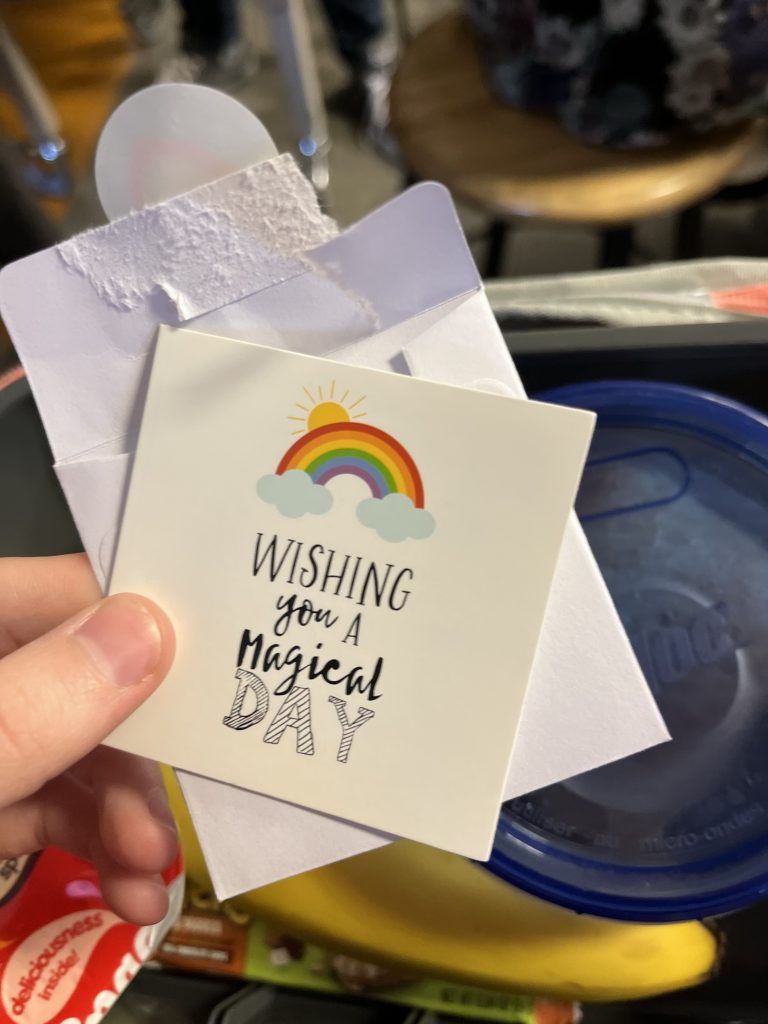
Like others, I am a fan of quick texts, even email … but I still love the old-fashioned approach to relationships through the hand-written word of a card, letter, or note. Recently I spent the week with my 16-year-old niece while her parents were away. One day, I tucked a small card in her lunch bag. At lunch, she snapped a photo of the card and sent me a text, thanking me for it. I later learned that she shared that same photo on her Instagram account. What was it about the card that made a teenager want to share it with her world?   

The photo of the note in Sue’s niece’s lunch. Photo provided by Sue Conrad Howes.

We know that a portion of the New Testament is formed of letters (called “epistles”), written from one person to another.  These letters have become our holy Scriptures. We have been able to use them as our guide, despite the fact that they were letters written over 2000 years ago. Did Paul have any idea his letters would have such staying power?  What is it about the epistles that makes us want to share them with the world? 

I wonder how many drafts Paul took to write his letters. Did he wish for white-out or an eraser, or did he take the time to think through his words before putting them on parchment? What does it mean when we take the time to think clearly about our words to another person, and then hand write them on paper? I always take more time when I write a card or letter, usually re-reading it before mailing it, than any text or even email that I write. Imagine if we all took a little bit more time in our communication: hand-written, spoken, or typed. Would it make it to someone’s Instagram account? 

If you’re looking to experience the epistles as they were originally heard or written, join Mosaic Institute’s “Formed by Scripture” class this spring.  You’ll dig more deeply into the stories behind the Bible, explore the experiences that shape how we interpret Scripture, and practice interacting with the Bible in ways that can change us—like writing out one of its books by hand! 


Sue Conrad Howes

Sue Conrad Howes is part of the communication team for Mosaic Mennonite Conference. She is an ordained pastor in MC USA and is a chaplain at St.Luke’s Penn Foundation. She and her husband live in Quakertown, PA and are members at West Swamp Mennonite Church.

Filed Under: Articles, Blog Tagged With: Sue Conrad Howes

A Call to Prayer

January 4, 2023 by Conference Office

By Mike Clemmer 

Years ago, as I began my first pastorate, my wife gifted me with a beautiful hand-crafted kneeling bench. She knew how important it would be for my ministry to daily spend time with the Lord in prayer and “bow down, kneel before the Lord, and acknowledge that He is God” (Psalm 95:6). 

Time with the Lord and before the Lord is paramount in hearing from God and in worshipping the Lord. Through prayer and the scriptures, we learn more of God’s heart. We also invite the Holy Spirit to speak and guide our thoughts and actions. It is a daily practice that is too important to avoid or dismiss.  

I keep the prayer bench in my church office and find myself on the kneeling rail often. Yet unfortunately, I also find myself walking past it way too often as well. Perhaps my pride tells me that I already know what’s best or maybe I simply feel like I do not have the time to pray. In any case, my time of kneeling before the Lord is often hijacked by my own selfish thoughts and interests.  

As I begin 2023, the reminder of my need to pray and prioritize time before the Lord is more timely than ever. With busy schedules and the pressures of ever-changing cultural norms, discernment surrounding matters of faith and the church has become a very difficult task. We long for a clear word from the Lord on all matters of faith and practice, yet we often walk right past our prayer benches. Instead, we look for clear direction through what feels best or what makes the most sense to us. I find myself even speaking for God on some of these things without ever spending the time on my prayer rail listening to God’s voice. 

Mosaic Conference is also in the midst of a discernment process. Conference delegates recently passed the Pathways Document which lays out a plan forward in discerning our relationship with each other, with Mennonite Church USA (MC USA), as well as other matters of practice in the church.  

In the Pathways document, the first bullet point is a reminder for all of us to kneel before the Lord and pray. It states: 

We believe that we are called by God in this time:  To share in the practice of continued prayer and fasting so that we may discern, yield, and listen to the Spirit among us.  

This is a simple call to prayer and fasting. It is an invitation for all of us to spend time in God’s presence and to listen to and yield to what the Spirit tells us. How will we respond to this call to prayer? Will we be able to kneel on our prayer benches each day, study God’s word, and allow the Spirit to speak to us, or will we simply walk by and believe that we already know what God wants for us?  

My prayer is that we can all humbly prioritize prayer and the spiritual disciplines in our journey towards discernment and that God’s voice will clearly be heard as we bow before God’s throne each day in 2023.  


Mike Clemmer

Mike Clemmer is a Conference Leadership Minister and serves as the pastor of Maple Grove Mennonite Church (Lancaster Conference).

Filed Under: Articles, Blog Tagged With: Mike Clemmer

The Gift You Don’t Expect

December 19, 2022 by Conference Office

By Michelle Ramirez 

Besides commemorating the birth of Christ, the holiday season is about giving and receiving gifts. But what if a gift you joyfully receive comes with something you weren’t expecting at all?  

I recently received a gift of a puppy from someone who knew I really wanted one.  You can imagine the joy I felt in receiving this gift. I have always loved dogs and wanted a dog my whole life. Unfortunately, because my family moved around a lot, I was never able to have one. One of our church members recently had a dog who gave birth to a litter of nine puppies. He knew how much I always wanted a dog, so he gifted me a puppy, to my surprise.  

In the days leading up to my puppy’s homecoming, I prepared myself as best I could, knowing puppies are not easy to care for. I read all the information I could find and bought whatever I thought would be necessary, but I still felt unprepared. I received the gift I always wanted, but I didn’t expect all the responsibility that came along with it.

I realized how very similar this is to how we respond in our walk with Christ. We pray fervently for something but find it hard to accept the trials that can come with asking for something. The Lord, in His infinite mercy, may grant us the gift we want, but He also grants us the tools we need to receive it. 

Atlas, Michelle’s new puppy, as he prepares for homecoming. Photo provided by Michelle Ramirez.

Often, we forget that in the asking, we also receive gifts we weren’t expecting. Those extra gifts could be, like me with my puppy, extra responsibilities, momentary struggles, or even our characters being tried by fire. Even though God gives us these unexpected gifts, what is great is that He knows He gave it to us with a purpose (see Jeremiah 29:11). His plans are always to prosper us and not harm us. The gifts we weren’t expecting become the tools we need to actually grow.  

So this holiday season, while we receive gifts from loved ones, let’s remember we are constantly receiving gifts from our heavenly father as well. Those gifts might come with added things we weren’t expecting, but it will always be for our good!


Michelle Ramirez

Michelle Ramirez is the Youth and Community Formation Coordinator for Florida for Mosaic Conference.

Filed Under: Articles, Blog Tagged With: Christmas, Michelle Ramirez

On Fasting…

December 15, 2022 by Cindy Angela

by Jeff Wright

The call to fast ought not to be a throwaway line.  

In almost five decades of deciding and trying to follow Jesus daily in life, I have seen the call to fasting used as a spiritual punchline far too often.  Christians have a tendency to call one another to fast when they really, really want us to pray, or they really, really think I need to lose weight.  Fasting often gets treated like the spiritual equivalent of hot fudge sauce on our vanilla ice cream intercessions … if we fast (or at least throw around the language of fasting), then our prayers must really, really be sincere, and we must really, really be spiritual. 

Yeah, I don’t think so. 

Fasting, if we are open to the spiritual habit, ought to be fun.  After all, fasting at its best is about laying aside things that want to capture us – the 24-hour cable news, the screens we carry around with us, that second piece of pie.  Fasting is about saying “no” so that we are able to say “yes” to increased time spent in the company of Jesus.  Fasting opens the door joyfully to enable us to pray boldly and learn to forgive extravagantly. Fasting creates a pathway toward Christlikeness. 

We’re into Pathways right now in Mosaic Conference.  Our pathway begins with prayer and fasting and leads to discernment, which invites us to being formational, missional, and intercultural as churches.  Then (and only then) the pathway will guide us to ask the pertinent question of whether or not membership in Mennonite Church USA (MC USA) helps or hinders us on the path forward.   

My hunch is that MC USA membership is truly not a central issue in our walk with Christ.  Finding the pathways to Jesus that bypass the over-stimulated world we’ve created and help us bond together as a church full of missionary disciples seems way more important than the current denominational feud. Fasting is a pathway to put aside the anxieties of our stuff, and listen thoughtfully to the Jesus who loves us, accepts us, and forgives us, even before we’ve thought to ask for it. 

Maybe, if we begin the Mosaic Pathways Process with true fasting and honest prayer, where we end up in our discernment, and whose brand name we cherish, won’t really matter … because we will have rediscovered Jesus, our ever-present Savior, teacher, Lord, and friend.  


Jeff Wright

Jeff Wright is a Mosaic Leadership Minister for California and the Intentional Interim Lead Pastor at Blooming Glen (PA) Mennonite Church.  He is not an expert on fasting (lock up your pies!), but at this stage of his life and ministry, he is willing to give up a weekly slice of blueberry pie, his favorite, if it would help him discover new pathways to get to know Jesus better.

Filed Under: Articles, Blog Tagged With: Jeff Wright

  • « Go to Previous Page
  • Go to page 1
  • Interim pages omitted …
  • Go to page 4
  • Go to page 5
  • Go to page 6
  • Go to page 7
  • Go to page 8
  • Interim pages omitted …
  • Go to page 17
  • Go to Next Page »

Primary Sidebar

  • Home
  • About Us
    • Our History
    • Vision & Mission
    • Staff
    • Boards and Committees
    • Church & Ministry Directory
    • Mennonite Links
  • Media
    • Articles
    • Newsletters
    • Video
    • Audio
    • Bulletin Announcements
  • Resources
    • Conference Documents
    • Missional
    • Intercultural
    • Formational
    • Stewardship
    • Church Safety
    • Leaders’ Resources
    • Request a Speaker
    • Pastoral Openings
    • Job Openings
  • Give
  • Events
    • Delegate Assembly
    • Youth Event
    • Conference Calendar
  • Mosaic Institute
  • Vibrant Mosaic
  • Contact Us

Footer

  • Home
  • Contact Us
  • Delegate Assembly
  • Vision & Mission
  • Our History
  • Formational
  • Intercultural
  • Missional
  • Mosaic Institute
  • Give
  • Stewardship
  • Church Safety
  • Leaders’ Resources
  • Articles
  • Bulletin Announcements

Copyright © 2026 Mosaic Mennonite Conference | Privacy Policy | Terms of Use
Aligned with