• Skip to main content
  • Skip to primary sidebar
  • Skip to footer

Mosaic MennonitesMosaic Mennonites

Missional - Intercultural - Formational

  • Home
  • About Us
    • Our History
    • Vision & Mission
    • Staff
    • Boards and Committees
    • Church & Ministry Directory
    • Mennonite Links
  • Media
    • Articles
    • Newsletters
    • Video
    • Audio
    • Bulletin Announcements
  • Resources
    • Conference Documents
    • Missional
    • Intercultural
    • Formational
    • Stewardship
    • Church Safety
    • Leaders’ Resources
    • Request a Speaker
    • Pastoral Openings
    • Job Openings
  • Give
  • Events
    • Delegate Assembly
    • Youth Event
    • Conference Calendar
  • Mosaic Institute
  • Vibrant Mosaic
  • Contact Us
  • 繁體中文 (Traditional Chinese)
  • English
  • Việt Nam (Vietnamese)
  • Español (Spanish)
  • Indonesia (Indonesian)
  • Kreol ayisyen (Creole)

Blog

A Prayer Journey 

December 14, 2023 by Cindy Angela

by Emily Ralph Servant

When I was a child, I believed in miracles.  Prayer could move mountains; we prayed fervently and often.  By the time I was a teenager, I had a list of people and circumstances for whom I prayed every morning, early, before the rest of my family woke up. My (literal) prayer closet heard many petitions for healed bodies, restored marriages, world peace. 

By the time I was in my twenties, I found my prayer life had grown stale. After many years of interceding for people and situations without seeing healing, restoration, or peace, I found prayer to be painful. I couldn’t push requests out of my mouth when my heart didn’t truly believe that the answer would be “yes.” 

In seminary, I was introduced to contemplative prayer. It took a while for me to learn how to still my racing thoughts and simply sit in God’s presence, but eventually I began to experience God’s powerful and healing love flowing through me as I came to God without wishes or demands. It was enough to be with God and know that I was loved. 

This practice of contemplative prayer was tested in my early thirties, as I struggled with depression and anxiety, healing from past trauma. Stilling an anxious mind was challenging; experiencing God’s presence felt impossible when my body and heart startled and ached.  I found myself longing to believe that I could ask God for peace, restoration, and joy, and God would make it happen. 

But there was no magic wand. 

Still, time and again God met me, holding me close in the quiet and the pain. And as the peace, restoration, and joy slowly filtered back, I wrestled to make sense of a lifetime of conflicting experiences of prayer. I visited other congregations in Mosaic Conference and heard stories of times when the church prayed for healing and the cancer disappeared.  Yet someone I love still endures chronic pain after decades of intercession. I remembered times when funds miraculously showed up to pay a pressing bill. And I also remembered when I begged God to intervene with justice and mercy and still my child was taken from me. 

I have found that, anymore, I don’t often have words to give to God. When someone I know is hurting, I rarely ask God for anything more than “Please!” Most often, I simply hold them in the compassionate, redeeming presence of God, trusting in the one who said to a sick man, “I do want to!” (Luke 5:13, CEB) 

“There are different spiritual gifts but the same Spirit; and there are different ministries and the same Lord; and there are different activities but the same God who produces all of them in everyone. A demonstration of the Spirit is given to each person for the common good.”

1 Corinthians 12:3-7, CEB

In this stage of my prayer journey, I find myself grateful for those in my life who have energy and faith to intercede for others. Rather than feeling condemned by them, I see them as Aaron and Hur, who held up Moses’ arms when he was getting tired (Exodus 17). I Corinthians 12 says that the church is a body made of many parts, each with its own gift. Maybe others have the gift to pray for healing and transformation, and I can receive that gift with gratitude. 

And perhaps I bring my own gift to the church. I am noticing that, as I stop filling my time with God with words, I have more space to listen. God speaks—in the stillness, in Scripture, in life circumstances, through other people, even in unexpected places in my neighborhood. When I listen for God and then change in response to what I hear, I am transformed. The world around me is transformed. Prayer changes things. 


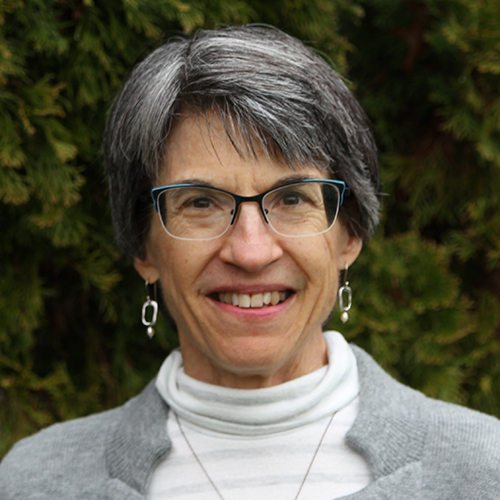
Emily Ralph Servant

Emily Ralph Servant is a Leadership Minister for Mosaic Mennonite Conference. Emily has served in pastoral roles at Swamp and Indonesian Light congregations and graduated from Eastern Mennonite Seminary.
Filed Under: Articles, Blog Tagged With: Emily Ralph Servant

Differences That Unify, Not Divide

December 7, 2023 by Cindy Angela

by Mary Nitzsche

When I was in the ordination process, I was serving as a Leadership Minister for Ohio Conference of Mennonite Church USA. Since I was not pastoring a congregation, the pastors I accompanied were asked to evaluate my readiness for ordination. One pastor, whom I will call Sam, struggled with whether he could support my ordination given his theological interpretation of scripture. Sam took this matter so seriously that he re-read the scriptures about the role of women in leadership, discussed his perspective with trusted colleagues, and prayed about this decision. In his prayerful discernment, he came to his prior conclusion that women should not be ordained.  

Sam communicated his position in a lengthy written document sent certified mail to me and multiple conference leaders. The letter ended with his conviction that he would not stand in the way of the conference decision. There were no threats to leave the conference or denomination if there was support for my ordination. There were no threats he would no longer accept my leadership role in accompanying him in ministry.

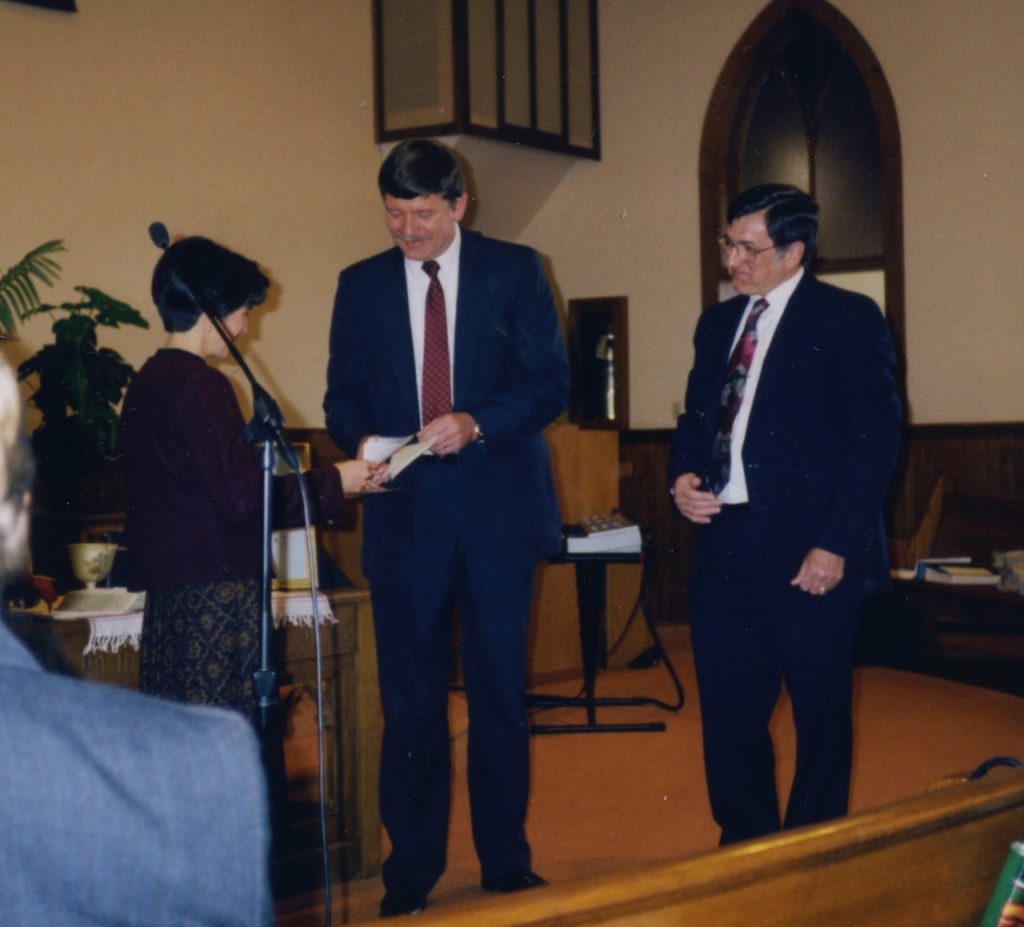
Mary Nitzsche (left) was ordained as Regional Pastor of Ohio Conference at Oak Grove Mennonite Church in Smithville, OH on November 16, 1997. Photo provided by Mary Nitzsche.


My ordination was supported by the other pastors, conference leadership, and the Ministerial Committee of Ohio Conference and Central District Conference. With his congregational responsibilities, Sam was not able to attend my ordination on November 16, 1997, 26 years ago. 

Because I was unsure of how my ordination would impact our relationship, it took six months after my ordination to have the courage to call Sam. I asked if I could visit his congregation and get to know them. The first thing out of Sam’s mouth was, “Would you be willing to preach?”  

I was shocked and I hesitated to respond. How could he invite me to preach in his congregation while not endorsing the ordination of women, I wondered. Without needing to understand his reasoning, I accepted the invitation with humility and tears of joy. I had experienced God’s grace like never before.  

From this gracious brother, I learned the importance and priority of relationship over belief. I learned the importance of prayerful discernment on matters of belief with an openness to new interpretations. I learned that two people can take scripture seriously, study it carefully, follow Jesus faithfully, and interpret the same scripture differently. I learned that when there is disagreement, there can be mutual respect rather than judgment, and a willingness to remain in fellowship rather than separate. While I understand there are times when separation may be best for a relationship or faith community, I do not believe this should be the norm.  

Before his impending death on the cross, Jesus’ prayed three times for his current and future disciples, “that they will all be one–as you are in me, Father, and I am in you. And may they be in us so that the world will believe you sent me. As you, Father, are in me and I am in you, may they also be in us, so that the world may believe that you have sent me.” (John 17:21 NLT). Jesus’ disciples had different personalities and different understandings of Jesus and his mission, and as such, the oneness to which Jesus was calling them did not mean sameness. 

Jesus’ invitation was to remain in relationship even when perspectives are different. In a polarized world in Jesus’ time and now, oneness is a sign of faithfully following the teaching and practices of Jesus. I learned this 26 years ago from my gracious brother in Christ, and I hope my life has demonstrated Jesus’ prayer over these many years of ministry.  


Mary Nitzsche

Mary Nitzsche is a Leadership Minister for Mosaic Conference. She and her husband, Wayne, are Midwest natives. They have two adult daughters, Alison and Megan, son-in-laws, Michael and David, and two grandchildren.

Filed Under: Articles, Blog, Blog Tagged With: Mary Nitzsche

As a Leader, I’m Tempted

November 30, 2023 by Cindy Angela

by Hendy Matahelemual

A church asked me to preach as part of a series on the prophets. The week I was scheduled, the prophet was Jesus. When I prayed about what to say, I felt the Holy Spirit wanted me to talk about how to lead like Jesus. I was taken aback. “No, not leadership,” I thought. 

Leadership is one of the most challenging topics for me to preach about. Perhaps this is because I struggle with self-confidence. Most of the time I don’t feel like a good leader. 

Henry Nouwen’s book In the Name of Jesus: Reflections on Christian Leadership, gave me encouragement. Nouwen writes that a leader is tempted to be relevant, spectacular, and powerful. In my leadership roles, I’m tempted to try to be everything to everyone. Especially in an immigrant community, the pastor’s role is not limited to preaching and leading Bible study. We are expected to be so much more: handyman, driver, interpreter, legal counsel, realtor, and 24/7 emergency and information hotline. The community might have unrealistic expectations. If we are not careful, burnout and depression are around the corner. 

When Jesus was tempted in the desert, the devil tried to get him to use his power for the wrong reasons. I think the devil uses the same tricks on leaders today. I have fallen into the “relevance” trap because I want to be recognized as a pastor who helps people. There’s an urge inside of me to be useful for my congregation, conference, and community. 

There is nothing wrong with helping meet people’s needs. But the motive must be genuine love, not a desire to impress others or fill a void in one’s own life. Meeting the world’s needs might solve an immediate problem but not an eternal one. Maybe you fixed someone’s furniture or helped resolve an asylum case. These good deeds don’t meet the deepest human need: God’s love. 

“God’s love can be manifested through personal connections,” Nouwen writes. “We live in a culture where everything is measured by results, achievements, and numbers, but there’s less emphasis on relationships and connections. As leaders, we need to be irrelevant to this culture by being vulnerable as individuals who also need love from God and care from the community.” 

The next temptation is to be spectacular. In Indonesia, I worked as a pastor at a megachurch. We had an average attendance of more than 2,000 people and about 40 staff. Every year, we baptized around 100 people. 

When I moved to the US, everything changed. I pastor a small congregation. At one point, we had fewer than ten people in our Sunday service. I had to work two or even three jobs to support my ministry. In the first three years, we baptized three people. My wife and I felt like failures. Friends back home asked why we were wasting our time and energy. They said we should return to Indonesia. 

We are glad we stayed. I learned a lot leading a small congregation. The congregation sees me as I am. I cannot hide behind the pulpit on a big stage, out of reach. Others see my vulnerability and our lives become intertwined. My congregation sees our struggles in marriage, parenting, and making ends meet. At first, this seemed like frailty. But we grew to understand it as a blessing. Others love us as we are. 

Nouwen says a leader needs the people as much as they need the leader. I’m trying to grow as a leader while being led by others, and to lead like Jesus by not giving in to temptation to be relevant, spectacular, or powerful.   

A version of this article originally appeared in Anabaptist World and is reprinted with permission.


Hendy Matahelemual

Hendy Matahelemual is the Associate Minister for Community Engagement for Mosaic Conference. Hendy Matahelemual was born and grew up in the city of Bandung, Indonesia. Hendy lives in Philadelphia with his wife Marina and their three boys, Judah, Levi and Asher.

Filed Under: Articles, Blog, Blog Tagged With: Hendy Matahelemual

From Artificial Harmony to Just Diversity 

November 2, 2023 by Conference Office

By: Stephen Kriss

This summer our Mosaic Board, along with some staff and committees, participated in training with Carlos Romero (long-time former Executive Director of Mennonite Education Agency) on the Intercultural Development Inventory (IDI). The IDI is an internationally recognized tool used to gauge individual and group intercultural levels. The gauge ranges from denial and minimization to acceptance and adaptation. It provides vocabulary and a framework for sometimes difficult conversations around intercultural transformation.  

As a core priority and reality of Mosaic, we continue to discern and discover what it means to be intercultural. We aim to stay rooted in the Biblical narrative of the Spirit’s work, evident in the Gospels and the early life of the church.  

In our training, Romero pointed out that Mosaic has spent a lot of time talking about what we have in common. We have yet to find ways to discover, unveil, and name our differences. This is part of the intercultural journey. 

Romero acknowledged that we are a community that officially formed in 2020 and is still developing a sense of shared identity. We have only met fully in-person with our delegates once. We are still learning what it means to include communities from Vermont to California and Florida with our Pennsylvania roots.  

Photo by Nataliya Vaitkevich

In her book, The Space Between Us, Betty Pries highlights Patrick Lencioni’s metaphor of “artificial harmony.” In this reality, differences remain under the surface and undiscussed. There are multiple reasons this happens. 

In Mennonite and Protestant church settings, I believe we hold “artificial harmony” not because we fear conflict as much as we fear the outcome of conflict, which has often meant that we split and sever relationships. If we had healthy models of how to acknowledge, embrace, and work through differences together, we might not be so conflict-averse. 

When we don’t regularly work through conflict, the outcomes are often separation, leaving the room, scapegoating, and demonization. In our context of cultural polarization, we walk away from each other rather than give the Spirit time and space to work. 

Our Pathways strategic planning process has uncovered that we need to spend time cultivating the practice of talking about our differences and navigating conflict without allowing only the loudest voices to be heard while others withdraw to avoid conflict.  

If we knew that our commitments to each other would keep us together even in disagreement, we would be better able to manage conflicts and interpersonal storminess. This will require both strategic and Spirit work, utilizing our hearts, heads, and guts.  

In contrast to artificial harmony, Safwat Marzouk, in his book Intercultural Church, calls for “just diversity.” We are not always aware of the ways the early church struggled and worked at this … from Jesus’ boundary-breaking, to the martyrdom of Stephen (who was named to a role to address an issue of equity based on his qualifications and ethnic identity), to the struggles of keeping kosher, the roles of women, the realities of slavery, and the ethnic divisions of Jews and Gentiles … it was constant negotiation as the Good News crossed boundaries into new communities. 

Conversation about our cultural, theological, ethnic, language, political, and personal differences will be part of seeking “just diversity” within Mosaic. This is God’s work with us, strategic and holy, hopeful and hard.


Stephen Kriss

Stephen Kriss is the Executive Minister of Mosaic Conference.

Filed Under: Articles, Blog Tagged With: Stephen Kriss

Pruning, Planting, and Harvesting as Metaphors on Rural Church Life

October 26, 2023 by Conference Office

By Jeff Wright

People often ask me what Mosaic Conference is like. How can a rural/suburban cluster of churches in southeast Pennsylvania provide anything meaningful to churches in Florida, New Jersey, Vermont, and California? What holds us together in a season of disintegration and polarization? 

Though I have spent nearly four decades living in southern California, with its morning rush hour and beloved freeways, I have found my time in rural-suburban southeastern Pennsylvania to provide new ways of responding to these questions. Three rural metaphors help me to understand and appreciate the work of Mosaic Conference. 

Photo by Jeffrey Clayton on Unsplash
Photo by Felix Mittermeier

First, we aren’t afraid to prune that which isn’t fruitful. For years, Mosaic has been laboring to become more formational (centered in Christ), intercultural (united by Christ), and missional (inviting others to Christ). These are our priorities. Nothing else is as important. Pruning and transplanting create healthier and stronger crops.

Second, we aren’t afraid to plant new crops. I had no idea before coming to Pennsylvania that there is a difference between sweet corn and seed corn. Apparently, some land is suited for one and some land for the other. The hard work is finding out what your soil supports best. In Mosaic Conference, we are planting a variety of churches and Conference-Related Ministries (CRMs). Rather than conforming to a unified set of behaviors, our churches and CRMs are committed to common values–centered in Christ, united by Christ, and inviting others to Christ. For our churches and CRMs to grow these values, we need to be pioneers and try new things. And, very likely, to fail sometimes. 

Pruning and planting are risky businesses. We fear we may whack away too much. We worry that planting something new may be an inadequate return on our investment, which leads to a third metaphor. 

We harvest not based on hard work but on abundant prayer. We can plant the best seed, in the straightest rows, using topflight equipment and state of the art fertilizer, but unless it rains abundantly, mixed with warm sunshine, there won’t be much harvest. Prayer is our rain and sun. When we pray, our work is multiplied and our pruning and planting turn into an abundant harvest.  

Doing church is a risky business. Staying focused on who God is calling us to be, and pruning away what is not part of that call takes courage. Planting new ways of staying centered in Christ, united by Christ, and inviting others to Christ is risky. Committing the harvest to God’s care through a life of prayer is risky.  

  • What do you think Mosaic congregations and CRMs need to prune to be more focused on who God wants us to be? 
  • What new seeds does God want Mosaic congregations and CRMs to plant in our rural and small towns, in our cities, and across the globe? 
  • What kind of harvest are you praying for? 

Mosaic Conference, as a historically rural people with a growing urban influx and increasingly global reach, is a risky business of pruning, planting, and harvesting. 


Jeff Wright

Jeff Wright is a Mosaic Conference Leadership Minister who comes alongside churches in urban California and rural Pennsylvania. He serves as intentional Interim Pastor at Blooming Glen (PA). Jeff and Debbie miss the beach, freeway traffic, and taco trucks. They love Wawa coffee, road trips, and small-town diners. A loyal fan of the Los Angeles Dodgers, Jeff is already anticipating March 20, 2024, opening day for the Dodgers.

Filed Under: Articles, Blog Tagged With: Jeff Wright

Creating a Fruitful Ministry at Every Stage of Life 

October 12, 2023 by Conference Office

We have the capacity to enhance our passion in Christian ministry, in our lives, and in our families each day. When I think about how to do this, I think back to my mother. 

Though my mother’s life was short (she died before she was 50), she made a big impact on her family and in the community.  She had six children; I am the third in order of birth. We were a big family and my paternal grandmother lived with us.  

My mother started a clothing store of the best brands of that time. The store grew rapidly, and so did her work and responsibility with the family. She really liked what she did–it showed in her face, in the way she dressed, and in her energy. Surely at the end of the day she was very tired, but we didn’t notice it. I think she was physically tired, but not mentally.  

I admire her as someone who planned well. She would think ahead about the next day and always make birthdays, Christmas, and New Years special occasions. I remember my mother, too, in our church services. My mother is an example of how to appreciate each God-given day and how life, family, and Christian ministry can be joyful.   

The psychologist Rafael Santandreu writes in his book, The Glasses of Happiness, “The first rule to make life very interesting is to set a high goal that excites us. A good life is to strive, to go to bed tired every night, but having enjoyed the day.” I agree with Santandreu, and I feel this way too about ministry and service to the church.  

Studies show that Monday is the most depressing day for pastors. “More and more leaders are experiencing burnout, even those who enjoy regular sabbaticals and vacation periods. Their exhaustion has become more severe, and the discouragement and tiredness reach ‘to the bone,'” according to “The Pastors Aren’t All Right: 38% Consider Leaving Ministry,” in Christianity Today, from November 16, 2021 (online).    

This causes me to ask: How do we find a solution to this depressed state of pastors on Monday and other days of the week? 

The same Christianity Today article reflects on how the many challenges faced by pastors forces “pastors to find their identity in Christ and not in the perfection of their ministry.” 

Photo by Mohamed hamdi

Pastor Nic Burleson “had to face his own fears related to lack of growth, and he had to remind himself that God’s call in Matthew 25:21 is centered on faithfulness, not success.” These struggles are causing some pastors to lean into their relationship with Jesus and discover new resilience. This too can be part of the fruitfulness and happiness that we create in our ministries. 

His master replied, “Well done, good and faithful servant! You have been faithful with a few things; I will put you in charge of many things. Come and share your master’s happiness!” (Matthew 25:21, NIV). 


Filed Under: Articles, Blog, Mosaic News En Español Tagged With: Marco Guete

Dear God … It’s me, Marta 

October 5, 2023 by Conference Office

Photo by Andrea Piacquadio & Photo by Ben Vaughn on Unsplash

Dear God, 

It’s me, Marta. 

I am still glowing inside from my visit to Garden Chapel yesterday. The two-hour drive on a Sunday morning was long enough to quiet my mind and open space for your presence, your peace, and your Spirit to settle in and take hold.   

Upon arriving I found the two pastors, Tim and Hector, already hard at work, setting up systems for two services, one in English and one in Spanish (or Spanglish), in-person and on Zoom, one upstairs and one downstairs in their newly renovated building, divinely provided through a community ministry connection. These pastors have full-time time jobs and a deep passion for Christ, ministry, the Word of God, and their diverse community. Oh, the stories they tell, Lord, of how You are working and moving.   

After the service, one of the sisters invited me and the two pastor’s wives for a coffee at a local Colombian bakery. What a wonderful gift to sit and fellowship with my sisters, covering topics from the Conference to our ministry work and our families. I am still glowing, Lord, from spending time with You and Your people. 

But it’s not just at Garden Chapel but at Spring Mount, Plains, Nations Worship Center, Peña de Horeb, Mennonite Bible Fellowship, Circle of Hope, Evangelica Menonita de Oracion y Adoracion, and all the other churches I am invited to visit. 

“For there is one body and one Spirit, just as you have been called to one glorious hope for the future. There is one Lord, one faith, one baptism, one God and Father of all, who is over all, in all, and living through all” (Ephesians 4:4-6, NLT).  

Thank You, Lord.   

Love, Marta 


Dear Mosaic Conference, 

It’s me, Marta.   

During the Pathways Forward focus groups, I heard a phrase multiple times: “I love the diversity of Mosaic but…” The “BUT” threw me off. “But” is used to introduce a phrase contrasting what has already been mentioned. It invalidates everything said before. It does not allow for both things to exist at the same time. 

If we use the word “AND,” we can make both statements true: “I love the diversity of Mosaic AND…” 

We need the AND to answer in unity. We need the AND for our commitment “to making our churches places of radical hospitality, inviting and engaging all people regardless of race, ethnicity, age, gender, lifestyle, or socioeconomic status. God desires to bring transformation to all people; therefore, we will welcome all people and call all people to repentance and holy living” (Grace and Truth, Church Together Statement). 

We need the AND to “be intentional about identifying those on the margins of our churches and society and provide resources for the work of mutual transformation according to the good news of Jesus Christ” (Going to the Margins, Church Together Statement). 

The diverse congregations of Mosaic Conference already minister in the margins.  There are no BUTS about it. Let us be attentive to sticking points and replace them with, “We love the diversity of the body of Christ in Mosaic, AND we will worship the Lord and serve the Lord in unity.” 

“True worship of God transcends time, culture, language, and nation,” says Nelson Kraybill in his book, Apocalypse and Allegiance. Kraybill says that when we worship God, we join a vast multitude of saints from all peoples and all eras of history. When we “see ourselves as part of this multitude, it makes us less likely to idolize our countries. We are less likely to let issues and perspectives of our own generation eclipse the shared wisdom of saints through the ages.”  

Love, Marta 

Filed Under: Articles, Blog Tagged With: Marta Castillo

The Faith of a Tonsil 

September 21, 2023 by Conference Office

I had just sent out the invitations for my Remission party – to celebrate that after two years, I had finally achieved remission from leukemia, when I got the call. They noticed a small area of concern in my tonsil on a recent scan. “It is probably nothing,” but I should get another scan. A day later, my doctor called me and said they found a tumor in my tonsil. My surgery was in 13 days.  

Things happened quickly. Mostly, I was grateful. Let’s get this tumor out. Yet I also had to plan for an unexpected two weeks off from work and more. For two years I had gone through multiple treatments and chemo. It had been long and tiring. I was ready to return to my old self. If the tumor was malignant, this would be the first of two surgeries, plus possible radiation. My head was swirling.  

I moved toward the surgery, checking things off my lists, preparing for recovery, and praying. Praying that this would be benign. I was surrounded by an army of prayer warriors too. Yet, I still found myself struggling to sleep at night. I googled “tonsil cancer.” I worried. I was scared and depressed, no matter how much I prayed or others prayed for me.  

One morning I awoke, feeling like I had received a message from God: “All will be well.” The assurance I felt did not ensure a benign biopsy or an easy road ahead, but that “all will be well,” regardless. This reminder of God’s presence carried me for the next few days. 

My surgery went well. Now to wait for the biopsy results, which would take about a week. Recovery from such surgery is awful. I was barely able to swallow, even my own saliva, and I lost ten pounds in the first week. The silver lining about having such intense pain is that it kept my mind off the biopsy results. A week passed and no results. My pain was still bad, but slightly improving, so I found myself thinking more about the biopsy. The hypothetical scenarios would play out, often in the middle of the night, as I waited. God’s assurance a week before seemed distant. 

In the hospital, just a few minutes before surgery, Sue is ready for her tonsil and tumor to be removed.

Photo by: Michael Howes

Last week, I met with my doctor. He told me that the primary biopsy results were in, but that it would be another two weeks until I received the final, full report. The initial biopsy report showed no signs of malignancy. Benign. He was quite confident that the final report would be the same.  

I felt lighter, relieved, renewed.   

I’m still waiting for those final biopsy results … probably for another week. But now the waiting doesn’t seem so difficult. I have trust in the doctor and his belief, for which I am grateful.  

However, it makes me pause. I still don’t know what the final biopsy result will be. Yet, the doctor’s confidence has allowed me to release my fear of the unknown. Why was I not able to release that fear to God as I prayed? Shouldn’t I be able to release it, trusting God that all will be well, regardless of the final biopsy? I confess I wasn’t. But with the doctor I was.  

I don’t want to beat myself up for my lack of faith. It’s common. But it has made me think about prayer and faith, especially during medical challenges. What are we praying for? If we pray in faith, why do we still worry? Why can’t I trust God’s word in the same way that I trust the doctor’s word? 

Lord, I believe. Help my unbelief.  

Filed Under: Articles, Blog Tagged With: Sue Conrad Howes

  • « Go to Previous Page
  • Go to page 1
  • Go to page 2
  • Go to page 3
  • Go to page 4
  • Go to page 5
  • Go to page 6
  • Interim pages omitted …
  • Go to page 17
  • Go to Next Page »

Primary Sidebar

  • Home
  • About Us
    • Our History
    • Vision & Mission
    • Staff
    • Boards and Committees
    • Church & Ministry Directory
    • Mennonite Links
  • Media
    • Articles
    • Newsletters
    • Video
    • Audio
    • Bulletin Announcements
  • Resources
    • Conference Documents
    • Missional
    • Intercultural
    • Formational
    • Stewardship
    • Church Safety
    • Leaders’ Resources
    • Request a Speaker
    • Pastoral Openings
    • Job Openings
  • Give
  • Events
    • Delegate Assembly
    • Youth Event
    • Conference Calendar
  • Mosaic Institute
  • Vibrant Mosaic
  • Contact Us

Footer

  • Home
  • Contact Us
  • Delegate Assembly
  • Vision & Mission
  • Our History
  • Formational
  • Intercultural
  • Missional
  • Mosaic Institute
  • Give
  • Stewardship
  • Church Safety
  • Leaders’ Resources
  • Articles
  • Bulletin Announcements

Copyright © 2026 Mosaic Mennonite Conference | Privacy Policy | Terms of Use
Aligned with