• Skip to main content
  • Skip to primary sidebar
  • Skip to footer

Mosaic MennonitesMosaic Mennonites

Missional - Intercultural - Formational

  • Home
  • About Us
    • Our History
    • Vision & Mission
    • Staff
    • Boards and Committees
    • Church & Ministry Directory
    • Mennonite Links
  • Media
    • Articles
    • Newsletters
    • Video
    • Audio
    • Bulletin Announcements
  • Resources
    • Conference Documents
    • Missional
    • Intercultural
    • Formational
    • Stewardship
    • Church Safety
    • Leaders’ Resources
    • Request a Speaker
    • Pastoral Openings
    • Job Openings
  • Give
  • Events
    • Delegate Assembly
    • Youth Event
    • Conference Calendar
  • Mosaic Institute
  • Vibrant Mosaic
  • Contact Us
  • English
  • Việt Nam (Vietnamese)
  • Español (Spanish)
  • Indonesia (Indonesian)

Conference News

MC USA Executive Board rejects Mosaic proposal

May 15, 2025 by Cindy Angela

by Paul Shrag, Anabaptist World

Originally published on May 13, 2025, in Anabaptist World, and reprinted with permission.    

A Mosaic Mennonite Conference proposal to redefine its relationship to the denomination won’t work, the Mennonite Church USA Executive Board decided May 8. 

Mosaic, one of MC USA’s largest conferences, had proposed to become a program entity — an organization that provides services to meet churchwide goals. 

But the Executive Board, meeting concurrently with the Constituency Leaders Council in Wichita, Kan., passed a motion saying the idea “is not viable within our structure.” 

A Pennsylvania-based conference that has expanded nationwide, Mosaic is evaluating its affiliation — seeking a partnership with MC USA rather than membership — and may decide the relationship’s future in November. 

The Executive Board proposed a mediated conversation with the Mosaic board to seek “reconciliation for broken relationships.” 
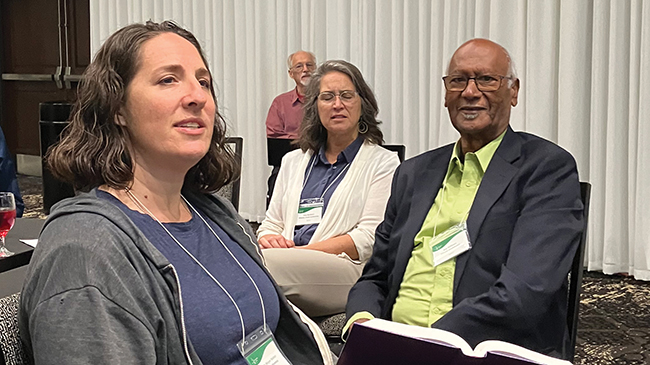
Mosaic moderators Angela Moyer Walter (left) and Roy Williams (right) at the CLC meeting. Photo by Paul Schrag/AW.

Mosaic moderator Angela Moyer Walter and executive minister Stephen Kriss said the Mosaic board would consider the request. 

Moyer Walter said Mosaic leaders didn’t have other partnership ideas to propose. 

Explaining the Executive Board’s action to the CLC, MC USA moderator Jon Carlson cited “the strangeness of the relationship” that would result from redefining Mosaic as something other than an area conference. 

“We recognize the complexity of a body that continues to act in many ways as an area conference but is not treated as an area conference within our system,” he said. 

He noted that MC USA’s two current program entities — Everence, a financial organization, and Mennonite Health Services Association — do not have member congregations. 

Mosaic has about 7,500 members in 60 congregations. Based in Lansdale, Pa., it was formed in 2019, uniting Franconia and Eastern District conferences. 

During a May 9 joint session of the Executive Board and the CLC — an advisory group of conference and constituency group leaders — Moyer Walter said it was “sad and painful” to hear the Executive Board’s decision. 

“We were hopeful of trying something new that would work for both MC USA and Mosaic, as the status quo was not healthy for us to remain a member conference,” she said. 

“Our churches are doing creative things. . . . It is hard as a conference leader when the things our congregations are bringing to us aren’t always prioritized at the MC USA level. . .  

“We welcome continued conversations. . . . Even when our structures don’t hold, we still care deeply about the church. We are still the same people in ministry. We still want to partner in ways that feel healthy and mutual together.” 

Mosaic is in its third year of discernment about affiliation. Last November, delegates voted to “establish a robust partnership” with MC USA without defining how this would differ from the current relationship. They directed a team to bring proposals for bylaw changes to their 2025 assembly Nov. 1. 

After last year’s assembly, two Mosaic congregations that wanted to disaffiliate from MC USA withdrew from the conference: Vincent in Spring City, Pa., and Salem in Quakertown, Pa. 

After Moyer Walter and Carlson addressed the joint session, Heidi Regier Kreider, conference minister of Western District Conference, said she hoped Mosaic would stay with MC USA and added that some Western District congregations “feel affinity” with Mosaic congregations. 

“We find Mosaic’s presence in MC USA strengthens all of us,” she said. “There is theological diversity, and that does not prevent us from working together.” 

Also at the meeting, the Executive Board recommended resolutions and bylaw changes to delegates at the MC USA biennial convention July 8-12 in Greensboro, N.C. 

One would reaffirm and update a “Churchwide Statement on Immigration” first approved in 2003 and reaffirmed in 2014. 

Lorraine Stutzman Amstutz, denominational minister for peace and justice, said the resolution would add new resources and action steps at a time of fear for immigrant communities. 

“This is a critical time for us to acknowledge policies that are impacting our immigrant and asylum-seeking communities and strengthen our commitment to action on behalf of those who are threatened and feeling fearful for their lives here,” she said. 

A second resolution proposes to require all conferences and congregations to use the same set of abuse response and prevention policies for pastors and ministerial leaders. Current policies are voluntary, leading to inconsistent application. 

“Consistency across the system will lead to safer congregations for minors and vulnerable adults,” according to the resolution’s introduction. 

The board and CLC members acknowledged that some might be wary of a mandate from the denominational board. 

Chris Nord, moderator of Pacific Northwest Mennonite Conference, said: “Mennonites are suspicious of top-down polity, so I think it’s important to show how this proposal actually, even though it does impose a denominational [mandate], is to remediate against power hoarding and abuse of power.” 

A new Prevention and Accountability Resource will replace the current Ministerial Sexual Misconduct and Policy and Procedure Document and be available to all, regardless of whether delegates decide to require all to use it. 

Proposed bylaw changes include revisions related to the integration of Mennonite Education Agency into the Executive Board’s operations — a structural change the Executive Board and MEA board have already approved. MEA has seen its governance role over higher-education institutions greatly diminish over the past 20 years. By Aug. 1, MEA will cease to exist, and its functions will be moved into the work of denominational staff. 

Another proposed bylaw change would give the Executive Board the ability to recommend the removal of an agency’s executive director. The agency’s board would still have the final say. 


Paul Shrag

Paul Schrag is editor of Anabaptist World. He lives in Newton, Kan., attends First Mennonite Church of Newton and is married to Wendy. They have two adult daughters, Abby Koch and Becca Schrag. He was on the staff of Mennonite World Review for 32 years, serving as editor since 1996.
Filed Under: Articles Tagged With: anabaptist world, CLC Meeting, Conference News, MC USA, Mennonite Church USA, Paul Shrag

Dr. Joseph Manickam to Support Mosaic Conference in Partnership Development

April 3, 2025 by Cindy Angela

Dr. Joseph Manickam, Executive Director of Arelti, has begun a six-month contract (February-August 2025) to support Mosaic Mennonite Conference with partnership development. 

In early February, Manickam accompanied a delegation to visit Conference-Related Ministry Peace Proclamation Ministries International in India. He has been asked to also meet with other global and U.S. community-center based Conference-Related Ministries. He will also support the Mosaic Conference Board in conversations about partnership with other Mennonite organizations, as well as provide accompaniment to Mosaic Executive Ministers and priority team leaders. 

“We are asking Dr. Manickam to help us continue to deepen intercultural awareness and think about partnerships in ways that aren’t colonial or paternalistic,” shared Executive Conference Minister Stephen Kriss. 

“His experience as the son of mission workers from India to Thailand; with Pacific Southwest Conference in California; and in leading Mennonite organizations are all valuable as the Conference tries to understand the possibilities that exist in partnerships outside the U.S. in ways that are healthy, mutual, and strengths-based.” 

Kriss continued, “Joe’s work with Mosaic Conference comes at a critical time as we discern and navigate our relationship with Mennonite Church USA and work to define what a robust partnership could look like.” 

Mosaic Mennonite Conference occasionally works with outside consultants to navigate critical issues and changing contexts, as it did with Grovider to develop the current strategic plan. 

When asked why Dr. Manickam agreed to this work, he responded, “I continue to believe in the church’s ability, as broken as it may be, to transform our communities toward a greater alignment with God’s Reign on this earth.”  

“I look forward to networking and connecting with Mosaic’s missional energy. Mosaic is in a space of missional curiosity right now, and I sense this curiosity is aligned with the movement of the Holy Spirit around the world,” he continued.  

Manickam will also serve as the keynote speaker at the upcoming Oasis gathering for Mosaic Pastors of Color in May, on the topic “Living as Diaspora People.” 
 
Dr. Joseph A. Manickam was born in Chiang Mai, Thailand to Paul and Mano Manickam, missionaries sent by the Church of South India to Thailand in 1958. The youngest of six children, Joseph grew up in a family deeply committed to seeing God’s Love translated into the local context crossing social barriers of many forms as he and his family continually swung between a South Indian home, a western school system, and living among the Thai people. Joseph married Wanda Wyse in 1994 in Yoder, Kansas and they have two children. Manickam is the founder and Chief Executive Officer of Arelti, a nonprofit organization focused on walking with the oppressed to foster hope through the transformation of communities on the margins. 

He served as the ninth president of Hesston College in Hesston, Kansas, and as Director of the Institute of Religion, Culture, and Peace and faculty member for Peace Studies at Payap University in Chiang Mai, Thailand. Previously he served in Thailand for three years with Mennonite Central Committee (MCC) Canada as Director of the Central-Southern and Northeast Asia Program, and earlier in his career, he was Director of the MCC Asia Program and Associate Director of the Center for Anabaptist Leadership in California. 

Dr. Manickam earned a B.A. in Communications from Goshen College (Goshen, Ind.) and an M.A. and Ph.D. in Intercultural Studies from Fuller Theological Seminary (Pasadena, Calif.). He has also previously served on the boards of The Mennonite and Anabaptist Mennonite Biblical Seminary (Elkhart, Ind.), and his academic interests include Race/Ethnic Studies and Interreligious Engagement. Manickam’s relational abilities and his strong intercultural competency have been common threads in his work. His doctoral dissertation at Fuller focused on “A Study of Race, Culture and Ethnicity in Mennonite Church USA.”


Mosaic values two-way communication and encourages our constituents to respond with feedback, questions, or encouragement. To interact with this article, please email communication@mosaicmennonites.org.

Filed Under: Articles Tagged With: Conference News

March 2025 Mosaic Conference Board Report

April 3, 2025 by Cindy Angela

Mosaic Conference Moderator Angela Moyer Walter and Assistant Moderator Roy Williams report on the March 26, 2025 board meeting, including updates on the strategic plan, Spring Assembly gatherings throughout April, continued conversation with MC USA on ministry partnership, the dates for the Fall Assembly, and announcing the next Conference Assistant Moderator.

Mosaic values two-way communication and encourages our constituents to respond with feedback, questions, or encouragement. To interact with this article, please email communication@mosaicmennonites.org.

Filed Under: Articles Tagged With: Board Updates, Conference News

Mosaic Conference explores ministry partnership as Program Entity of MC USA

February 20, 2025 by Cindy Angela

At its January 2025 meeting, Mosaic Conference’s Board decided to explore becoming a Program Entity with Mennonite Church USA (MC USA). “Program Entity” status is designated by the MC USA bylaws to “arrange for the delivery of programs and services that carry out specific churchwide goals. [Program Entities] cooperate and network with other parts of the church around common goals.” 

Mosaic would be the first MC USA conference to shift to a ministry partnership via a Program Entity status. Everence and Mennonite Health Services are both currently named as program entities and listed as ministry partners on the Mennonite Church USA website.   

During November 2024’s annual Assembly, Mosaic’s delegates empowered the Board to work with MC USA in developing a plan that would allow Mosaic Conference to establish a “robust partnership” with MC USA. The approved action called on the Board to bring recommended bylaw amendments to the 2025 delegate assembly. 

Since the delegate action in November, Mosaic’s leadership has been gathering information and having conversations with MC USA leaders to explore the option of developing a ministry partnership as a Program Entity. Mosaic Conference moderator Angela Moyer Walter and assistant moderator Roy Williams met with MC USA moderator Jon Carlson and moderator-elect Marty Lehman leading up to MC USA’s Executive Board (EB) meeting on February 8 and have communicated with Carlson by email since the meeting. 

Lehman and Moyer Walter have since met to begin drafting a set of shared agreements integrating feedback from MC USA’s Executive Board, Mosaic staff and Board, and sibling MC USA conferences. Mosaic desires to collaborate with MC USA around core priorities including youth faith formation, intercultural leadership development, and church planting accompaniment. Additionally, Mosaic’s leadership hopes to explore ways to partner through shared values and mutual relationships, rather than transactional services. MC USA and Mosaic leadership will continue to discuss the implications on how members of Mosaic will participate in the life of Mennonite Church USA as a Program Entity. 

At the request of the denomination to work alongside other MC USA conferences, Moyer Walter shared about this proposal with conference moderators in a January meeting; direct conversations with the leadership of other conferences have been ongoing. “I value the healthy dialog we are having with many of our sibling conferences,” reflects Moyer Walter. “They have encouraged us to continue the good work that God has begun in Mosaic.” 

Filed Under: Articles Tagged With: Conference Board, Conference News, Mennonite Church USA

After Assembly, Three Congregations Vote on Affiliation with Mosaic Conference  

December 19, 2024 by Cindy Angela

At the Mosaic Conference Assembly in November, the delegates were asked to vote on the following ballot: “To affirm, with gratitude, the work and recommendation of the Pathway Steering Team to establish a robust partnership with Mennonite Church USA, and to bring recommended bylaw amendments for delegate discernment at the 2025 Mosaic Conference Assembly.”  The vote passed with 71% affirmation, which means that Mosaic Conference leadership will be working toward defining a relationship of partnership with Mennonite Church USA (MC USA).   

Following Assembly, the leadership of three Mosaic Conference congregations sought to discern their own relationship with Mosaic and Mennonite Church USA. Perkiomenville (PA), Swamp (Quakertown, PA) and Vincent (Spring City, PA) all had congregation votes related to affiliation with Mosaic Conference between November 10 and December 8.  

Perkiomenville

“When Mosaic announced a two-year Pathway plan at Assembly in 2022, Perk Church agreed to wait for the results of that process,” shared Mike Spinelli, Lead Pastor of Perkiomenville. “Church leadership understood that the 2024 recommendation from the Board did not result in a clear break from MC USA and asked for another year of processing.”  

Perkiomenville’s leadership called for a congregational meeting prior to the 2024 Assembly to give delegates guidance for voting. At that meeting, a member of the congregation moved for a resolution to disaffiliate with the Mosaic Conference since the vote this year was not a clear move toward leaving MC USA.  

This resolution was voted on at Perkiomenville’s annual business meeting two weeks later. “Discussion around the resolution included voices asking that the congregation not pass it and give Mosaic Conference one more year. This resulted in a vote that fell below our 67% threshold for major church decisions,” Spinelli shared. “As such, Perk Church will be a member of Mosaic through this year and will reconsider its ties to Mosaic when the new proposal is made in 2025.” 

Swamp 

Following the 2024 Assembly, Swamp’s Assembly delegates unanimously recommended to the Church Board that Swamp would leave Mosaic Mennonite Conference and shared this with the congregation. At Swamp’s member meeting a few weeks later, the Church Board shared a proposal, which had their unanimous recommendation, to “end Swamp Mennonite Church’s affiliation with Mosaic Mennonite Conference.”   

The text of the proposal indicates Swamp’s desire not to be an independent church and recognizes that a decision about future affiliation with a different conference will take time.  

The proposal also stated that during this transition period, “the congregation and its leaders may still partner with Mosaic for the sake of holding pastoral credentials, participating in the health insurance plan, and gaining counsel from the assigned Mosaic Leadership Minister.”

The vote passed by 92 percent. Details about the timing of Swamp’s departure from Mosaic Conference are still to be determined. 

“This is an especially difficult decision. We love Mosaic,” shared Lead Pastor Nathan Good in an email to Mosaic leadership. “We have invested time, energy, and resources, especially over the last decade. We have many important relationships within Mosaic. And the reality is that we agree with the Mosaic body on most things. There were many tears at our congregational meeting and at our Board meeting [prior to the vote].” 

Vincent 

On December 8, Vincent congregation moved toward disaffiliation with Mosaic, with a vote passing by 77 percent. It was initiated after a recommendation from the congregation’s elders stating ongoing disagreements with Mosaic Mennonite Conference. The ballot suggested that bylaws would be adjusted in January and that the congregation would move toward exploring new conference affiliations in 2025. The full disaffiliation would be recognized by Mosaic after the bylaw change is affirmed. 

“We recognize that some historic Mosaic congregations feel discomfort maintaining any connection to Mennonite Church USA. There is some tension around ongoing discernment about human sexuality within our Conference as well,” commented Stephen Kriss, Executive Minister. “I appreciate that these congregations remained in relationship with Mosaic while the Pathway process moved over the last two years. We honor their decisions and discernment. And we regret the potential loss of long-time member communities.”  

Filed Under: Articles, Blog Tagged With: Conference News

Mosaic Conference Receives Grant for Thriving Congregations Program 

July 25, 2024 by Cindy Angela

Published:  July 25, 2024

LANSDALE, Pennsylvania– Mosaic Mennonite Conference has received a $1,250,000 grant from the Lilly Endowment, Inc. to provide learning communities and coaching for congregational leaders and their congregations; funding for congregational learning experiences and missional experiments; and targeted supports for Mosaic’s growing community of leaders of color. 

The project is being funded through Lilly Endowment’s Thriving Congregations Initiative. The aim of the initiative is to encourage the flourishing of congregations by helping them deepen their relationships with God, enhance their connections with each other, and contribute to the vitality of their communities and the world. 

The five-year project, titled “The Vibrant Mosaic Program,” is designed to integrate the Conference’s missional, formational, and intercultural priorities into congregational life. It seeks to build resilience among Mosaic congregations through spiritual practices, deepening relationships, common mission, and a sense of belonging. 

The Vibrant Mosaic Program includes three components:  

  • Learning communities of congregational leaders who participate in up to two years of classes and travel, along with targeted coaching as they implement what they’ve learned on a congregational level.
  • Congregational missional experiments and learning experiences funded by $5,000 microgrants and focused on each congregation’s growth edge.
  • Specialized support and gatherings for leaders of color to learn, build relationships, and cast vision. 

“We believe that vibrant, thriving Mosaic congregations are missional, intercultural, and formational, embodying the reconciling love of Jesus in our broken and beautiful world,” shares Vibrant Mosaic’s codirector, Rev. Dr. Emily Ralph Servant, Mosaic’s Leadership Minister for Strategic Priorities.  

Ministers and leaders gathered for a Mosaic Institute course in May 2023.
The Introduction to Mosaic class at Fern Rock Retreat in 2022.

“The Vibrant Mosaic Program will provide congregations and congregational leaders with opportunities to strengthen their rootedness in our tradition while also increasing their missional, intercultural, and formational capacity through education, on-site communal experiences, spiritual practices, and relationship-building.” 

Mosaic Mennonite Conference is a community of congregations and non-profit organizations that stretches from Vermont to Florida and from New Jersey to California, with global connections in Mexico, Colombia, India, and England. The conference was birthed in the early 18th century in southeastern Pennsylvania, split in the mid-19th century into two distinct conferences, and experienced a reconciliation and merger in 2019 that blossomed into Mosaic Conference the following year. Since that time, the conference has integrated several networks of congregations and experienced a wave of emerging communities from across the country, shifting the demographics of the conference, as well as creating an influx of members that do not share a common history.  

“In the midst of the disorientation that often comes with rapid growth, Mosaic Conference has been exploring how to ground our congregations in our rich theological and communal tradition while also remaining open to transformation through relationships with new brothers and sisters among us,” shares Executive Minister Rev. Dr. Stephen Kriss. “Our desire for the Vibrant Mosaic Program is to cultivate resilient congregations who, together, recognize God in our changing reality and respond with courage and creativity.” 

The implementation of the Vibrant Mosaic Program has already begun. This summer and fall, program staff are making plans for an anti-oppression training for staff and board members (scheduled for September 5-7); a summer intercultural competency training for course instructors, program staff, and interpreters/ facilitators; and the first wave of course revisions with coaching from The Kaleidoscope Institute’s founder, Eric Law.  

Beginning in January 2025, Vibrant Mosaic will launch its first cohort. Five congregations will be added each year. Congregations who are interested in participating should talk with their leadership minister.  

Vibrant Mosaic’s grant funding will support the program through June 2029, with a plan in place to integrate it into the conference operating budget so that the program is fully sustainable by 2033. 

Mosaic Mennonite Conference is one of 238 organizations that have received implementation grants through Lilly Endowment’s Thriving Congregations Initiative. Reflecting a wide variety of Christian traditions, the organizations represent mainline Protestant, evangelical, Catholic, Orthodox, peace church and Pentecostal faith communities. 

“Congregations play an essential role in deepening the faith of individuals and contributing to the vitality of communities,” said Christopher L. Coble, Lilly Endowment’s Vice President for Religion. “We hope that these programs will nurture the vibrancy and spark the creativity of congregations, helping them imagine new ways to share God’s love in their communities and across the globe.” 

About Lilly Endowment Inc. 

Lilly Endowment Inc. is a private foundation created in 1937 by J.K. Lilly, Sr., and his sons, Eli and J.K., Jr., through gifts of stock in their pharmaceutical business, Eli Lilly and Company. While those gifts remain the financial bedrock of the Endowment, it is a separate entity from the company, with a distinct governing board, staff and location. In keeping with the founders’ wishes, the Endowment supports the causes of community development, education and religion and maintains a special commitment to its hometown, Indianapolis, and home state, Indiana. A principal aim of the Endowment’s religion grantmaking is to deepen and enrich the lives of Christians in the United States, primarily by seeking out and supporting efforts that enhance the vitality of congregations and strengthen the pastoral and lay leadership of Christian communities. The Endowment also seeks to improve public understanding of diverse religious traditions by supporting fair and accurate portrayals of the role religion plays in the United States and across the globe. 

Filed Under: Articles Tagged With: Conference News

Mosaic Conference Receives $10,000 for Ambassadors Program

June 27, 2024 by Cindy Angela

Mosaic Mennonite Conference (Lansdale, PA) has received a $10,000 charitable distribution from the Schowalter Foundation to help fund the summer 2024 Ambassadors Youth Leadership Development Program.  

The Ambassadors Youth Leadership Development Program provides summer ministry experience to gifted young adults (ages 18-24) impacting their local communities. This program builds on a 20-year commitment by Mosaic (previously Franconia) Conference to develop young adult leaders through ministry experience.  

The program seeks to cultivate young adults’ commitment to Christian service and foster opportunities for Anabaptist witness and spiritual growth in their local communities and inspire young adults and develop their leadership skills. 

Danilo Sanchez, Leadership Minister for Intercultural Transformation, directs this program. Sanchez himself participated in a Franconia Conference-led summer service program as a young adult.

“These young adult Ambassadors give back to their community, work on their leadership gifts, learn more about who they are, and work closely with their pastor,” Sanchez shares. “As a young adult, I greatly benefitted from leadership opportunities with the conference which led me to become the pastor I am today.” 

For 10 weeks from June to August, the Ambassadors serve in their congregations’ Vacation Bible Schools and peace camps, at Conference-Related Ministry community centers, and more. They receive guidance from their pastor or another supervisor and mentor to discuss goals, receive support, and reflect on their experiences. The Ambassadors receive a stipend for their impactful work.  

In addition to the service opportunities, there are monthly virtual cohort gatherings for participants to build relationships, pray, and develop leadership skills. At the end of the program, there is a 2.5 day in-person retreat, designed and led by Sanchez and Hendy Matahelemual, Associate Minister for Community Engagement, which this year will take place in Tampa, Florida for the first time.

In 2024, 10 young adults are participating in the Ambassadors program, hosted by their congregation or Conference-Related Ministry. Initially, there were plans to host just six Ambassadors, but due to high levels of interest from applicants and host congregations, and the possibility of additional funding, the program was able to grow.  

“J.A. Schowalter wanted his legacy to continue on beyond his lifetime, supporting the missional work of Mennonite churches and organizations with similar faith and values,” said Schowalter Foundation President Diane Yoder. “We are pleased to support the efforts of Mosaic Mennonites through his vision and generosity.” 

The Schowalter Foundation was established in 1954 from the estate of J. A. Schowalter, a Mennonite from Newton, Kansas. The Foundation supports initiatives that follow the Mennonite convictions of service and missions, peacemaking and social concerns, and other programs and projects carried out by Mennonite Church USA and the Church of God in Christ, Mennonite, as well as Mennonite higher education institutions. To learn more about the life and legacy of J. A. Schowalter and The Schowalter Foundation’s mission and grants, visit schowalterfoundation.org. 

Filed Under: Articles Tagged With: Conference News

Conference Board Affirms Anchor Statements for the Strategic Plan  

May 23, 2024 by Cindy Angela

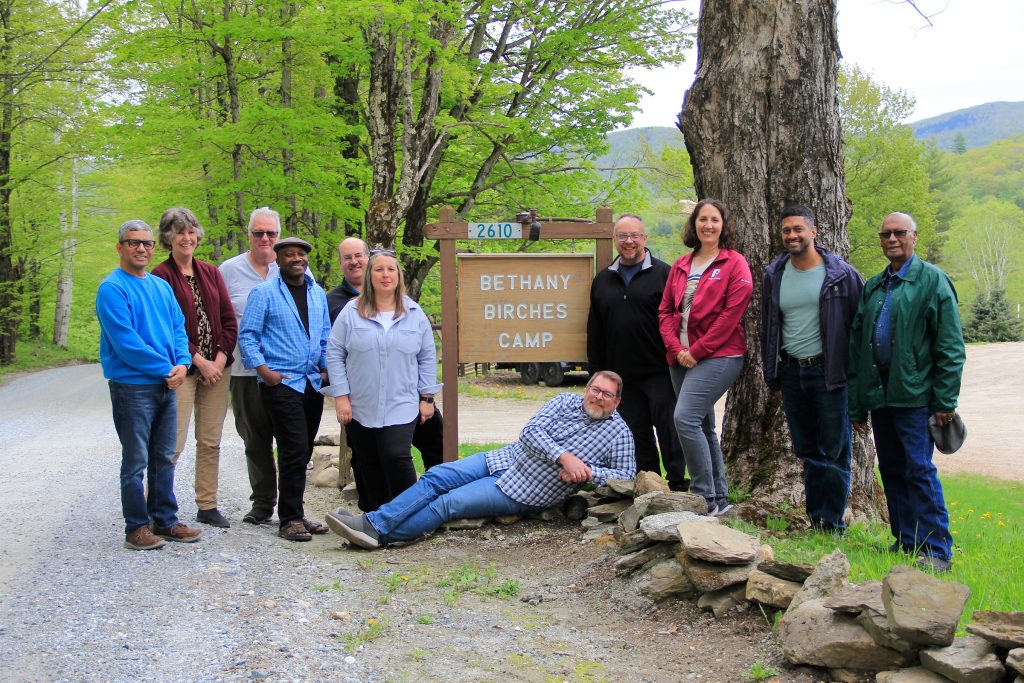
Mosaic board members gathered at Bethany Birches Camp for a retreat. 

On May 17-19 the Mosaic Conference Board met at Bethany Birches Camp (Plymouth, VT) for an offsite, in-person retreat. The Conference Board, which meets 6 times a year, supervises the business of the conference, including conference committees, and ensures that the conference is maintaining alignment with its vision and following the lead of the Spirit into areas of growth and change.  

The group gathered for worship, prayer, relationship building, and an equipping session on discernment and decision making, led by Mosaic Leadership Ministers Rose Bender Cook and Noel Santiago. The board also affirmed the Anchor Statements from the Pathway Team Strategic Plan.  

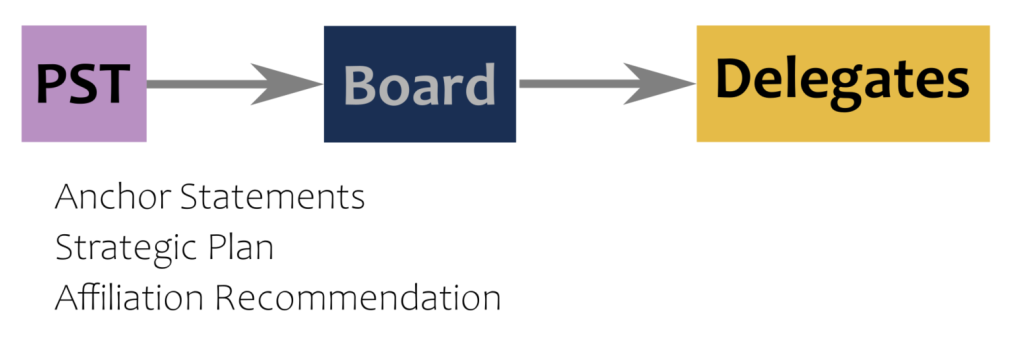
The anchor statements form the framework for the strategic plan, which is currently being developed by the Pathway Steering Team with support from the consultant organization Grovider. The anchor statements cover five areas: reconciliation, leadership development, relationship building, clarity/identity, and communication and articulates how Mosaic will work toward those five areas. Each anchor statement has corresponding objectives and activities in the strategic plan that are currently under development. (download the Anchor Statements here in English, Spanish or Bahasa Indonesia) 

“I affirm the hard work, which is not fast work, of the Pathway Steering Team to attend to all of the details of creating the strategic plan,” shares Conference Moderator Angela Moyer Walter. “They have been discerning tangible steps for us to live into our vision, to embody the reconciling love of Jesus in our broken and beautiful world.”   

During the board meeting, members of the board echoed this sense of affirmation of the frequent meeting, listening, discernment, and planning that the Pathways Steering Team has done. They affirmed the process so far and invoked God’s continued blessing on the work.   

“The Pathways team has gone through the forming, norming, and storming stages, and I think we are entering the performing stage,” reflects Kiron Mateti (Plains [Hatfield, PA]), board member and member of the Pathway Steering Team. “Getting concrete steps on paper is encouraging. All these strategic words are a little new to me, but they are just tools to communicate the concrete ways Mosaic can live out our Mission and Vision, keeping our Missional, Formational, and Intercultural Priorities in mind.”  

Mateti continued, “The session with Rose and Noel could not have come at a better time. I am quick to enter “decision-making” mode and weigh the data and steps in a logical way but entering into “discernment” is a practice and a habit. As Noel put it, ‘discernment is what God reveals and decision-making is what we do with that.’”  

The Pathway Steering Team will provide the Board with the Anchor Statements (done), strategic plan, and affiliation recommendation (in progress). Graphic by Kiron Mateti. 

The full strategic plan, and a recommendation around the question of affiliation with Mennonite Church USA, will be brought by the Pathway Steering Team to the board meeting on August 19. By the end of August, the board will set the agenda for the November Assembly.  

“Now is the time for praying for the Pathways Steering Team. These commitments are the crux of moving forward together as Mosaic, and they give me hope,” Moyer Walter reflected.  

We encourage you to reach out to your Lead Ministers, or the Pathway Team members, with your questions and feedback.   

Filed Under: Articles Tagged With: Conference News, Mosaic Board, Pathway, Pathway Steering Team

  • « Go to Previous Page
  • Go to page 1
  • Go to page 2
  • Go to page 3
  • Go to page 4
  • Go to page 5
  • Interim pages omitted …
  • Go to page 95
  • Go to Next Page »

Primary Sidebar

  • Home
  • About Us
    • Our History
    • Vision & Mission
    • Staff
    • Boards and Committees
    • Church & Ministry Directory
    • Mennonite Links
  • Media
    • Articles
    • Newsletters
    • Video
    • Audio
    • Bulletin Announcements
  • Resources
    • Conference Documents
    • Missional
    • Intercultural
    • Formational
    • Stewardship
    • Church Safety
    • Leaders’ Resources
    • Request a Speaker
    • Pastoral Openings
    • Job Openings
  • Give
  • Events
    • Delegate Assembly
    • Youth Event
    • Conference Calendar
  • Mosaic Institute
  • Vibrant Mosaic
  • Contact Us

Footer

  • Home
  • Contact Us
  • Delegate Assembly
  • Vision & Mission
  • Our History
  • Formational
  • Intercultural
  • Missional
  • Mosaic Institute
  • Give
  • Stewardship
  • Church Safety
  • Leaders’ Resources
  • Articles
  • Bulletin Announcements

Copyright © 2026 Mosaic Mennonite Conference | Privacy Policy | Terms of Use
Aligned with