• Skip to main content
  • Skip to primary sidebar
  • Skip to footer

Mosaic MennonitesMosaic Mennonites

Missional - Intercultural - Formational

  • Home
  • About Us
    • Our History
    • Vision & Mission
    • Staff
    • Boards and Committees
    • Church & Ministry Directory
    • Mennonite Links
  • Media
    • Articles
    • Newsletters
    • Video
    • Audio
    • Bulletin Announcements
  • Resources
    • Conference Documents
    • Missional
    • Intercultural
    • Formational
    • Stewardship
    • Church Safety
    • Leaders’ Resources
    • Request a Speaker
    • Pastoral Openings
    • Job Openings
  • Give
    • Leadership Development Matching Gift
  • Events
    • Pentecost
    • Delegate Assembly
    • Faith & Life
    • Youth Event
    • Women’s Gathering
    • Conference Calendar
  • Mosaic Institute
  • Vibrant Mosaic
  • Contact Us
  • 繁體中文 (Traditional Chinese)
  • English
  • Việt Nam (Vietnamese)
  • Español (Spanish)
  • Indonesia (Indonesian)
  • Kreol ayisyen (Creole)

Articles

The End of Youth Ministry? 

February 15, 2024 by Cindy Angela

by Michelle Curtis

I don’t like to read books alone. So when Brooke Martin, Pastor of Youth & Community Formation for Mosaic Conference, invited me to join a book study group for The End of Youth Ministry? by Andrew Root, I jumped at the chance.  

The book study group, comprised of youth Pastors and leaders, gathered around back porches and youth rooms to discuss a few chapters every other week. We lamented the difficulties of leading youth ministries in 2023. We shared how much we love our youth and how much we want them to know Jesus’ love. We waded through the philosophical parts of the book, trying to make sense of how they apply to middle schoolers.  

Some of the biggest takeaways felt like both “aha!” moments and also a reminder that youth ministry should not be different than any other ministry in pointing people to the core of our faith. We, with Paul, proclaim Christ and him crucified. Root’s writings challenged us to help youth walk toward the cross, not away from it.  

© Andrew Root

Instead of focusing primarily on fun, Root told how walking with youth toward the suffering they see and experience can help us all to see our stories as part of Jesus’ story of death and resurrection. When we walk toward suffering together, we can start to see and name how God brings new life out our death experiences. The whole book is based on how a youth group was transformed by the experience of gathering together in a hospital waiting room when one of their members almost died. There they had an opportunity to hear stories of how God brought life out of death in the lives of two adults in their church.  

Among our book study group of youth pastors and directors, I was the only one whose job title didn’t formally include youth or faith formation. I serve as co-Pastor of Ambler Mennonite Church along with my husband, Jacob, and we’ve shared the role of starting a monthly youth group over the last few years.  

Sometimes I feel jealous of churches with the staff and size to gather their youth together every Sunday and Wednesday. But I’ve realized that one of the gifts of our small church is that we are intergenerational by necessity. When we put together boxes of food for our neighbors each December, we intentionally invite the youth, but the whole church has to come together to make it work. We’re too small to do otherwise.  

When my parents were in youth group, it was their whole social network. They had activities most days of the week. Instead of longing for that past, Root encourages us to understand what has shifted over the last few decades. Instead of trying to compete with all the extracurriculars filling the lives of our youth, Root encourages us to see clearly what youth ministry is for: joy. It’s for helping youth to experience the joy in community that grows out of walking through suffering together and seeing how God brings life out of death.  

We’re all still chewing on the book’s implications for each of our ministries. I’m thinking more about how to walk with our youth toward the cross, and how to help them find themselves in God’s story.  

Youth Groups completing various challenges during the Mission Impossible event at Souderton (PA) Mennonite in September 2023. Photo provided by Brooke Martin. 

To be clear, Root is not advocating that we do away with fun. He ends the book in a Dairy Queen with ice cream and friendship. In that spirit, we ended our book study with coffee and Yum-Yum donuts, celebrating the relationships that we’ve built through these weeks together.  


Michelle Curtis

Michelle Christian Curtis is co-pastor of Ambler (PA) Mennonite Church with her husband, Jacob.

Filed Under: Articles Tagged With: Ambler, formational, Michelle Curtis

Bearing Witness to the Lives of Neighbors We’ve Lost

February 15, 2024 by Cindy Angela

by Pat Freed, Zion congregation

A Memorial to the Lost, comprised of around 90 shirts representing the lives lost to gun violence in Montgomery County in the past five years, on Zion Mennonite’s campus. Photo by Alice Wolfgang.

At the corner of Cherry Lane and Front Street in Souderton, PA, there are about 90 colorful T-shirts waving in the breeze. They bear witness to deaths by gun violence in Montgomery County over the last five years. Each shirt tells the name, age, and date of death of someone dearly loved and continually mourned by their families and friends. 

Zion (Souderton, PA) Mennonite has partnered with Heeding God’s Call to End Gun Violence, an organization that focuses on faith communities as a key group in helping to solve the problem of gun violence. Our intention in hosting a Memorial to the Lost on the Zion campus is to raise awareness and inspire action to end this epidemic of gun violence. 

Our youth group participated in making the T-shirts, and they found the simple act of writing on the shirts to be personal and powerful. The names belong to real people who were our neighbors. We pray that God will take our efforts and make an incredible difference in our community and everywhere. 

In 2023, the Salford (Harleysville, PA) and Plains (Hatfield, PA) congregations also held Memorials to the Lost honoring the lives of those who had died because of gun violence locally. 

Members of the Zion youth group write on the colorful shirts that are a part of the Memorial to the Lost. Photo by Mike Ford.
Participants installed the T-shirts for the Memorial and offered prayers for those who’ve died and their loved ones on a rainy Sunday. Photo by Mike Ford.

As a follow up to this installation, Zion, along with other local churches, will be hosting a Gun Violence Awareness Walk in Souderton on Sunday, April 21, 2024. We will walk through town as witnesses for peace and change. At the end of the walk, participants will sign letters to their lawmakers to encourage them to implement more common-sense gun laws. All are welcome to walk and pray together to heed God’s call to end gun violence. 


Patrice Freed

Patrice Freed grew up at Zion Mennonite (Souderton, PA) and still worships there. She’s a grandmother to nine and loves the outdoors and working for peace and justice.

Filed Under: Articles Tagged With: Zion

To Shoot or to Sing 

February 8, 2024 by Cindy Angela

by Josh Meyer

1 Give thanks to the Lord, for he is good; his love endures forever… 
8 Let [us] give thanks to the Lord for his unfailing love and his wonderful deeds for humankind, 
9 for he satisfies the thirsty and fills the hungry with good things. 

Psalm 107:1, 8-9, NIV

The word הֹד֣ו (hō-ḏū) in the Hebrew Bible is fascinating. It means “to give thanks,” but it also means “to shoot.” We read in the Psalms: “I will give thanks to the Lord because of his righteousness; I will sing the praises of the name of the Lord Most High” (Ps. 7:17).  But the same word, הֹד֣ו, is also used in Jeremiah 50:14: “Take up your positions around Babylon, all you who draw the bow. Shoot at her! Spare no arrows…”   

To shoot or to sing…   

Both meanings of הֹד֣ו come from the same root word for “hand.” You can use your hands to draw a bow, or you can use your hands to lift in gratitude.   

Built into this one Hebrew word is the tension we all feel in life. Sometimes it’s easy to give thanks: life is going well, circumstances are manageable, we feel God’s blessings. Other times it’s much more difficult: we are tempted instead to “shoot” arrows – arrows of anger, cynicism, sarcasm, bitterness, judgement.      

To shoot or to sing… 

Tradition tells us that the psalm 107 was written by David after being wrongfully accused of conspiracy against King Saul, which would surely result in David’s death. He pleads to God: “…save and deliver me from all who pursue me, or they will tear me apart like a lion and rip me to pieces with no one to rescue me.” (7:1). It was a dark and potentially deadly situation for David. He had every right to spare no arrows.  

Yet, in the final verse he chooses to lift his hands in song. “I will give thanks to the Lord because of his righteousness and will sing praise to the name of the Lord Most High.” In reflecting on this psalm, Charles Spurgeon writes: “What a blessing would it be if we could turn even the most disastrous event into a theme for song, and so turn the tables upon our great enemy.” 

And that’s just it, isn’t it? Giving thanks is actually the more effective “weapon.” It’s easier to reach for an arrow than a song, but it always misses the mark. The bow never satisfies.   

But we turn the tables when we choose to give thanks to Jesus, the One who on the cross took every arrow humanity could shoot, then rose from the dead to begin the restoration of all things – from death to life; from darkness to light; from shooting to singing… 

This week, may you turn the tables by giving thanks.   

May you choose singing over shooting, giving thanks over slinging arrows.   

May you put down your bow and lift up your hands.     


Josh Meyer

Josh Meyer is a Leadership Minister for Mosaic Conference.

Filed Under: Articles, Blog Tagged With: Josh Meyer

Accessible Family Ministry Workshop Centers Belonging 

February 8, 2024 by Cindy Angela

by Jennifer Svetlik

“Everyone wants to know that they belong, that they are important, and missed when they are not there, especially at church,” shared Bonnie Miller, field associate for the Anabaptist Disabilities Network (ADN).  

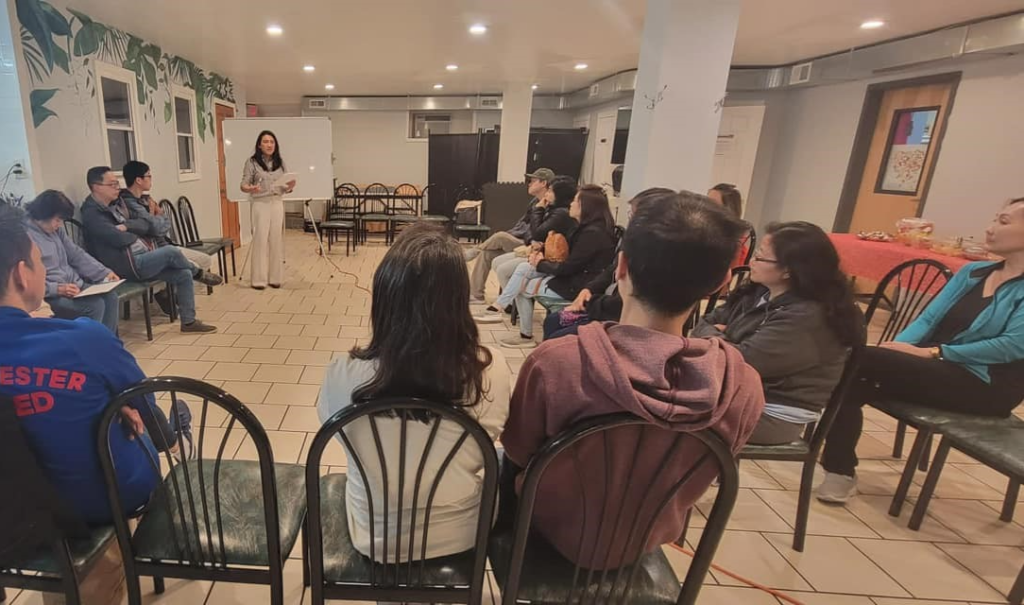
On Saturday, January 27, nearly 30 pastors, elders, directors of children’s and youth ministry, and other leaders from 13 congregations gathered at the Mosaic Office and on Zoom for a workshop titled “Nurturing Accessible Family Ministry.” 

The participants in the Mosaic office during the Nurturing Accessible Family Ministry Workshop. Photo by Jennifer Svetlik. 

The formation opportunity was facilitated by Bonnie and her husband Lyle Miller, ADN board member. Bonnie and Lyle introduced themselves by sharing about how their lives as parents have been touched by disability.  

They opened the time by dispelling several myths, including “there are not people with disabilities in our congregation,” citing statistics that one in seven children, to around half of those over age 65, have a disability. “Every church is planted in a community with people who are impacted by chronic illness, mental health challenges, and physical and intellectual disabilities.”  

The ten “petals” of the “belonging flower” shared in the workshop. Image provided by Bonnie and Lyle Miller.

The workshop focused on the concept of fostering belonging, as a sense of invitation that goes beyond inclusion within congregations. Drawing heavily on the work of Dr. Erik Carter, participants were invited to reflect on 10 aspects of “broad belonging” and how those are or can be more deeply cultivated in their congregations.  

The participants on Zoom in the Nurturing Accessible Family Ministry Workshop. Photo by Rose Bender Cook. 

“It’s about putting people in places where they will develop relationships with each other, more than developing new programs,” Bonnie shared.  

Noting that churches are exempt from the Americans with Disabilities Act, “it is important that this conversation happen in churches. How do we work toward inclusion so that people of all abilities are integrated into all our [formation opportunities]?” reflected Bonnie. Later Lyle noted that even if churches have ramps to make their spaces wheelchair accessible, often the one place that is not accessible is the platform upfront, limiting those with mobility issues from leading worship. 

Some of the concepts that were shared were around universal design, which is the creation of an environment so that it can be accessed by people of all bodies and abilities, and its applications in learning. Also included were resources on how to advocate for families impacted by disability, accessibility audits for a church building, and best practices for relating to neurodivergent youth or children (including those with diagnoses such as autism or ADHD). “Much of fostering belonging are ordinary actions of hospitality; disability expertise isn’t needed. Training can be helpful, but genuine invitation and connection are most important,” Lyle encouraged.  

“One takeaway for me is to keep asking questions of families impacted by disabilities, to learn what would help them to integrate well into church life, and to encourage awareness from our church leaders,” shared Carol Gehman, youth leader and preschool teacher at Bally (PA) Mennonite. “It has made me think more intentionally about the ways in which people with disabilities can share their gifts with the congregation more visibly.” 

“I learned more about how the church can be more accessible to people with disabilities and how we can be a more welcoming community,” reflected Britannia Worotikan, a children’s ministry teacher at Philadelphia Praise Center. 

The idea for the workshop was born out of the connections that several Mosaic congregations had made around their work toward making their formation more accessible. They desired to gather with leaders within other congregations across the Conference to receive training and share resources and ideas.  

Thanks to a grant from Plains Mennonite, each participating congregation received a bin of sensory items and resources, so they could begin to implement some ideas right away.  

View the training’s recording, slides, and handouts:  

Slides

Handouts

Filed Under: Articles Tagged With: Accesibility

Creating Opportunities for Jesus-Centered Formation to Talk Across Difference

February 8, 2024 by Cindy Angela

ROSE BENDER COOK STAFF PROFILE

by Jennifer Svetlik

“I believe being formed in the way of Jesus means we operate differently than the broader culture around us which divides and puts people into camps,” shares Rose Bender Cook, Leadership Minister for Formation for Mosaic Conference. “In this role, I hope to help those within our Conference explore how we think, respond, talk to, and love one another even when we disagree.” 

Bender Cook has served as Interim Leadership Minister for Formation since October 2023, and in January 2024 transitioned to permanent status. Mosaic Conference has a Leadership Minister for each of its three priorities (missional, formational, and intercultural).  

“In this role, I work with the formation team to equip and support our credentialed leaders, congregations, and Conference-Related Ministries so they can be formed more and more into the image of Christ,” Bender Cook explains.  

“Formation is about the spiritual disciplines and practices that we engage in as disciples of Jesus. It is about being transformed so that we live out the prayer to do God’s will ‘on earth as it is in heaven’.” 

Since 2021 Bender Cook has helped lead Mosaic Institute, first as a curriculum developer and adjunct professor, then as Assistant Director, and then Director. 

“As a pastor, I am always thinking about formation for the congregation I serve, and in this new role, I will be challenged to think more broadly about creating spaces where we can all be formed by the Word of God and the Spirit’s work in one another,” reflects Bender Cook. 

Bender Cook with Whitehall congregation, where she is a pastor, on their annual covenant renewal Sunday in November 2023. Photo by Patti Connolly. 

Originally from Wellman, IA, her first profession was as a social studies teacher for sixteen years. In 2010, she became the pastor of Whitehall (PA) Mennonite. For four years she worked as an adjunct professor for Eastern Mennonite University’s STEP Program, and she has also worked as a research assistant.  

“I have done a lot of curricula writing over the years, so this new role is a perfect combination of teaching, designing curricula, and pastoring,” Bender Cook says. “Through the Pathways process, we have heard that congregations want support in navigating difficult conversations, so that is something we will be working on in 2024,” she adds. 

Through her role as a pastor at Whitehall, Rose served on the Conference credentialing committee for three terms (12 years) and now serves on the ministerial committee.  

Bender Cook snuggles her new grandson at Christmastime. Photo by Rose Bender Cook. 

In her free time, Bender Cook enjoys walking her beagle, Bailey, reading or listening to books, doing puzzles in the winter, playing board games, quilting, and cheering on the Iowa Hawkeyes. Bender Cook also coached girls’ basketball for over ten years. When she was in high school, she played the six-on-six version (Iowa was the last state to switch to five-on-five). 

“Since November, though, being a grandma tops the list! My grandchild lives about six hours away but whenever I can get a snuggle, I am there for it!” Bender Cook shares.  


Jennifer Svetlik

Jennifer is Communication Associate/Editor for Mosaic. She grew up near Houston, TX and spent a decade living in intentional community in Washington DC, before moving to Lansdale, PA with her spouse, Sheldon Good. She is a graduate of the University of Texas and Washington Theological Seminary. She serves as Children’s Faith Formation Director at Salford Mennonite (Harleysville, PA). Jenn has two elementary-school-aged children and loves biking, camping, gardening, and vermicomposting with her family. 

Filed Under: Articles Tagged With: Rose Bender Cook

2024 Mosaic Budget Highlights 

February 1, 2024 by Cindy Angela

by Mosaic Staff

At the January 22, 2024 Mosaic Conference Board meeting, the Board passed the 2024 budget which begins on February 1, 2024. The total budget this year represents nearly $1.2 million dollars, an increase from recent years.  

Just over half of the income for the Mosaic Conference operating budget comes from income from the effective stewardship of the Conference properties.  

There is an expected increase in the budget of 3.07% from congregational giving, including estimates from new congregations to the Conference in 2024. 

The priorities of the 2024 budget reveal that this year will be… 

  • a year of continued staff time on the Pathway process. 
  • a transitional year with a few staff retirements later this year. 
  • one of strengthening our commitment to staffing Mosaic’s Missional, Formational and Intercultural priorities. 
  • one of strengthening our communication and development initiatives with increased, dedicated, multilingual staffing. 
  • one of increased staff time focused on Spanish-speaking communities where significant growth continues to emerge. 
  • one of exploration of new partnerships and resource generation possibilities. 
  • continued discernment and investment in global partnerships and cultivating new communities. 
  • a year of continued accompaniment of Conference-Related Ministries and congregations.  

“Many pieces make our budget work each year. Although a large chunk of revenue comes from real estate income, Mosaic is only possible through many congregations and individuals each doing their part so that we can provide effective leadership and accompaniment with our diverse leaders, ministries, and communities,” reflects Cory Longacre, Chair of the Board’s Finance Committee.  

We are grateful for the generosity and wise stewardship that undergirds our Mosaic mission of embodying the reconciling love of Jesus. 

Filed Under: Articles

The Pathway Towards Shaping Our Future Together, Phase 2 

February 1, 2024 by Cindy Angela

by Marta Castillo

Pathway Steering Team members present at the 2023 Conference Assembly.

During the Pathways presentation at the November 2023 Assembly, I blurted out a request to the delegates, on behalf of the team, that I never intended to share out loud, even though it had been a prayer in my spirit. It was a request for trust from the delegates, to trust in the work of God’s Spirit through our team in the Mosaic strategic planning process.  

Last fall, during one of our delegate preparation sessions, Steven Hunsberger, a delegate from Blooming Glen (PA), mentioned a business concept of “know, like, trust” as a process we go through to get to the point where we are comfortable enough to associate with or do business with someone. 

As we enter the second year of our two-year strategic planning process, imagine the implications of knowing each other, liking (loving) each other, and trusting each other as congregations and Conference-Related Ministries choosing to walk together.

In Phase Two of our strategic planning, we are focusing on clarity around our identity, clear and kind communication, the work of building relationships, building leadership capacity in our leaders, and acknowledging and reconciling our differences. 

On January 22, Haroldo Nunes of Seguidores de Cristo (Sarasota, FL) was appointed by the Board to join the Pathways Steering Team. The Team is meeting every other week with Grovider, our consultant, to set goals around our three priorities (missional, formational, and intercultural) as outlined in the Pathway Towards Shaping Our Future Together document, and to identify strategic initiatives, performance indicators, capacity needs, and more. 

In addition, this work will clarify our relationships with each other, other Anabaptist communities, and Mennonite Church USA. In November 2024, at this year’s Assembly, we will present our findings using the information gathered from delegates and leaders in our Conference. 

The Pathways Steering team will continue to, as it says in the Pathway document, “to share in the practice of continued prayer and fasting so that we may discern, yield, and listen to the Spirit among us.” 

We will continue “to walk together, recognizing discernment is a commitment to the community that we proclaim as the center of our life and the reconciliation that we proclaim is the center of our work. We will remain in respectful conversation and friendship as we discern God’s future for us together amid brokenness and beauty.” We ask you to join us. 

Our Pathways Steering Team will provide progress updates of our work throughout the year in Mosaic News. For now, we ask for your prayers for guidance through the power of the Holy Spirit and for your trust.  

In the words of Romans 15:5-7 (from a recent Praying Scripture), “May God, who gives this patience and encouragement, help you live in complete harmony with each other, as is fitting for followers of Christ Jesus. Then all of you can join with one voice, giving praise and glory to God, the Father of our Lord Jesus Christ. Therefore, accept each other just as Christ has accepted you so that God will be given glory.” (NLT) 


Marta Castillo

Marta Castillo is the Associate Executive Minister for Mosaic Conference. Marta lives in Norristown, PA, with her husband, Julio, and has three sons, Christian, Andres and Daniel and one granddaughter, Isabel.

Filed Under: Articles Tagged With: Pathway Process

When 1 + 1 = 3 (or more) 

February 1, 2024 by Cindy Angela

“Eight weeks. Would you be willing to help us out for eight weeks…maybe ten at the most?”  

This was the invitation I received to join the Conference communication staff in January 2020. As the Conference changed and grew, so did the needs of the communication staff, so my eight weeks was extended multiple times until I became a permanent staff member. Now, four years later, I have decided it is time for me to pass the baton along.  

For the four years that I worked for Mosaic, I worked at least one other job, sometimes two. My jobs were always part-time jobs, so on paper, it seemed like the math should add up. Rarely did the number of hours purportedly worked add up to over 40. Surely, I could handle a full-time load. Many weeks, I did, and it was fine. Some weeks felt lighter than full-time, and others more than full-time. I was bi-vocational, working in two areas that I loved: communication and chaplaincy. I was on the communication staff for Mosaic, and I was a chaplain. I felt fortunate. And I was. 

But over time, the toll of doing two part-time jobs that required my energy and thinking outside of the standard hours worked began to feel heavy. It was hard to juggle the schedules; which job do I prioritize when I have both jobs requesting my presence at the exact same time? How do I make sacrifices in one job to be successful in the other? Carrying the energy, knowledge, and responsibility of two jobs began to feel like I wasn’t able to do either one as well as I wanted.  

I know many people, especially those of us in ministry, are bi-vocational. Some people may choose this, as they welcome the opportunity to set boundaries and feel like having another job allows them this possibility. Other people are bi-vocational due to financial needs. For some, being bi-vocational allows them to experience a variety of professional experiences, something I enjoyed in my two roles.  

But, after four years, I realized that juggling two jobs is not sustainable for me in the long run. I want to be able to focus more steadily on one job and do it well. For me, this meant choosing the job that allowed my truest passion, being a chaplain, to shine.  

As a result, I say goodbye to my role on the communication team of Mosaic Conference. I do so sadly, as I have thoroughly enjoyed my time as a staff member. But I’m not going away, as I still am an active member of a Mosaic congregation. I just won’t have the regular staff interaction now, and I will miss that. The Mosaic staff are amazing. They work very hard to support a growing, changing, diverse group of people and theological beliefs and they do it with joy, integrity, commitment, and even some laughter.  

Many of the Mosaic staff are bi-vocational. Many of them are juggling multiple roles in their life too, like you. So, as you work with them, give them grace and understanding, knowing that 1 + 1 does not always equal 2.  


Sue Conrad Howes

Sue Conrad Howes is a chaplain at St.Luke’s Penn Foundation and is an ordained pastor in MC USA. She and her husband live in Quakertown, PA and are members at West Swamp Mennonite Church.

Filed Under: Articles, Blog Tagged With: Sue Conrad Howes

  • « Go to Previous Page
  • Go to page 1
  • Interim pages omitted …
  • Go to page 33
  • Go to page 34
  • Go to page 35
  • Go to page 36
  • Go to page 37
  • Interim pages omitted …
  • Go to page 168
  • Go to Next Page »

Primary Sidebar

  • Home
  • About Us
    • Our History
    • Vision & Mission
    • Staff
    • Boards and Committees
    • Church & Ministry Directory
    • Mennonite Links
  • Media
    • Articles
    • Newsletters
    • Video
    • Audio
    • Bulletin Announcements
  • Resources
    • Conference Documents
    • Missional
    • Intercultural
    • Formational
    • Stewardship
    • Church Safety
    • Leaders’ Resources
    • Request a Speaker
    • Pastoral Openings
    • Job Openings
  • Give
    • Leadership Development Matching Gift
  • Events
    • Pentecost
    • Delegate Assembly
    • Faith & Life
    • Youth Event
    • Women’s Gathering
    • Conference Calendar
  • Mosaic Institute
  • Vibrant Mosaic
  • Contact Us

Footer

  • Home
  • Contact Us
  • Delegate Assembly
  • Vision & Mission
  • Our History
  • Formational
  • Intercultural
  • Missional
  • Mosaic Institute
  • Give
  • Stewardship
  • Church Safety
  • Leaders’ Resources
  • Articles
  • Bulletin Announcements

Copyright © 2026 Mosaic Mennonite Conference | Privacy Policy | Terms of Use
Aligned with