• Skip to main content
  • Skip to primary sidebar
  • Skip to footer

Mosaic MennonitesMosaic Mennonites

Missional - Intercultural - Formational

  • Home
  • About Us
    • Our History
    • Vision & Mission
    • Staff
    • Boards and Committees
    • Church & Ministry Directory
    • Mennonite Links
  • Media
    • Articles
    • Newsletters
    • Video
    • Audio
    • Bulletin Announcements
  • Resources
    • Conference Documents
    • Missional
    • Intercultural
    • Formational
    • Stewardship
    • Church Safety
    • Leaders’ Resources
    • Request a Speaker
    • Pastoral Openings
    • Job Openings
  • Give
    • Leadership Development Matching Gift
  • Events
    • Pentecost
    • Delegate Assembly
    • Faith & Life
    • Youth Event
    • Women’s Gathering
    • Conference Calendar
  • Mosaic Institute
  • Vibrant Mosaic
  • Contact Us
  • 繁體中文 (Traditional Chinese)
  • English
  • Việt Nam (Vietnamese)
  • Español (Spanish)
  • Indonesia (Indonesian)
  • Kreol ayisyen (Creole)

Articles

Growing into a Mosaic with Antiracism Training 

September 26, 2024 by Cindy Angela

by Janet Panning

Editors Note: The anti-oppression training that Mosaic leaders received is one of the first activities of the Vibrant Mosaic Program.    

In early September, I participated in an Antiracism Analysis Training led by the nonprofit organization Roots of Justice. Our training took place at the new Philadelphia Praise Center (PPC) building on South 18th Street in Philadelphia. Our tasty Indonesian meals were catered by members of PPC, and Pastor Aldo joined us for the two-and-a-half day training. Around half of the participants were white and half were persons of color. Most of us were connected to Mosaic Conference, as board, staff, committee members, pastors or other leaders.  

We started on Thursday evening by adding to drawings of giant icebergs scattered around the room. The icebergs represented periods of the history of the United States, from the 1600s to the present. The iceberg, our trainers explained, is a metaphor for racism. A small part can be seen while much takes place out of sight. The out-of-sight part includes the systems and structures that perpetuate racism.  

Participants view the icebergs upon which they had written acts of racism and resistance within various time periods of U.S. history. 

Our opening task was to remember U.S. history and write actions of oppression on the inside of the iceberg and actions of resistance on the outside. We filled the icebergs with notes about slavery, red-lining, destruction of Black business districts, Jim Crow, family separations, segregated schools, the Indian Removal Act and Trails of Tears, Indian boarding Schools, and more. The acts of resistance included the underground railroad; the development and flourishing of Black institutions such as mutual assistance associations, universities and colleges, business centers and banks; civil rights actions, and more.  

The realities of racism and oppression that our small group was able to identify in such a short time saddened me. It is a depressing reminder of our history of depravity as a country and too often as a culture, particularly as we see instances in our own time, and sometimes within ourselves. The pairing of acts of resistance in the same historic period, however, is a reminder that there has been resistance to racism and oppression from the beginning. Our task today is to continue the work.  

Through exercises and caucuses, we looked at examples of systems and structures that support the entrenchment of racial injustice today and we talked about our roles in maintaining or dismantling systems of racism. We talked about the benefits that our current system allocates to persons who are white and the barriers and harm our current systems create for persons of color.  

As a white person, for instance, I have never had to give my children “the talk” of how to keep safe from persons in authority that might view them as a threat. My husband and I don’t think about getting pulled over in our cars when we drive at night. I have confidence when I go to the doctor that I will be heard. Prior to 2022, if I had chronic kidney disease and needed a kidney transplant, the risk scale used to assess my need would put me ahead of the black woman who had the exact same condition. 

At Mosaic Conference, we have a God-given opportunity to live in to our intercultural commitment as we continue to grow. This richness gives us an opportunity to share in each other’s gifts, experiences, perspectives, and burdens. This work will include listening to each other and listening for opportunities to support God’s work in diverse communities, including working for a more just and equitable country. 

Participants and trainers were hosted by Philadelphia Praise Center. 

Janet Panning

Janet Panning serves on the Mosaic Board and is the Ministerial Committee Chair. Janet is actively involved at Plains (Hatfield, PA) Mennonite Church where she serves as an elder. She is employed by Montgomery County’s Office of Public Health in Maternal and Child Health. Janet is married to Steve and they have two daughters, Megan & Molly.

Filed Under: Articles Tagged With: Janet Panning, Roots of Justice, Vibrant Mosaic

Starting to Shell the Corn: Get to Know Healthy Niños Honduras (Part II)

September 19, 2024 by Cindy Angela

by Javier Márquez

Editor’s Note: This is the first in a series of four feature articles on HNH, originally published in Spanish in 2024. All photos by Javier Márquez.

Part I | Part II | Part III | Part IV

In the top left, we can see one of the communities waiting for a medical brigade. Top right, one of the registration stations. Bottom left, a dentist and child, after performing a dental cleaning. Bottom left, a child with donations to take home.

The Brigades

Every morning, after breakfast, four vehicles leave from the main facilities of the Conference-Related Ministry Healthy Niños Honduras (HNH) toward a local community that has been previously selected and prepared by the staff. Among these vehicles are a team of volunteers and medical staff, along with the medical brigade equipment. When they arrive, there are nine stations organized: registration, vital signs and vitamins, deworming, height and weight, donations, medical consultation, pharmacy, dentistry, and construction. 
 

To reach the communities, one must drive to pick up the doctors working with HNH, then travel a path surrounded by cornfields, cross rivers, and climb mountains. When the brigade arrives, the community is always organized, either at the town’s school or church. Sometimes they have prepared signs that read “WELCOME,” and community leaders are always ready, some with lists in hand and a team prepared to help unload the truck and set up each of the stations.

Each brigade serves around 120 people per community, most of whom are children. The brigades provide families with donations such as clothing and toys, medically attend to the entire community, build floors in the poorest houses, and donate water filters. Undoubtedly the most important goal, though, is to identify children suffering from malnutrition, based on height and weight assessments. Once identified, the families—which often exceed 60% of those present—are invited to take their children to the Nutrition Center, a place designed for children to recover.

Children from a local community; top left, a typical house in the rural area of Honduras; and top right, a child whose family is receiving a concrete floor for their home.

The Volunteers

The volunteer teams are a key part of this ministry. On each visit, a group from a Mennonite congregation in the U.S. volunteer for a week along with the medical team. Many of these congregations are part of Mosaic Conference. Last year, 56 teams from congregations volunteered.

The teams are diverse. At least twice a month, people of all ages, genders, and professions arrive. They are students, pastors, entrepreneurs, and retired people, some who are here for the first time and others have been serving with HNH for years. Many have developed friendships with people from HNH or the community.

They arrive enthusiastic, ready to lend a hand at one of the nine stations, prepared to learn and ask questions, to pray every morning before heading out to the brigades, and to pray and reflect with the Bible every night when they return.

The Communities and the Medical Team

It is amazing, even in areas where there aren’t many houses, how many people come to the school or church where the brigade will take place. That is how villages and mountains are throughout much of Latin America. Rural communities that, despite growing some crops, have a high level of malnutrition and poverty. Families who have been waiting for the brigade for months arrive clean and smiling. The brigade also strengthens community leadership and is a gathering time for locals. 

The volunteers arrive alongside highly qualified doctors, nurses, interpreters, engineers, and community leaders. A staff person coordinates the brigade, including oversight of registering medical information, reviewing patients’ medical histories, attending to families, cleaning or extracting teeth, building floors, or encouraging families to go to the Nutrition Center. 

Filed Under: Articles, Mosaic News En Español Tagged With: Healthy Niños de Honduras, Javier Marquez, Mosaic News en Español

August 2024 Faith and Life Gathering

September 19, 2024 by Cindy Angela

by Andrew Zetts

The Faith and Life Commission of Mosaic Conference provides space for pastors and credentialed leaders to build ties of friendship and support. We convene quarterly to discuss scripture and listen to how we might interpret and apply those scriptures. We pray for each other and our congregations in light of our reflections. We seek to develop relationships of mutual trust and accountability, deepening our convictions and  involvement in the congregations we lead. 


It is common for congregants and community members to ask questions of pastors. So, what happens when pastors get together? Who asks the questions? It turns out, they all do.  

At the most recent in-person Faith and Life Gathering that was hosted on August 28 at Swamp (Quakertown, PA) Mennonite, seven Mosaic pastors from different ministry contexts gathered to be formed by scripture and community with each other. The discussion centered around Matthew 16:13-20 and the foundations of the Church.  

While the discussion and interpretation moved in a variety of directions, it was rooted in an important revelation in the text: Jesus is the Son of Man, God among us. 

In a room of well-trained, highly experienced pastors, there was an air of humility and openness at our gathering. Pastors are famous for being verbose and ready to engage an audience. This wasn’t that kind of meeting.  

Rather, it was a room full of questions, curiosity, and vulnerability. Throughout our hour and a half together, I heard things like: “I don’t know, what do you think?”, “What’s it like for you and your congregation?”, “I used to think about it this way, but my years of ministry have led me to think differently…”, and “I’m not really sure, how has your church handled it?”  

At first, I was hesitant to attend. Life in ministry is busy, and the gathering was one of many color-coded rectangles on my Outlook calendar. I confess, I even arrived late.   

But I left the gathering refreshed and renewed. Something transformative happens when we are in each other’s company, open ourselves up to the Spirit and each other, and prepare to be moved. My peers’ posture toward questions rather than certitude made mutual transformation even more likely.  

In divisive times, gathering is essential. One of the participants reflected at the end of our meeting, “I’m glad I came today; this was a really humanizing experience.”  

I’m grateful that Mosaic makes these Faith and Life gatherings possible, and I hope to do my own part in supporting the effort. I hope to be at the next one on November 6 in person or November 7, 2024, on Zoom. See you there! 


Andrew Zetts

Andrew Zetts is Associate Pastor at Salford Mennonite (Harleysville, PA).

Filed Under: Articles Tagged With: Andrew Zetts, Faith and Life, Faith and Life Commission, Faith and Life Gathering

Reflections on Seven Years with Mosaic Conference

September 19, 2024 by Cindy Angela

by Mary Nitzche

In the spring of 2017, I was invited to serve as Associate Executive Minister beginning July 1. For nearly five years I served in this role until my successor, Marta Castillo, began in February 2022. Since then, I have been gradually letting go of some responsibilities while assuming new roles. February 2022, I began a two-year administrative role with the Mosaic Board and Executive Committee. In January 2024, I was invited to a one-year interim Leadership Minister role with Hendy Matahelemual for our three Indonesian congregations in California. One role I continued throughout my tenure with Mosaic was serving as Leadership Minister for the Alpha, Fairfield, and Taftsville congregations. At the end of September, I will be fully retiring. (No more asks, Steve!)

As I reflect on my seven years with Mosaic Conference, relationships that formed brought me gratitude, joy, and challenge. 

Gratitude

I am so grateful for the team of colleagues I worked alongside. I value the comradery, and unique gifts, perspectives, and wisdom they each bring to our team.  

Each time I was ready to release responsibilities, one of our staff members was prepared and willing to assume the role. I am so grateful for competent, committed, and younger leaders who are serving well as I let go. The vision for developing younger leaders is bearing much fruit. 

I am grateful for our conference priorities, particularly nurturing intercultural connections. The diversity of our staff and member congregations reflects our intentionality and hard work of welcoming and becoming more culturally sensitive. 

Joys

Relationships with colleagues, pastors, conference and congregational leaders, and leaders within Mennonite Church USA (Conference Ministers and Constituency Leader Council members) has been an invaluable gift. 

Leading two groups, women pastors and leaders and chaplains has been gratifying.  I witnessed the care, support, and encouragement given to each other as they faced opportunities, challenges, and transitions in their ministry settings. 

Assisting new leaders through the credential process was tedious and inspiring, especially hearing their stories of call to ministry. Participating in or attending their licensing and ordination services, reminded me of the Holy Spirit’s mysterious and holy activity in calling, preparing, and empowering leaders to serve in a variety of ministry roles and settings. 

Interviewing women who were first to be credentialed in our conference (Franconia, Eastern District, and Mosaic) and representing different cultural groups has been another holy experience.  

Challenges/laments

As the credentialing process became more complex given the nuances of our growing cultural diversity, I realized it was time for me to make room for someone more gifted and experienced.  

Conflict over theological differences was also beginning to wear on me even though, from our origins as Anabaptists, this has been an ongoing struggle. 

While I cherish all the relationships, new understandings gained, and rich experiences of the last seven years, it is time to retire. In each step of my long discernment process toward retirement, I recognized my priorities were shifting. The demands of the work physically, emotionally, intellectually, and interculturally were beginning to stretch me in body, mind, and spirit. 

Thank you, Mosaic Conference for the privilege of serving in a variety of roles with your trust and support each step of the way. 


Mary Nitzsche

Mary Nitzsche is a Leadership Minister for Mosaic Conference. She and her husband, Wayne, are Midwest natives. They have two adult daughters, Alison and Megan, sons-in-law, Michael and David, and two delightful grandchildren, William and Audrey. Mary enjoys spending time with family and friends, walking, knitting, sewing, and cooking.

Filed Under: Articles, Blog Tagged With: Mary Nitzsche

Surrendering Our Desires, Becoming Fully Mosaic

September 19, 2024 by Cindy Angela

by Danilo Sanchez

September 14 was the start of the series of the 2024 delegate preparation meetings for Assembly delegates to have conversations regarding Mosaic’s Strategic Plan, Pathways Recommendation on Affiliation, and learn about the Vibrant Mosaic Program. Prior to and in these meetings there is a lot of information to absorb.  

In working with our consultant, Grovider, the Pathways Steering Team (PST) created a strategic plan that would guide the work of Mosaic for the next three years. The strategic plan was borne out of the listening tour and Grovider compiled the data from that listening and gave the PST five clear themes which we used to develop the Pillar Statements for the Strategic Plan. Those five pillars are Reconciliation, Relationship Building, Clarity and Identity, Leadership Development, and Communication.  

The PST devoted several months to crafting objectives and activities aligned with them. It was hard to imagine what Mosaic could look like in three years and what was necessary to reach those goals. We recognized that as a conference we are conflict avoidant, so we listed activities that support communication and conflict resolution skills. For clarity and identity, we devised ways to live into our three priorities and help everyone in the conference understand them. We wanted to move the conference to a more “centered-set” model rather than a “bounded-set,” so we included reviewing our conference documents and statements. For leadership development, we included elements of the Vibrant Mosaic Program, trusting that we would receive grant funding to do so.  

Our hardest work was on the recommendation for affiliation. We spent a lot of time hearing from one another and discerning together. Ultimately, we decided “partnership, rather than membership” was the best approach for affiliation with MC USA. As stated in the rationale, our recommendation gives space for those who disagree to covenant as one body, while maintaining some level of relationship. Some congregations in Mosaic want to remove themselves from MC USA because of the Repentance and Transformation Resolution, while others affirmed the resolution and are excited about being members of MC USA. As a newly reconciled conference, it felt most important to figure out how to live into our name “Mosaic” and find space for each of those groups to belong.  

Another dynamic in our recommendation is that as Mosaic has worked at its missional and formational priorities, new global, Spirit-led relationships have emerged naturally. Mosaic Conference has a history of being experimental and entrepreneurial. Being a member of MC USA has posed a challenge to us that limits establishing those new relationships. As members, we would not be able to credential those leaders or have those communities join our conference. Being a partner with MC USA would let us live out our priorities and form deeper local and global relationships. 

I recognize that being on the PST has allowed me to process this recommendation and my emotions about it before others in the conference. I entered this process wanting very strongly to remain members of MC USA. I was going to fight for it. I value the relationships, networking, and resources the denomination provides. I have positive memories of attending various events and Convention.  

My stance changed during this process as I learned to practice “holy indifference” which calls us to set aside our own will and desired outcome and allow the Holy Spirit to transform in ways we need to be transformed. I heard concerns from affirming pastors and traditional pastors about the direction of our conference and how we should affiliate with MC USA. On the PST, I had to wrestle with different viewpoints and concerns of my teammates. In the end, the Holy Spirit took over the Pathways process. We all surrendered our desired outcomes to discern what was best for us as a conference and our pathway forward.   

We are excited about the strategic plan and how it will transform us as a conference. We are excited about the Vibrant Mosaic Program and the new opportunities it will create. And we are hopeful about the recommendation that it will shape new models for relating in institutions and allow us to be fully Mosaic. 


Danilo Sanchez

Danilo Sanchez is the Leadership Minister for Intercultural Transformation for Mosaic Conference. Danilo Sanchez lives in Allentown with his wife Mary and two daughters. He is a pastor at Ripple and leads in the areas of leadership development, discipleship, and teaching. Danilo also works part-time with the housing program of Ripple Community Inc as the Community Life Director.

Filed Under: Articles, Uncategorized Tagged With: Danilo Sanchez, Pathway Process, Pathway Steering Team

A Congregant and Her Pastor Dialogue About Pathways

September 12, 2024 by Cindy Angela

By Brenda Shelly and Jeff Wright

With permission, Mosaic News is reprinting an email dialogue that took place shortly after the Mosaic Board affirmed the Pathways Team’s recommendation for partnership, rather than membership, with MC USA.  

Subject: A question 

I guess I don’t have a clear understanding of what denominational membership “does” for a conference or a church. Other than the feeling of belonging to something larger (which makes me a little nostalgic and wistful when I recall the many impactful weeks I spent at conventions shepherding teens as a sponsor or being part of an uncomfortable table of strangers in delegate sessions who somehow become sweet friends by the end of the third day of forced conversation).  

Can you define for me exactly what would change if Mosaic became a partner with MC USA rather than a member? What is lost? What is gained?  

I feel like I understand the third way approach. How could we do anything else in this situation without amputating limbs from this body we call the church? If only all our anatomical parts would agree which direction to walk, right?  

-Brenda Shelly (Blooming Glen [PA] Mennonite)  

Subject: Re: A question

Brenda: 

I appreciate being asked this question, and particularly appreciate how it has been asked.  You have a wonderful spirit, getting to tough issues with tender care. Thanks. 

I was a participant in the efforts to bring the Mennonite Church and the General Conference Mennonite Church (which had a strong Canadian contingent and numerically bigger and more spread-out U.S. contingent) together into a binational merger. In the early days (1989-1997), we wanted three church bodies to become one. Unfortunately, Revenue Canada and by their own admission, the Canadian Mennonite leadership in Winnipeg, did not agree with that vision, and so by 1999 the three bodies began to become two national churches. “Amputation” was part of the organizational solution when merger took place in 2001. Even then, there were those of us serving on General Boards who found the language of “realignment” more descriptive and meaningful than “integration” or “merger.”   

Amid this realignment as national churches, there also began almost immediately realignment of local congregations from one conference to another. Churches withdrew from Ohio Conference and Indiana-Michigan Conference to join Central District Conference. The Iowa-Nebraska Conference and the Northern District Conference realigned as Central Plains Conference. The churches on the West Coast in three conferences had already merged into two conferences in 1994. Churches in various smaller conferences in the deep south, the Great Lakes, Maryland, and New York realigned with what we then knew as Lancaster Mennonite Conference (which was as early as 1971 ambivalent about connecting with other Mennonites in a denominational system). The Puerto Rican Mennonite Conference ultimately decided not to participate in this realignment as a part of the MC USA system. Other churches, in Oregon, Washington, Idaho, Oklahoma, Missouri, and Florida joined more “conservative” Mennonite Conference or became independent. So, the realignment process was always a bit shaky, as congregations in both the former GCMC system and the former MC system struggled to navigate a new denomination that was chronically underfunded from day one. 

On your question of purpose, I would say that MC USA has been unable to provide the value of large conventions for over a decade. Issues of cost, demographics, and purpose for denominational conventions have been in flux for several convention cycles. What I think a denominational body can do today is pool limited resources for efforts that require a larger, deeper scope of work. Hymnals, curriculum, commentaries, missionaries, primary, secondary, and higher education, and other projects are examples of that which require collaboration and pooled investment.  

As for the question of change, I would begin by saying exactitude isn’t as possible as one might hope. One thing that is lost is Mosaic Conference’s place at the MC USA decision-making table. One thing that is likely gained is the capacity and the mandate to cultivate a global community of local congregations and ministries with a different freedom to respond to diverse contexts relationally and effectively. Where this might take us is not yet fully known, but the current status quo is not effective for enhancing a global community of local congregations and ministries. 

Personally, I think the church press is focused on compromise and human sexuality – as if these issues are somehow new. In the 2019 merger of Eastern District and Franconia, which gave birth to Mosaic, we knew the question of affiliation would need to be addressed – but then COVID hit. While LGBTQIA+ inclusion is an issue, it is not the singular driver of this conversation.  

I don’t believe that Mosaic is seeking to create more schism and division. It is useful for me to remember that the New Testament has various metaphors for the church; the body image is one of several. In the case of Mosaic, I think we are seeking to be a more grown-up part of the household of faith, able and willing to respond to things unique to our experience. 

I look to Mennonite Central Committee (MCC) or Everence as future models of Mosaic Mennonite Conference and its potential relationship to MC USA. There are significant differences within MCC’s constituency about women in ministry, divorce, LGBTQIA+ inclusion, the scope of the peace witness, and more. Yet somehow, MCC finds ways for disparate groups of Mennonites to do relief, development, and peacebuilding in the name of Christ. I can foresee Mosaic Conference working with MC USA…and LMC, Brethren in Christ, and the even the Mennonite Brethren and plain Mennonite communities to do good in the world, collaborating with agencies like MennoMedia, Mennonite Mission Network, Eastern Mennonite Mission, Virginia Mennonite Mission…and Mennonite World Conference (maybe especially MWC). 

What is being proposed, in my opinion, is not a severing of relationships, but a continued adaptation and realignment. Speaking personally, I think MC USA will find itself returning to a more General Conference Mennonite Church polity point: dual membership. If I can be forgiven some prognostication, I think MC USA will ultimately be membered by local congregations, not area conferences. Local congregations may (or may not) be members of MC USA, and by separate action may (or may not) be members of a specific conference. Being a member of one might provide an access point to collaboration, but not necessarily to specific assemblies of decision-makers. 

I hope I haven’t wandered in the tall weeds too much. My reply comes to you as a pastor and in no way seeks to speak for Mosaic Conference. As it might be said: “The opinions expressed in this email are the opinions of the author alone, and does not represent Mosaic Conference, MC USA, or Blooming Glen Mennonite in any official capacity, and are subject to change without notice.” 

Thanks again, Brenda, for asking.

-Jeff Wright

Filed Under: Articles

Ministerial Committee Update – September 2024

September 12, 2024 by Cindy Angela

The Ministerial Committee makes decisions on ministry credentials and policies that promote the support, health, and training of credentialed leaders and safe church practices for congregations. They meet quarterly to act on recommendations from the credentialing committee, review and revise current policies around credentialed leaders, and provide leadership in cases of misconduct.   

Report from the September 4, 2024 Ministerial Committee Meeting

Credentialing Updates and Motions

Ordination

  • Effiem Obasi (LA [CA] Faith Chapel)
  • Emmanuel Villatoro (Philadelphia [PA] Praise Center)

Withdrawn

  • Charles Ness (Towamencin [PA])
  • Mark Wenger (Franconia [PA])

License Extension

  • Benjamin Toussaint (Solidarity and Harmony [Philadelphia, PA])

Active without Charge to Active

  • Samuel Charles (Bethel Worship and Teaching Center [Levittown, PA]) 
  • Tim Weaver – Mosaic Leadership Minister
Other Ministerial Committee Updates

Hearing from Beth Yoder (Salford [PA]) about her Giving and Receiving Counsel Process

Giving and Receiving Counsel Policy Update – adding steps for after committee determination

Misconduct Policy Review – for situations of conflict of interest and enmeshment

Credentialing Renewal Update – approximately half of credentialed leaders have successfully renewed their credentials

Credentialing Process Alternative Questionnaire will be tested with Partner in Ministry leaders outside of the United States.


Definitions Related to Credentials:  

  • Licensed for Specific Ministry (LSM) – Person called from within the congregation to serve in a specific leadership assignment within the congregation or another organization  
  • Licensed toward Ordination (LTO) – Issued for a three-year period with the purpose of testing the inner and outer call to ministry, further discerning of ministerial gifts, abilities, and aptitude; may or may not lead to ordination.  
  • License Extension – A three year-extension is given to a person in active ministry who has a license towards ordination but is not ready for ordination. 
  • Ordination (ORD) – Long-term leadership ministry credential appropriate for all pastors, area conference ministry staff, chaplains, missionaries, evangelists, and those determined by the church to have a continuing ministerial-leadership role in and on behalf of the church.  

Status Definitions

  • Active – held by those serving in a leadership-ministry assignment. 
  • Active without Charge – held by those not presently holding a ministry assignment.  
  • Inactive – held by those who have been without a ministerial assignment for more than three consecutive years.  
  • Retired – held by those who have retired from active ministry.  
  • Withdrawn – is given when a ministry credential is ended for non-disciplinary reasons. 

Filed Under: Articles Tagged With: ministerial committee

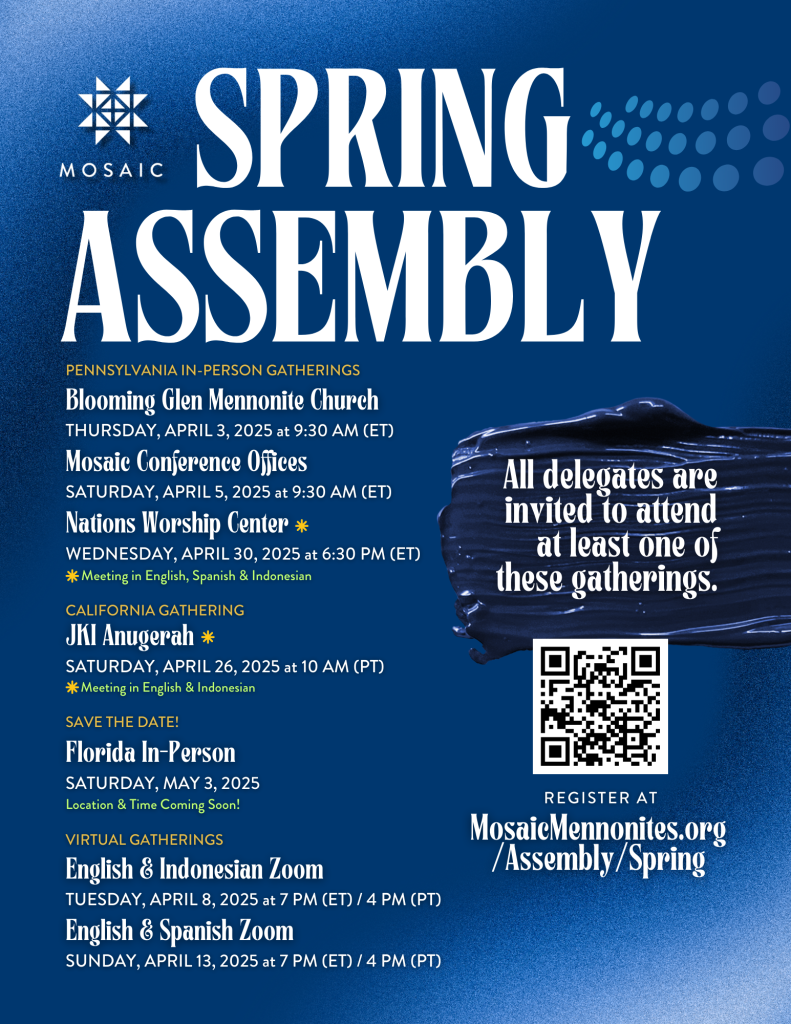
Get Ready for Mosaic Mennonite Conference Assembly 

September 5, 2024 by Cindy Angela

Saturday, November 2, 2024: 9 AM-4:30 PM  

Registration for delegates will take place from 8:30-9 AM

Souderton Mennonite Church (map) 
105 W Chestnut St., Souderton, PA 18964  
(in person – there is no virtual option this year) 

Delegate Registration 

All delegates named by their congregations should have received an email on September 3, 2024, explaining the day-of onsite delegate registration process.  

If you are attending Assembly as a guest (all non-delegates), you are most welcome.  To help us plan and prepare, please let us know by signing up here. RSVP for non-delegates opened on Tuesday, Sept. 3. Delegates were automatically signed up when their congregation named them.

Sue Conrad Howes, former Editor of Mosaic News, has returned as Mosaic Assembly’s Registrar. 

If you are coming from a distance, plan your travel and arrange for your lodging.  If you need assistance with lodging, please click here for information. 

Please pray for the Assembly, Mosaic’s Board, delegates, the Mosaic staff planning it, those attending, and God’s leading in the process.


Delegate Preparation Meetings

What are Assembly Delegate Preparation Meetings? 
Mosaic Conference holds a series of delegate preparation meetings in the weeks leading up to our gathered Assembly. The purpose of these meetings is to help delegates understand the important commitment and specific duties they are responsible for, to prepare them with the latest information on the issues that will be discussed, and to give an opportunity to give feedback and ask questions. 

Delegates are asked to please attend at least one meeting on a date & location that best suits them.  Let us know what meeting you are attending so we can plan.

Guests are welcome to attend these meetings.  


  • Important Mosaic Conference Documents
  • Delegate Assembly Policy & Delegate Ministry Description (Pages 8-10)
  • Past Issues of our weekly e-newsletter, Mosaic News

The 2024 Docket will be released in early October and emailed to delegates.

Visit MosaicMennonites.org/assembly for more information.  

Filed Under: Articles Tagged With: Conference Assembly 2024

  • « Go to Previous Page
  • Go to page 1
  • Interim pages omitted …
  • Go to page 19
  • Go to page 20
  • Go to page 21
  • Go to page 22
  • Go to page 23
  • Interim pages omitted …
  • Go to page 165
  • Go to Next Page »

Primary Sidebar

  • Home
  • About Us
    • Our History
    • Vision & Mission
    • Staff
    • Boards and Committees
    • Church & Ministry Directory
    • Mennonite Links
  • Media
    • Articles
    • Newsletters
    • Video
    • Audio
    • Bulletin Announcements
  • Resources
    • Conference Documents
    • Missional
    • Intercultural
    • Formational
    • Stewardship
    • Church Safety
    • Leaders’ Resources
    • Request a Speaker
    • Pastoral Openings
    • Job Openings
  • Give
    • Leadership Development Matching Gift
  • Events
    • Pentecost
    • Delegate Assembly
    • Faith & Life
    • Youth Event
    • Women’s Gathering
    • Conference Calendar
  • Mosaic Institute
  • Vibrant Mosaic
  • Contact Us

Footer

  • Home
  • Contact Us
  • Delegate Assembly
  • Vision & Mission
  • Our History
  • Formational
  • Intercultural
  • Missional
  • Mosaic Institute
  • Give
  • Stewardship
  • Church Safety
  • Leaders’ Resources
  • Articles
  • Bulletin Announcements

Copyright © 2025 Mosaic Mennonite Conference | Privacy Policy | Terms of Use
Aligned with