
(posted January 22) You are invited to the Perkasie Mennonite Church’s Patchwork Coffeehouse live concert with Bunny Barnes and Russ Rentler to the February coffeehouse on Saturday, February 21, 2026, 7:30 pm, at 320 W Chestnut St., Perkasie, Pa. Patchwork is pleased to present this double bill with two great entertainers—Bunny Barnes, Premiere Guitarist and Russ Rentler, Multi-Instrumentalist! Wheelchair accessible.
Perkasie Mennonite Church
A Place of Peace and Rest
The year 2020 will forever stand out. It was a year that changed both our world and our lives. The year 2020 was also the year that gave birth to a vision at our church – a Peace Garden. Mary Lou Cummings and the Ministry and Community Connections Teams at Perkasie (PA) Mennonite Church envisioned this place.
The dream and vision of the Peace Garden was a spot of natural beauty that would become a place of rest and peace to all in the community. People who drove or walked by could stop to smell the flowers, choose a book from the crafted book box, or sit and rest on the repurposed bench. This vision became especially significant as we lived through the first year of the pandemic. Being outdoors gave us an appreciation of the constancy and beauty of God’s creation, and experiencing nature’s constant movement, even with the many unknowns, gave us a sense of security and encouragement.
Early in the life of this garden, as I finished working in the Peace Garden one afternoon, there were a few passers-by that made some lovely comments. Their comments helped us to realize how this little, and as yet incomplete, garden was already inspiring our local community. During lockdown and social distancing, we still had a way of reaching out to others.
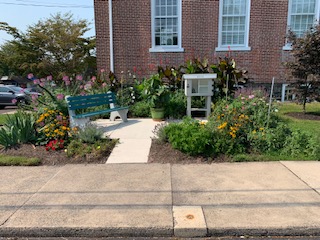
The crafted book box, which is now part of the Little Free Library network, was repurposed and placed early in the life of this project. A diligent team’s vision and purpose are to keep it stocked with books that are welcoming, portraying justice and diversity.
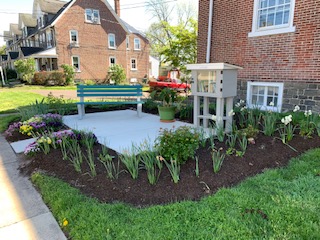
After working in the garden on a Thursday afternoon, in the fall of 2020, I brought my grandkids to see the place. They asked if we could walk on the patio, choose books, and sit on the bench. There were four or five youngsters on bikes who came up as we did this, waiting until we were done. These school-aged children carefully discussed how to open the book box safely, Covid-style, and collaboratively decided to use their T-shirt ends to handle the latch!
As we continued to work in the garden over the next many months, preparing the beds, turning the soil, and planting, we were greeted and encouraged by people walking by. There seemed to be an overall feeling of gratefulness and thanks from our neighbors.
A woman who was on a walk, stopped to chat and admire how the garden was coming along, saying that it was a great idea.
A young man who was walking his dog came to donate a book. He told me how he had donated some other books recently when he noticed the box was empty and encouraged his wife to stop by and enjoy the garden too. He also shared his knowledge of many other free library boxes in the community but stated that he likes the fact that this one has a bench where you can sit, choose a book, and enjoy.
A grade school-aged girl on her bike, shouted, “Hi,” as I was working one day. As I looked up and responded, she smiled. As she rode away, she said, “You know, I come here every day to do my homework. I’ll probably see you again!”
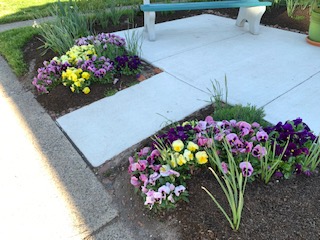
“You know, I come here every day to do my homework. I’ll probably see you again!”
This spring, a Peace Pole will finally be added to our little garden. Long-awaited, it will stand strong, declaring peace, love and justice for all.
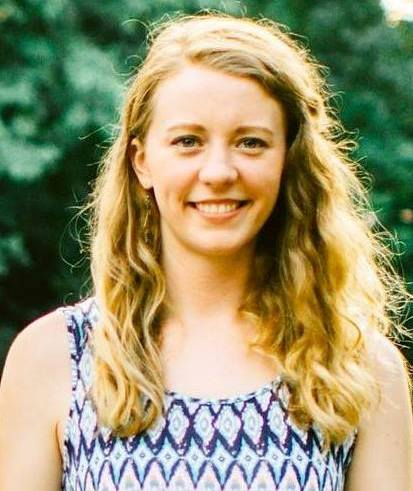
Feeling God’s Radical Love
by Jessica Miller, Perkasie (PA) congregation
My call to ministry was a surprise to me. I never encountered a female pastor until I was a teenager. The possibility that I could be a pastor was something that never crossed my mind.

When I graduated from high school, I attended Eastern Mennonite University, to pursue teaching, as I had a natural way with children and always enjoyed school. Two years after college graduation, in 2013, I started to seriously question whether teaching was really my calling.
My two years since college were spent teaching at Lezha Academic Center in Albania through Virginia Mennonite Missions. Those years changed me in ways I never could have anticipated. I encountered the radical love of God in new and powerful ways. Furthermore, I found myself feeling more compelled to dedicate my life to helping others experience God’s love.
By the end of my second year, I was expending more time and energy preparing for the after-school Bible Club than I was for my regular classes. More than anything I wanted my students to know they were deeply loved by God. This shift in my focus, along with weeks of prayer and discernment, confirmed for me that I needed to pursue ministry.
Upon returning home to the US, I was hired as the Director of Children’s Ministries at Souderton (PA) Mennonite Church. When I interviewed, they told me they were looking for someone with a pastoral heart, who would consider becoming a credentialed leader. Although I wasn’t certain if credentialing or ordination were in my future, I told them I felt called to the ministry of sharing God’s love with others and that I was open to pastoral leadership if God was leading me to that. Less than 2 years later, with the blessing of the congregation, I was licensed as a pastor through the Conference.
I spent three years at Souderton Mennonite Church, pouring my heart into caring for the children and families. The deeper I went into pastoral ministry, the more I felt I needed to further my education.
Over the past three and half years, I have been pursuing my Masters of Divinity at Drew Theological School while working part-time at Perkasie (PA) Mennonite. It has been energizing to be part of a small church community that shares my passion for helping others experience the radical love of God. That same spirit of love was strong among us as we gathered together to celebrate my ordination to ministry this past November.
Every day, I am more convinced that the best way I can communicate God’s radical love is by helping others to realize that God embraces and cherishes them just as they are. The church reflects that love by reaching out and extending our embrace.
At the last chapel before my graduation from Drew, we sang a song that sums up what I believe ministry is:
Draw the circle wide. Draw it wider still.
Let this be our song, no one stands alone.
Standing side by side, draw the circle wide. (by Mark Miller)
This my constant prayer for our churches, our conference, and our world. May we continue to find ways to draw the circle wider, keeping Christ at the center, and reaching out until no one stands alone and all people know the truth of their belovedness.
Alternative Worship Approaches During Social-Distancing
by Sue Conrad Howes, West Swamp congregation

At the heart of congregational life is gathering for worship. In light of government warnings about the need for social distancing to prevent the spread of the coronavirus, many Eastern District & Franconia Conference congregations had to decide whether they should gather together on Sunday, cancel worship, or find alternative avenues to lead congregants.
For many, this meant finding ways to use technology to enhance their community worship. Facebook Live was a popular platform for many congregations. Salford congregation (Harleysville, PA) live streamed an abbreviated version of their worship service. One goal was to keep things as “normal” as possible; “The person who led the Children’s Time came in and read the story from the usual Children’s Time bench,” said Pastor Beth Yoder.

Meanwhile, Perkasie (PA) congregation had a casual, 30-minute service on Facebook Live. “We read Psalm 23 together, lit candles, and recited our peace lamp litany, had a scripture reading, and sermon,” reported Jessica Miller, associate pastor. She shared that the sermon response invited people to get a drink of water in their homes, an opportunity that would not have been realistic in the church pews.
One advantage to using Facebook Live as a platform was that participants had the opportunity to join the worship service live, watch it later on Facebook, or watch the service later via a video link posted on the church website, which gave those who do not have a Facebook account an opportunity to view the video link.
Many pastors noted that the services were shorter than a typical Sunday. Josh Meyer of Franconia congregation (Telford, PA) commented, “The service was simple and brief: a welcome, a pastoral prayer, some announcements, Scripture, a meditation, and a closing … 38 minutes.”

Not every church could live stream their worship experience, so alternative options were given. Methacton (Norristown, PA) sent out a group email that included a virtual worship service. Rocky Ridge (Quakertown, PA) put together a “virtual worship service” and a blog post for interaction. Ambler (PA) congregation used online conferencing. “Zoom worked well, with 40-plus persons participating, including two former congregants now in other states,” said interim pastor Dorcas Lehman. “It felt different, lively, meditative, and well-appreciated.”
A big surprise was the consistent report that participation was higher than expected. Deep Run East reported that about four times as many people watched the Facebook Live worship service than attend a typical Sunday morning in-person worship. “I was surprised by the breadth of people who joined the worship experience,” commented Pastor Ken Burkholder, “including people from numerous states, mission workers in Honduras, and others who would not typically worship in person at Deep Run East.” Likewise, Salford reported that by noon, their service had received over 1000 views.
Many pastors and congregants noted that each platform seemed to offer a valued sense of community to each other, especially during this time of social distancing and unknown. Methacton’s pastor Sandy Drescher-Lehman, reflected, “We often talk about wanting to be a ’church without walls’ and this time we really did it!”
Even though the response far exceeded the expectations, there were still problems. Franconia’s worship crew arrived at church to find their internet was down. Plains congregation (Hatfield, PA) planned to post a worship service video on their website by 10:30 am but discovered it took hours for the video to finish processing and uploading.
Another challenge was the obvious strangeness of leading a service in an empty auditorium or knowing how or where to make eye contact. Meyer commented, “So much of what happens during corporate worship is exactly that: corporate. Without a gathered body, a number of our regular worship practices needed to be adjusted.”
Despite the challenges, last minute implementations, and new approaches to worship, most every church reported very positive experiences from congregants. “Many expressed that being able to ‘gather’ in this way helped social solidarity, in a time when we are practicing social distancing,” said Lehman.
Congregational Profile: Perkasie Mennonite Church
by Mary Lou Cummings
“Welcome is one of the signs that a community is alive. To invite others to live with us is a sign that we aren’t afraid, that we have a treasure of truth, and of peace to share,” says Jean Vanier.
Perkasie Mennonite Church is a tiny but lively congregation that values welcome, whether of LGBTQ folks or others who have felt “outside the box” for many reasons. We aim to model Jesus (our succinct mission statement) in our daily lives in loving relationships and in service. Many, but not all, experience their faith journey through a progressive Christian lens. No matter where a person is in their faith journey, they are welcome.

PMC has had a long history of inclusion of those with intellectual disabilities, and several of these individuals have provided joy, humor, and spontaneity in our congregation for many years. Barbara Shisler has hosted a monthly Faith and Light chapter for many years, as well; this is a national program which offers fellowship in a spiritual context for community members with intellectual disabilities and their families.
In the past year, Brent Anders and Joe Matthew were invited to present two Second Hour seminars with resources, stories and language tips to help us all be more understanding and helpful in our relationships with LGBTQ attendees, friends, and neighbors. We are officially a Welcoming Congregation, and a number of our most recent new attendees sought us out for this open and welcoming environment.
PMC has trained many young people through the years, and finds joy in seeing these now-grown-up children living lives of faith and service in places around the country and the world. Today we have fewer children (although the ones we have get lots of love!), so we are exploring how to offer our wisdom and resources to young people’s programs run by others. Bucks Kids First is a program for at-risk kids (many in foster homes) which will be using our building for after-school mentoring four days a week. We also volunteer with other community programs like Bridge of Hope Bux-Mont, a homeless ministry for single mothers.

Hosting Patchwork Coffeehouse and Soul Talk (a progressive Christian study group) are other ways we reach out to the community. Favorite volunteer opportunities include FISH, MCC Material Resource Center, MCC, Care and Share, and ministries to the homeless. In recent years we have also hosted “Listen, Live, Local” events, including one evening inviting community conversation on gun control, and another on bridging the gap between right and left in the U.S.
The PMC community enjoys singing a capella music from the three Mennonite hymn books, and is looking forward to dipping into the new one next year. We value creativity in each other, which allows for both rich experience and change. One advantage of being small is the freedom to vary worship spaces and styles. During the summer, we meet more informally in our fellowship room, often around tables, and various members lead worship. “Every member a minister” is a favorite motto, which we take seriously.
Historically, our group was founded by Blooming Glen Mennonite Church as a mission outreach for young people in Perkasie. Over the years, gifted pastors offered leadership, such as Richard Detweiler, James Lapp, Jim Burkholder, Barbara Shisler, Beth Yoder, Wayne Nietszche, and Jessica Hedrick Miller, among others.
We appreciate your prayers as we seek to strengthen our relationships with people around us and model the love of Jesus that welcomes all people into God’s beloved community. Pray that we would be in tune to the movement of the Spirit in our community so that we can join in the good work that God is already doing.
Partnerships Embodying Christ’s Way of Redemptive Peace
by Mary Nitzsche, Associate Executive Minister
The slogan, “Doing together what we cannot do alone,” was put into action on Friday evening, September 28, when three Franconia Conference congregations partnered in mission to assemble relief kits. After hearing about Mennonite Central Committee’s (MCC) plea to send 10,000 relief kits around the world this year, Blooming Glen Mennonite Church invited Deep Run East Mennonite Church and Perkasie Mennonite Church to join them in collecting money to purchase supplies and assemble the relief kits. Initially, the hope was to donate enough money to assemble 300 kits, but more than $9,000 was contributed, enough to buy supplies for 610 kits.
Approximately 90 people of all ages, ranging from 3 to over 80 years old, gathered to share a meal and fellowship around tables. Following the meal, each table group relocated to another table to assemble kits which included rolling and tying over 2,000 towels, packaging shampoo in plastic bags, placing an MCC sticker on the bucket, or securing the bucket lids. After nearly 1 ½ hours of this multi-generational, cooperative, “worker bee” effort, 610 buckets were loaded into trailers. The evening ended with a group picture and prayer of blessing that these kits share God’s compassion, healing, and hope to people suffering the devastation of disaster or war.
Throughout the Franconia Conference website we are reminded of partnerships that span the globe providing opportunities to learn and share resources to embody and extend Christ’s way of redemptive peace. The relief kit partnership prompted me to explore how other Franconia Conference congregations are pooling money, skills, or resources to worship together, host community forums or events, or provide ministry in their communities. Many of these events are multi-generational, cross cultural, or cross denominational, reflecting the expansiveness of God’s way of peace. Some of these local partnerships have been highlighted in Intersectings articles over the past year. Others I learned about recently and will briefly describe.
Several congregations partnered with organizations and people in their broader communities to foster awareness and understanding, promote justice, and take action to address issues. Garden Chapel partnered with their community in Morris County, New Jersey, to host a forum on opioids and addiction providing education and prevention strategies for addressing the problem. Salem, Rocky Ridge, and Swamp Mennonite congregations are partnering with community non-profit organizations and the Quakertown Borough to address the opioid crisis in their community. A meeting place is provided for adults and “directionless” youth to build relationships and engage in meaningful activities. Perkasie Mennonite partnered with trained conflict facilitators to host a community event encouraging civil and respectful conversations about gun policies.

Other congregations planned celebrations and invited the community to participate. Plains Mennonite and Evangelical Center for Revival hosted a community Fourth of July Commemoration to celebrate and embrace diversity. Methacton Mennonite hosted a block party featuring a variety of food and music along a local dance/drum group. Ripple Church uses the sanctuary space of the St. Stephens Lutheran Community Center for worship services and shares several activities with the Christ Lutheran congregation. These activities include a Pesto Festival at the end of the summer using basil from their community garden, and a “Trunk or Treat” event in October to pass out treats from car trunks to the neighborhood children. Ripple also partners with Whitehall Mennonite to provide a Summer Bible School in the park.
Salford Mennonite and Advent Lutheran have partnered in sharing a community garden and providing food to those in their community; hosting educational events on anti-racism and other issues; worshipping together at an annual Thanksgiving service and taking an offering to support local and global ministry.
Several congregations planned joint worship services and opportunities for fellowship this summer. Nations Worship Center traveled to Deep Run East for worship and an intercultural fellowship meal. Centro de Alabanza and Towamencin Mennonite met for a joint baptism service followed by an intercultural fellowship meal. Our California congregations annually gather for worship, fellowship, and resourcing.
Some partnership stories have yet to be told, imagined, or planned. May these brief stories continue to encourage local and global opportunities to learn and share resources in our communities and beyond as we seek to embody and extend Christ’s way of redemptive peace.
Formation Through Mentorship
by Wayne Nitzsche, Interim LEADership Minister
Erik Erikson, psychologist, developed an eight stage theory of psychosocial development. You may remember it from a psych class in high school or college. The seventh of eight stages in his helpful construct is “generativity vs stagnation.” He associates this stage with the middle years (40-65.) To engage this stage one begins to think about contributing to future generations through parenting, grandparenting, and mentoring future generations. If we do not engage this stage we stagnant and life loses a sense of purpose.
This past year I became a grandfather to William. He has brought so much joy to my life. Even though he lives with our daughter and son-in-law in Long Beach, California, Mary and I have been able to bond and stay connected thanks to modern travel, and the technological wonder of FaceTime. Our lives take on new meaning as we engage our small part in mentoring this precious child.
A central task of the church has to do with faith formation. There are, of course, many beautiful examples in the Scripture of this happening through mentor/mentees such as that of Paul and Timothy, Naomi and Ruth and others. In the 1980’s I had a hand in developing the “life-planning” process in the Mennonite Church. In part, it was a plan for matching an adult with a youth, and helping them develop a generative relationship. The program has long since died, but the need remains for adults to consider how they pass on the faith.
Reflecting back on my early years in pastoral ministry, I was blessed to have mentors who noticed gifts for ministry and encouraged me to consider seminary. While in seminary I learned so much from an experienced and wise pastor, Clare. He was gracious when I made stupid mistakes, he affirmed and challenged me, and was always ready to give new opportunities. He modeled a love for Christ and the church, and was vulnerable with his struggles. He was never stagnant but growing and generative.

Now I’m older than Clare was when he mentored me. I’ve had the great privilege of mentoring Jessica Miller, who began at Perkasie Mennonite (PMC) in November, 2016 as our pastoral intern, but has since become our Associate Pastor. Jessica and I have long conversations about ministry, life, theology. I see her not only as a mentee, but also as a colleague from whom I can learn. I value her youthful wisdom and welcome the integration of her ministry with her theological studies at Drew Theological School. She has been a great gift to PMC. I trust that I might model some of the same things for Jessica that Clare did for me.
When we sit down together, sometimes we are intentional in reflecting on a specific aspect of ministry, personal or professional development. Other weeks it’s more informal and might be related to preaching, worship planning or pastoral care.
I’m still finding my way in another mentoring relationship with Steve McCloskey, who pastors Taftsville Chapel Mennonite Fellowship in Vermont. With the distance, we’ll perhaps need to rely more on technology to make connections. So be patient with me, Steve, as we find our way in this new relationship!
I’ve had to deal with self-doubt, wondering what, if anything, I had to offer. However as we offer ourselves and trust the Spirit, both our gifts and places where we are still being formed can be formative.
Might you, if you are like me and nearing the end of your active pastoral ministry, consider how you might mentor someone younger? Perhaps if you feel “stagnant” it might be the prompting of the Spirit to consider such a relationship. You’ll discover a joy and sense of purpose that is a gift from the Great Mentor, the God and Parent of us all. If you’d like to talk more about it, I’d be glad to share more over a cup of coffee. But bear with me, you’ll also have to indulge me as I share a picture or two of grandson William!
Love is a Verb and So Much More
by Wayne Nitzsche, Interim LEADership Minister and Pastor of Perkasie Mennonite Church
When taking elementary Greek as a seminary student, suddenly it dawned on me that my knowledge of the English language was woefully inadequate. I might not have been able to tell you that a verb “is a word used to describe an action, state, or occurrence, and forming the main part of the predicate of a sentence, such as hear, become, happen,” as Google says. But I’d have been able to say that is an action word!
So when I learned the theme for Mennonite Church USA for 2017, launched on Valentine’s Day, was: “Love is a Verb” I knew about verbs. I’m just glad they didn’t go with: “Love is a predicate noun.”
As followers of Christ we believe that God is love and that we are called to participate in God’s love. Not by the cheap “I’ll love you if you love me” ways of our culture, but in the gritty work of loving God, ourselves and our neighbors.
This theme of Love is a Verb will be the theme at our denominational assembly in Orlando in early July. As we lead up to that, Perkasie Mennonite (PMC), and perhaps other Franconia Conference congregations have recently engaged this theme. Here at PMC we developed a six week worship series focusing on: love is… a verb, … obeying Christ, … mutual, …. fear-less, ….of God, and …. life-giving. The series has been a study of the book of First John.
“This word of life was revealed, and we have seen it and testify to it, and declare to you the eternal life that was with the Father and was revealed to us…so that our fellowship is with the Father and with his Son Jesus Christ.” (1 John 1:2-3)
For the writer, the love of God is expressed in the revealed “word of life” (Jesus Christ) so that we might have fellowship (koinonia) with God and with each other. That love we’ve received is then expressed in love for each other in the local fellowship. Yet, scholars believe this struggling church was fractured because of theological diversity and a refusal to love in word and deed. In a series employing sharp contrasts comes the command to do the hard work of love.
Our love has been put to the test in very specific ways as we have walked with congregation members in life and death. I witnessed people expressing their love by sharing meals, sending cards, sitting in silence, in unceasing prayer and in many other acts of love. I know this happens on a daily basis, not only at PMC but in all the churches spread out over our conference.
We have members demonstrate active love – love as a verb – by urging us to speak into the political process with a voice of concern for peace and justice. We had hard discussions in our Sunday morning second hour around the issue of racism, and talked about what steps we might take to become allies.
As an Interim LEADership Minister with Franconia Conference, I’ve been relating to Alpha, Bally and Taftsville congregations. It’s been a joy to hear stories of love in action. Bally created a large banner with the words from the Welcoming Your Neighbors posters: “No matter where you are from, we are glad you are our neighbor” written in Arabic, Spanish and English. During a committee meeting, a stranger entered and expressed his appreciation for the sign. He is a recent immigrant from the Middle East and had been feeling very vulnerable.
Love in action is expressed at Taftsville in their recent addition of solar panels on the roof of their meeting place. They are now generating electricity that goes back onto the grid, as they continue to implement steps to care for God’s creation. I could go on with other illustrations just in these three congregations.
Let’s continue to challenge ourselves and our congregations to make Christ’s love known in our local communities. May we also celebrate and testify to the ways it is already happening in small ways in the wonderful diversity that is Franconia Mennonite Conference.
“We know love by this that he laid down his life for us – and we ought to lay down our lives for one another.” (1 John 3:16)

