
by Tim Moyer & Diane Bleam, Bally congregation, with Andrés Castillo
Over the last year, Bally (PA) Mennonite Church has been moving toward a “centered-set” rather than “bounded-set” approach to church. After about 6 months of processing on the theory of being centered-set and how it might work, we discovered the book Blue Ocean Faith by Dave Schmelzer. This book offered insights into practical applications of how churches can function as centered-set.

A bounded set can be depicted as a circle with congregational members (us) inside the circle and all other people outside (them). Congregations spend huge amounts of energy defining and defending the boundaries. When the boundary needs to be redrawn, people get hurt, angry, and disillusioned. It creates a split between people. A bounded set environment is more prone to tension. Since much energy goes into the boundary, accomplishing things can be unnecessarily hard, because some people see defending the boundary as defending their faith.
In a centered-set approach, all energy points towards Christ, who is the center. People are treated as equals and are either moving towards or away from Christ. Everyone is being constantly challenged and supported to draw closer to the center. People feel more comfortable in a supportive environment and tension diminishes.
Centered and bounded sets are not reflective of theological positions, instead, they are mindsets adopted by congregations that guide them in the way that they express their faith.

Bally congregation has intentionally shifted to a centered-set approach to expressing our faith after significant congregational processing. For four and a half months we designated our Sunday school hour for congregational input and discussion. We presented the centered-set concepts, facilitated discussion in small groups, collected ideas from the congregation, and envisioned new ministries.
Since adopting a centered-set model of expressing our faith, we’ve found that spontaneous ministries and changes have surfaced among us. For example, at one of our Council meetings while discussing our facility’s rental fees, we confronted ourselves with the question, “Why do we have lower rates for members than we do for all other people if we are a centered-set church?” We realized that our fees were a boundary and now charge the same for members and all other people who desire to use our facilities.
Another example would be our practice of inviting attendees to share testimonies and short sermons regarding how Christ is working in their lives. We also launched a monthly Sunday morning breakfast where we started inviting VBS families, our church’s preschool families, and families we encounter from other ministries. The breakfast runs during Sunday School, and people are welcome to attend church; however the main purpose of the breakfasts is to establish relationships.
“Community Outreach” now seems an outdated term at Bally. “Community Connections” is now the title for that committee which better describes how we interact with the broader community. Not only have we changed our view of the community surrounding our church, but we have also noted changes within our congregation–there seems to be much more energy and enthusiasm for ministries and relationship building.
In centered-set congregation, the additional energy is used to encourage all to move toward Christ. Instead of programs and rules, the focus should be on building relationships so that people can walk alongside and support each other in faith. Perhaps the most important part of a centered set, however, is to remember that Jesus is the center.


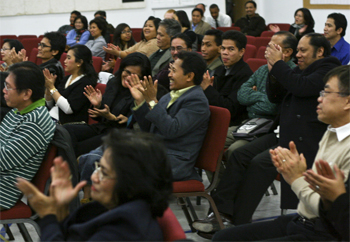
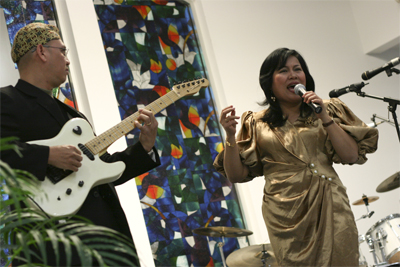 As I took photos, I noticed the variety of religions and cultures represented in the audience. Though I had never heard of Lydia Nursaid, she was obviously very famous, and it reminded me how God uses art and fame to draw people to Himself. Throughout the entire weekend, I experienced an incredible amount of generosity. I realized that while it’s easy for me to be hospitable towards people I’m close to, it’s hard to extend that to people I’ve just met. Being with people from other cultures challenges me to be patient and hospitable. When we try to connect with people we don’t know, we have to communicate and this can be an awkward process. “Body language” may be 80 percent communication, but sometimes the other 20 percent can make all the difference.
 After the event, I was escorted to the train station by Abraham Oetoyo, who owns a limousine company. As we were driving I learned that Abraham’s career started with a job at 7/11. I was inspired by how God blessed his faithfulness through connecting him with the right people and giving him solid ideas. When we arrived at the station I realized I had no cash with me and asked him if they accepted cards for the Metro train. He quickly pulled out his wallet and when I refused his offer of cash, he sharply responded, “We’ve got to help each other!” I accepted reluctantly, wondering how I could return his generosity.
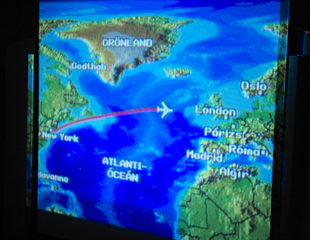 Today we finally arrived in Israel. We experienced God’s favor and traveling mercy. There were a lot of things that could have slowed us down but didn’t. The most challenging leg of our journey was the flight from JFK airport to Budapest. The air quality and cramptness proved tested the limits of my mental facualties. We were re leaved to rendezvous with our leader