• Skip to main content
  • Skip to primary sidebar
  • Skip to footer

Mosaic MennonitesMosaic Mennonites

Missional - Intercultural - Formational

  • Home
  • About Us
    • Our History
    • Vision & Mission
    • Staff
    • Boards and Committees
    • Church & Ministry Directory
    • Mennonite Links
  • Media
    • Articles
    • Newsletters
    • Video
    • Audio
    • Bulletin Announcements
  • Resources
    • Conference Documents
    • Missional
    • Intercultural
    • Formational
    • Stewardship
    • Church Safety
    • Leaders’ Resources
    • Request a Speaker
    • Pastoral Openings
    • Job Openings
  • Give
    • Leadership Development Matching Gift
  • Events
    • Pentecost
    • Delegate Assembly
    • Faith & Life
    • Youth Event
    • Women’s Gathering
    • Conference Calendar
  • Mosaic Institute
  • Vibrant Mosaic
  • Contact Us
  • English

Perkasie

Reflections on Hospitality Ministry in Calais, France

December 11, 2025 by Cindy Angela

Editor’s Note: Mennonite Mission Network has issued an urgent call for winter volunteers at the St. Maria Skobtsova House in Calais, France. Learn more about this hospitality ministry from Mosaic Partner in Ministry Peaceful Borders, and from a former volunteer who is part of a Mosaic congregation. 

Building Community in a Calais, France Suburb 

By Simon Jones 

Surrounded by a high wall and secure gate is a liminal place between hardship and home that offers the hope of respite and refuge. Up to fourteen women and children at any one time live there. 

The well-appointed house is filled with the carefree laughter of preschoolers, its kitchen alive with the smells of cooking, as women, starved of the opportunity to provide for themselves and their families, now cook and gossip and share food with everyone in the house. 

This is La Maison St. Maria Skobtsova (MSH), opened a decade ago to provide a place of safety and rest for displaced people from across North Africa and the Middle East. Over that time, it has been home to Eritrean men, volunteers working across the city, and now to women and their children. It has occupied two sites, moving to this present one in the summer of 2025. 

For the last three years, the house has been overseen by Mennonite Mission Network workers, Joseph and Rachel Givens, who moved to Calais with their two boys in 2022. They work with a group of volunteers overseen by a management committee, to ensure the smooth running of the house and to accompany the guests throughout their stay. 
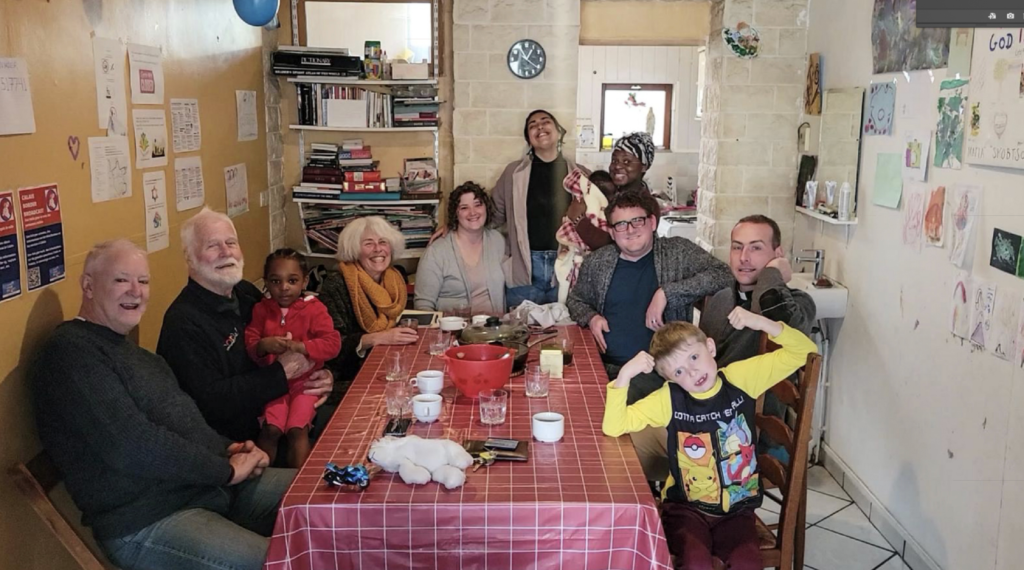
Gathered around the kitchen table. Photo by Joyce Hunsberger.

Volunteers come from across the world, though mainly Europe; they serve for a few weeks to three months or more. Some come only once, but others come for a term, return home and come back once they have refreshed their bodies and bank balances. Volunteers share the running of the house and the serving of the guests. The work is joyous and demanding–from cleaning bathrooms to accompanying guests to medical appointments, playing with children, shopping for supplies, and most importantly, joining the daily prayers of the house community. MSH exists to be a prayerful presence among the displaced in Calais. 

Life in the house is rich and complex. One of the volunteers, a retired French nun, says, everyone in the house is always on the point of leaving. Leaving is a constant that everyone lives with. She adds that “the community is a dynamic place, full of life, hope and energy, full of young people keen to make something of their lives.” These people make the community what it is. 

The house is full of difference—different countries and continents, different life experiences, different religious understandings and denominations. It works because Givens and the volunteers help these different people to get along, form community, and support one another. 

You can get more information about the house from me at simon@peacefulborders.org.

A Month of Hospitality in Calais 

by Joyce Hunsberger

The Mennonite Mission Network SOOP assignment in Calais, France, offers the chance to be a caring presence in the Maria Skobtsova House. Named for a Russian Orthodox saint who cared for refugees, migrants, the unhoused, and Jews in Paris during the second world war, the house is a refuge for women and children who have fled their home countries and hope to cross the English Channel to seek asylum in England. Smugglers charge high fees for dangerous crossings in overcrowded inflatable boats; drownings occur each month. One guest I met had already tried to cross six times. 

I spent a month living with 13 guests from Iraq, Iran, Eritrea, Libya, and Sudan. Volunteers came from across Europe, and together with guests we shared daily chores. Since my stay in 2024, the community has moved to a beautifully renovated building with more space, including a large new kitchen. The days follow a gentle rhythm of Taizé songs and prayers, plus occasional outings to the beach, a café, or the canal. Arabic was the most common language in the house, though I enjoyed speaking French in town and even used some German with an Eritrean family who had lived their for a time. Google Translate helped us bridge the rest. 
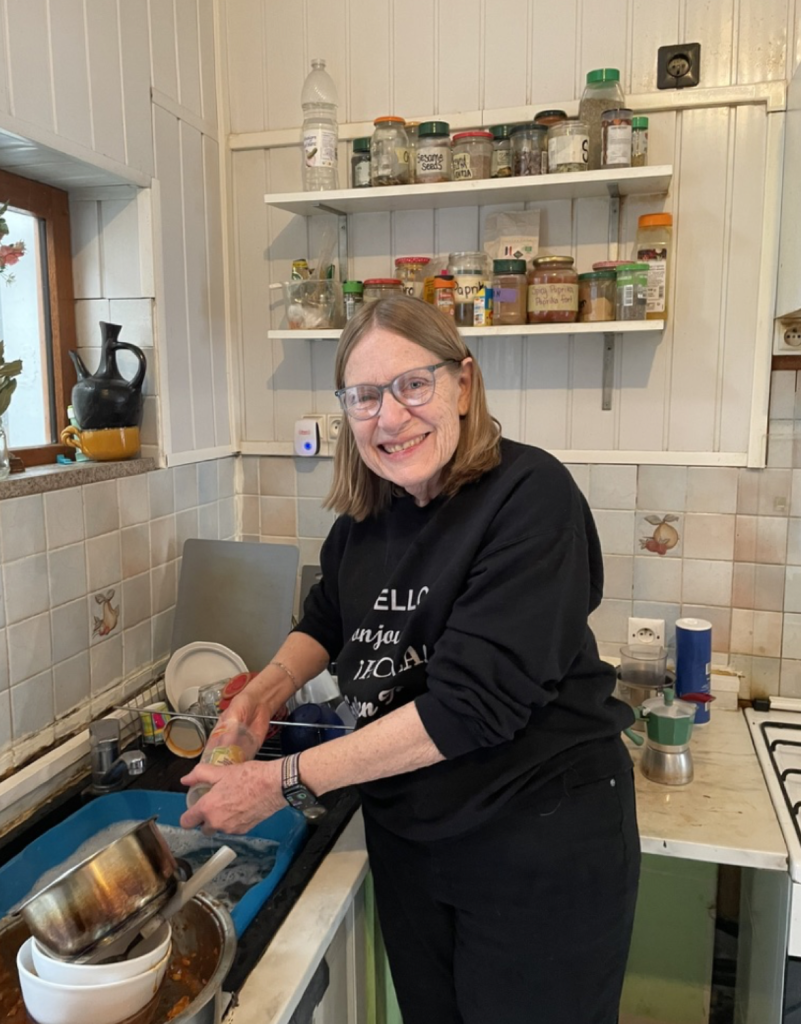
The author at work in the kitchen. Photo courtesy of Joyce Hunsberger.

The main “qualification” for being here is simply to treat residents as siblings, children of the same Father. It is not hard to do! Guests are grateful for a safe home. I offered English lessons, and they participated eagerly. Each evening the whole household shared dinner; Berbere (a favorite Eritrean spice) and fresh injera (a spongy sourdough bread) filled the kitchen daily. Donations of French bread were always on hand, along with Cheerios for breakfast. 

Other organizations support refugees in Calais, and the house collaborates closely with them. The men live in a camp outside town, which authorities dismantle every 48 hours, though the men return the next day. One day we chopped wood for them to use for cooking and warmth. 

Though the experience was challenging, volunteers were well supported. Whatever gifts you bring are enough. I came home changed, and from Pennsylvania I still whisper prayers for the house in Calais, a place filled with courage, welcome, and hope. 

Simon Jones

Simon Jones is a writer, activist, theologian, and Baptist minister. He co-founded Peaceful Borders in 2016 to support community formation in the Calais Jungle. He also co-founded the safe house in Calais in 2016. He is the author of 10 books on New Testament themes and ecclesiology.
Joyce Hunsberger

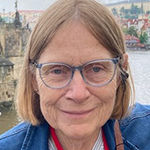
Raised in New England, Joyce Hunsberger moved to PA to teach French. Her two daughters were raised at Perkasie (PA) Mennonite, where she continues to be an active member. She has been happily living at Souderton Mennonite Homes for the past seven years.

Mosaic values two-way communication and encourages our constituents to respond with feedback, questions, or encouragement. To share your thoughts or send a message to the author(s), contact us at communication@mosaicmennonites.org.   
Filed Under: Articles Tagged With: Mennonite Mission Network, Peaceful Borders, Perkasie, Simon Jones

Joint Prayer Service for the People of Palestine and Israel

March 28, 2024 by Cindy Angela

by Eileen Kinch

A version of this article originally appeared in Anabaptist World and is reprinted with permission.  

On March 17, five Mosaic congregations, Ambler (PA), Methacton (Norristown, PA), Perkasie (PA), Salford (Harleysville, PA), and Plains (Hatfield, PA), held a joint service of prayer, singing, lament, and hope for the people of Palestine and Israel, as the humanitarian crisis in war-ravaged Gaza worsens. 

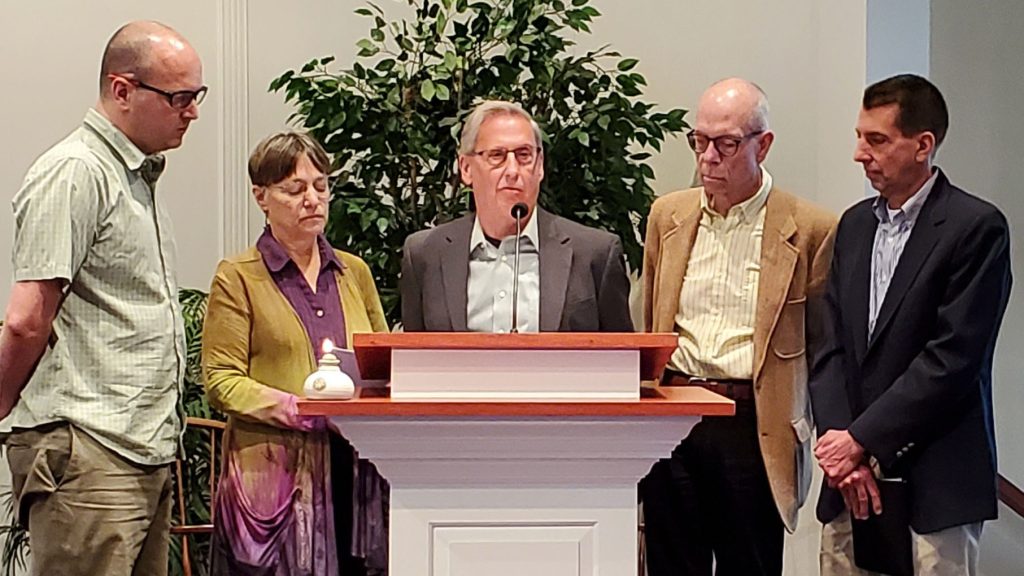
Pastors of the five congregations, Jacob Curtis (Ambler [PA]), Sandy Dresher-Lehman (Methacton [Norristown, PA]), Wayne Nitzsche (Perkasie [PA]), Dave Greiser (Salford [Harleysville, PA]) and Mike Derstine (Plains [Hatfield, PA]), offer the call to prayer. Photo by Joel Alderfer. 

Several Palestinian-American Christians and Muslims, and Israeli Jews from the Philadelphia area were invited to share their griefs and hopes for Palestine and Israel, including representatives from Philadelphia Palestinians of America, Prayers for Peace Alliance, Friends of Sabeel North America and If Not Now. 

Ambler’s co-pastor Jacob Curtis was the lead organizer. In his opening remarks, he reflected on how Jesus grew up under occupation, and blessed the poor, the grieving, the weak, those hungry and thirsty for justice, the peacemakers, and the persecuted. “When people are powerless, hungry, and thirsty, that is the side Jesus is on,” Curtis emphasized.  

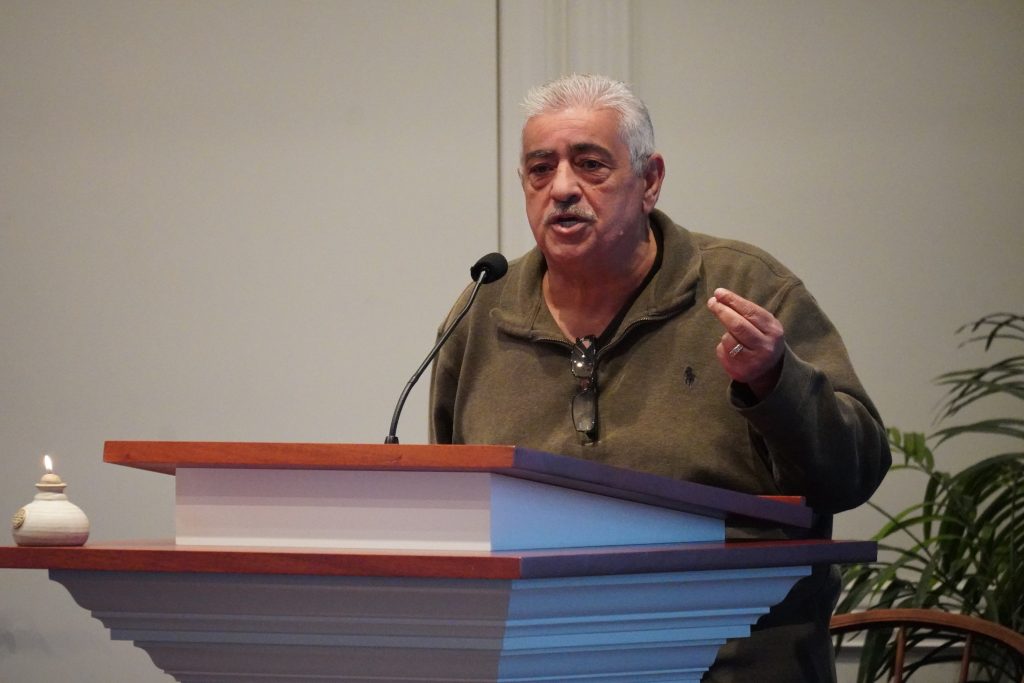
Samuel Kuttab, a Palestinian-American Christian and Mennonite shares his grief and hopes for Palestine. Photo by Jeremi Tumanan. 
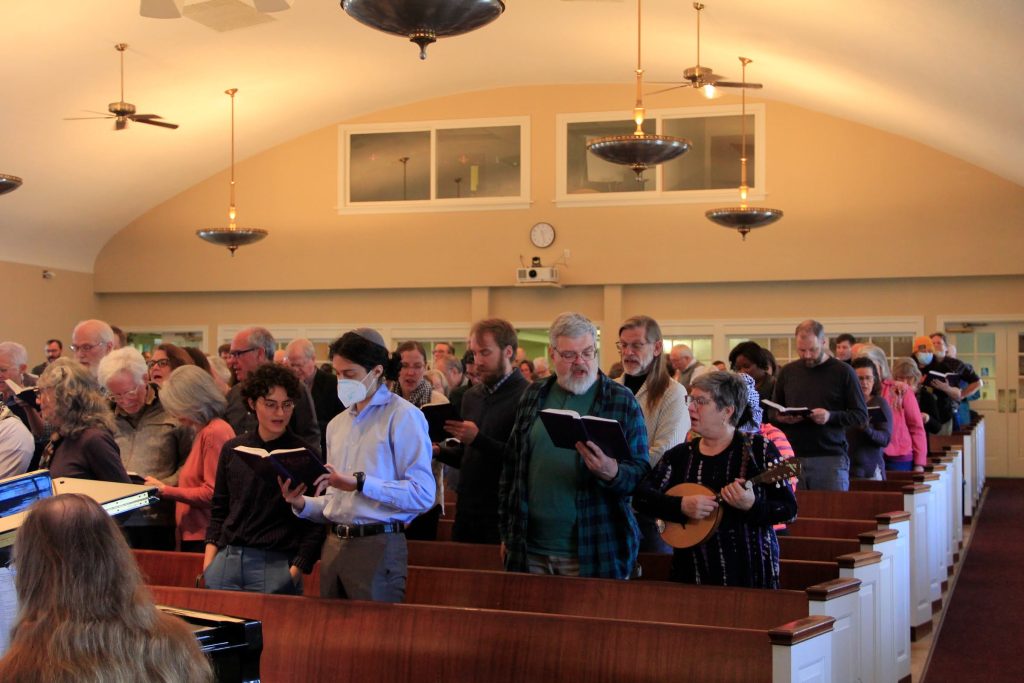
Singing together was a key feature of the worship service. Photo by Kiron Mateti. 

The idea for the service emerged from a conversation between Curtis and Samuel Kuttab, a Palestinian-American and former member of Ambler. Curtis asked if Ambler could hold a prayer service for Kuttab and his family. He envisioned a small gathering, but Kuttab said, “throw the doors open.” Nearly 250 people were present in the building, with 50 more attending via livestream. 

Curtis reflected on the suffering and trauma that Israelis have experienced since Hamas’s attack in Israel on October 7, and on how, in Israel’s response to that attack, “Palestinians are hungry, thirsty, sick, and unable to go home. Arabs around the world are increasingly afraid that they will also become targets.”  

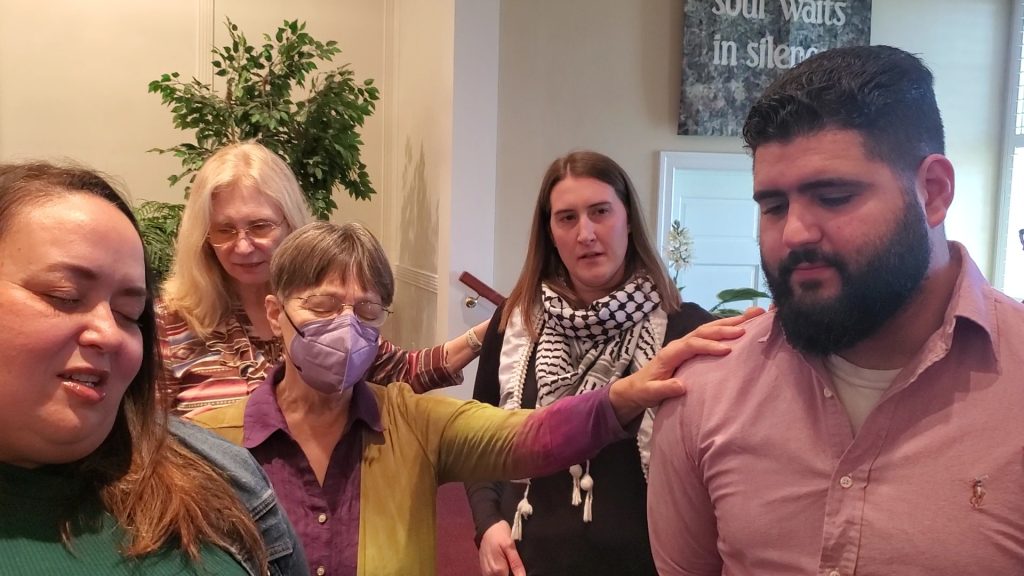
A small group lays hands on and prays for Amer Raja, a Palestinian-American, one of a number of guests who shared during the service. Photo by Joel Alderfer. 

“As Palestinians and Arabs grieve, Jesus is with them,” Curtis said, addressing those gathered. “And so are we…As Israelis and Jews grieve, Jesus is with them. And so are we.” 

Readings from Lamentations 5 were interspersed with reflections from Palestinian and Jewish friends. 

Ahlam Kuttab pointed out widespread American culpability in the war in Gaza, given that the U.S. is a leading arms supplier to Israel. Amer Raja shared that the current Muslim month of Ramadan is a joy-filled time of fasting and feasting, but in Gaza, people can’t have these festivities. He finds it hard to be joyful when not everyone can participate. 

Becca Feidelson, a representative from If Not Now, an American Jewish group that organizes for a just peace for Palestinians and Israelis, read the words of a fellow organizer, Ella Israeli. 

“How could we let our pain [from the Holocaust] become this?” Feidelson asked. She reflected on how Jews believe humans are made in the image of God, and each life is sacred. 

The second half of the service offered readings from Matthew 5 paired with reflections about hope. Dina Portnoy, a teacher in Philadelphia who grew up on an Israeli kibbutz that was built on a Palestinian village, said she finds hope in confronting difficult truths. She said some Israeli soldiers are refusing to serve in Gaza, and Israeli activists have lost jobs and are going to jail. 

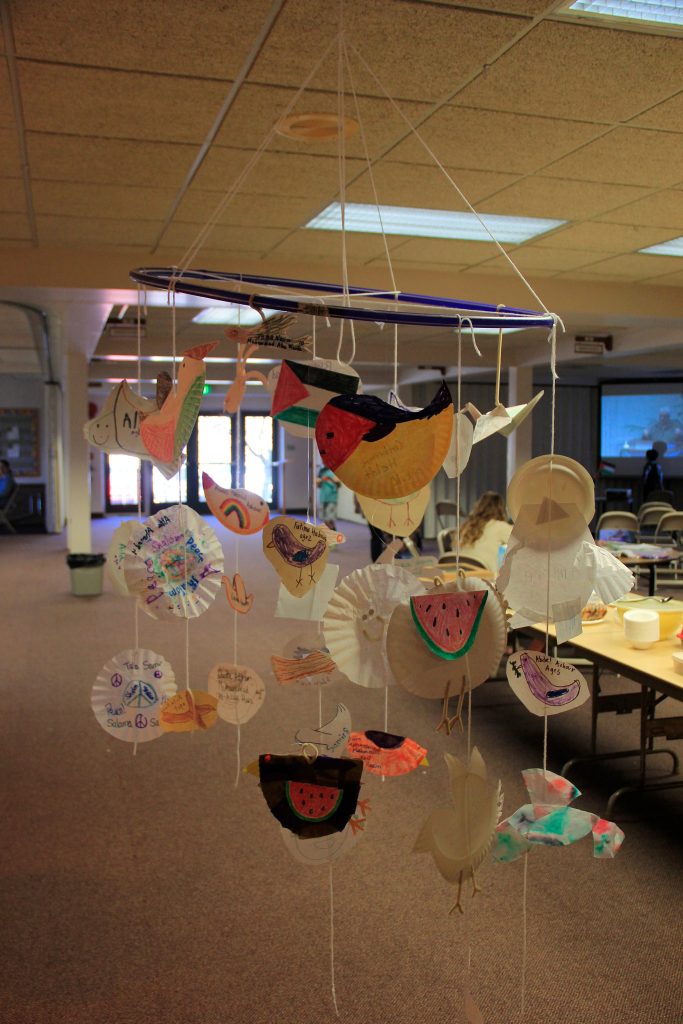
Around 40 people, mostly children and their grownups, watched the service’s livestream from the basement, while making Birds for Gaza and praying for children in Gaza. Photo by Kiron Mateti. 


Samuel Kuttab admitted that being a Mennonite and a Palestinian can be tough. Mennonites emphasize love, and Palestinians are suffering. 

“My faith goes into conflict,” he said. But he believes the Mennonite church has “woken up.” He is encouraged by the work of Mennonite Action, a new peace-advocacy group, and feels Mennonites have legitimacy in political action because “we are a peace church.” 

After the reflections, participants gathered to lay hands on the speakers and pray for them. An offering raised $5,500 for Mennonite Action. 

Following the service, participants shared refreshments and were invited to participate in Mennonite Action’s Holy Week Action to send postcards to local government representatives, urging them to support peace and diplomacy. 


Eileen Kinch

Eileen Kinch is a writer and editor for the Mosaic communication team. She holds a Master of Divinity degree, with an emphasis in the Ministry of Writing, from Earlham School of Religion. She and her husband, Joel Nofziger, who serves as director of the Mennonite Heritage Center in Harleysville, live near Tylersport, PA. They attend Methacton Mennonite Church. Eileen is also a member of Keystone Fellowship Friends Meeting in Lancaster County.

Filed Under: Articles Tagged With: Ambler, Methacton, Perkasie, Plains, Salford

Congregational Profile: Perkasie Mennonite Church

September 3, 2019 by Conference Office

by Mary Lou Cummings 

“Welcome is one of the signs that a community is alive.  To invite others to live with us is a sign that we aren’t afraid, that we have a treasure of truth, and of peace to share,” says Jean Vanier.

Perkasie Mennonite Church is a tiny but lively congregation that values welcome, whether of LGBTQ folks or others who have felt “outside the box” for many reasons.  We aim to model Jesus (our succinct mission statement)  in our daily lives in loving relationships and in service.  Many, but not all, experience their faith journey through a progressive Christian lens.   No matter where a person is in their faith journey, they are welcome. 

The communion table at Perkasie

PMC has had a long history of inclusion of those with intellectual disabilities, and several of these individuals have provided joy, humor, and spontaneity in our congregation for many years. Barbara Shisler has hosted a monthly Faith and Light chapter for many years, as well; this is a national program which offers fellowship in a spiritual context for community members with intellectual disabilities and their families.

In the past year, Brent Anders and Joe Matthew were invited to present two Second Hour seminars with resources, stories and language  tips to help us all be more understanding and helpful in our relationships with LGBTQ attendees, friends, and neighbors.  We are officially a Welcoming Congregation, and a number of our most recent new attendees sought us out for this open and welcoming  environment.

PMC has trained many young people through the years, and finds joy in seeing these now-grown-up children living lives of faith and service in places around the country and the world.  Today we have fewer children (although the ones we have get lots of love!), so we  are exploring how to offer our wisdom and resources to young people’s programs  run by others.  Bucks Kids First is a program for at-risk kids (many in foster homes) which will be using our building for after-school mentoring four days a week.   We also volunteer with other community programs like Bridge of Hope Bux-Mont, a homeless ministry for single mothers.

Perkasie hosts a Civil Conversation on guns

Hosting  Patchwork Coffeehouse and Soul Talk (a progressive Christian study group) are other ways we reach out to the community.  Favorite volunteer opportunities include FISH, MCC Material Resource Center, MCC, Care and Share, and ministries to the homeless. In recent years we have also hosted “Listen, Live, Local” events, including one evening inviting community conversation on gun control,  and another on bridging the gap between right and left in the  U.S.

The PMC community enjoys singing a capella music from the three Mennonite hymn books, and is looking forward to dipping into the  new one next year.  We value creativity in each other,  which allows for both rich experience and change.  One advantage of being small is the freedom to vary worship spaces and styles.  During the summer, we meet more informally in our fellowship room, often around tables, and various members lead  worship.  “Every member a minister” is a favorite motto, which we take seriously.

Historically, our group was founded by Blooming Glen Mennonite Church  as a mission outreach for young people in Perkasie.  Over the years, gifted pastors offered leadership,  such as Richard Detweiler, James Lapp, Jim Burkholder,  Barbara Shisler, Beth Yoder, Wayne Nietszche, and  Jessica Hedrick Miller, among others.

We appreciate your prayers as we seek to strengthen our relationships with people around us and model the love of Jesus that welcomes all people into God’s beloved community. Pray that we would be in tune to the movement of the Spirit in our community so that we can join in the good work that God is already doing.

Filed Under: Congregational Profiles Tagged With: Perkasie, Perkasie Mennonite Church

Pastors receive coaching in life and wellness

June 12, 2014 by Emily Ralph Servant

Trina Stutzman
Stutzman

by Lora Steiner, Franconia managing editor

When people think of health coaches, they usually think of Biggest Loser, the television show where participants vie each week to see who can lose the most weight—or someone with a whistle, like that annoying high school gym teacher who made your whole class run timed miles. Trina Stutzman isn’t one of those coaches. Stutzman, of Perkasie, Pa., is a wellness coach with Everence, through an initiative that offers combined support, education, and accountability to help people have more balance in their lives and increase their wellbeing.

Wellness coaching starts with a phone call to Everence, which matches interested participants with wellness coaches. The initial conversation focuses on what the participant hopes to gain from coaching—What’s most important to you? Where do you want to go?—then from there, it’s about establishing small goals and setting up first steps to success. Some people want to check in every week, others every month, but no matter how often, it’s always about working towards the participants’ goals. All coaching is done over the phone, and wellness coaches offer safe, supportive, nonjudgmental, and confidential space for conversation.

Wayne Nitzsche, pastor of Perkasie congregation, decided to take advantage of wellness coaching about two years ago, and stayed with it for a full year. When he first saw it was being offered, Nitzsche didn’t really think it was something he needed, but decided to try it anyway. What he found was a holistic approach to his wellbeing: concern for body and soul, mind and emotions.

For Nitzsche, the process ultimately led to him establishing habits for more balance, practices he still sticks to.

“I’ve come to believe pretty strongly that as we pay attention to our own functioning—be that spiritual or physical or emotional—that we find a deeper, richer life… but the temptation is to always look outside, look to someone else, to make our lives better, instead of looking within,” says Nitzsche.

Nitzsche says the hardest part was setting realistic goals, ones that were both stretching and yet attainable. His coach was good at reminding Nitzsche of his goals and being gracious when he didn’t meet them, celebrating when they were met, and looking deeper when they weren’t.

“To have that encouragement and accountability,” says Nitzsche, “Knowing that you’re going to talk to someone about what you’re doing or not doing—can be pretty helpful.”

Rollin Handrich, who works with Everence in their Goshen, Ind. office, says that sometimes the changes they’ve heard about have been dramatic, other times, incremental. But as he points out, people have often spent a lifetime developing habits that lead to their healthcare problems. The goal of the program, Handrich says, is to get people to rethink some of those habits and set comfortable goals, all the while considering the full picture of their lives: What are your stresses? What is your home life like? “It’s not just eat better, and exercise.”

Stutzman agrees.  “[Wellness coaching] is more than just physical health, but really looking at, ‘Do you want to be well?’ And that looks different for every person.”

She says some people set goals like losing weight, but for others, it’s setting healthy boundaries or stress relief. In a way, Stutzman sees her work as helping people bring into balance the commandment to love your neighbor as yourself.  “What does that look like to love yourself as you love other people?”

So far nearly 400 people—about 10 percent of eligible pastors and employees of Mennonite organizations—have participated in at least an initial phone call. It’s a part of the insurance plan offered to pastors and employees of Mennonite organizations whose plans are managed by Everence. Costs are covered by employers, and there is no charge to those who opt in to the program. Pastors and spouses covered by the Corinthian Plan can receive up to $600 for each filling out the online assessment and a follow-up coaching call to discuss their results. More information on wellness coaching is available at www.everence.com/wellness-coaching or by calling 800-348-7468, ext. 2462.

Filed Under: Articles, News Tagged With: Conference News, Everence, formational, Lora Steiner, Perkasie, Wayne Nitzsche, wellness

Remembering Becky Felton

January 8, 2013 by Emily Ralph Servant

from the Peace & Justice Committee of Eastern District and Franconia Conferences

Becky FeltonThe 2012 Peace Mug Award for Franconia and Eastern District Conferences, announced at the  joint fall Conference Assembly, honors Becky Felton, who passed away peacefully on November 2, 2012 after a courageous struggle with cancer.

Becky was a persistent advocate for peace and justice in her congregation, Perkasie Mennonite Church, in her community, and with the Peace & Justice Committee. Wayne Nitzsche, her pastor, described Becky as a congregational peacemaker in many ways.  “Perkasie has a worship ritual of lighting a peace lamp as we recite our pledge to be peacemakers. Becky urged us to consider and pray for peace locally and globally. She invited the congregation to participate in peace retreats and walks and brought needs for peace to our attention,” he reflected.  “But most importantly, Becky modeled the way of Jesus in her relationships in the congregation and beyond.”

Becky organized an intergenerational “Faith in Action” Sunday school class to keep peace and justice issues in front of the congregation.  The bi-monthly class has taken.on issues like The DREAM Act, hunger and homelessness, and the Israeli-Palestinian conflict. Becky suggested topics for the class and sometimes recommended or invited guest speakers. Faith in Action is not only about education, but also invites everyone to act.  “She made us write letters and make phone calls –  to help us speak our own little peace” to situations of oppression and conflict, one friend remembered.

Becky also faced her terminal illness with peace, knowing that she was at peace with God and with others.

Jason Hedrick,  Peace and Justice Committee chairperson, described Becky as “a pillar of the committee and a mentor. She created space for me to learn and grow from the time I first started to serve on the committee and even more so when I took over the role as chair. Her life modeled what it meant to work for peace; to consider those who were marginalized, both within our own community and outside; to take the time to listen to those who had differing view points; and to challenge others to grow, to take action. Mostly, though, she was a friend. What better way is there to work towards peace in the world than to be a friend to someone?”

Those who knew her well describe Becky as a champion of peace and justice,  at peace with God  and  at  peace  with others.   Becky served the Peace & Justice Committee as secretary, as financial secretary, and, for the past ten years, as registrar for our annual Winter Peace Retreat.   But because of her broad understanding of current peace and social justice issues and her character, these roles don’t adequately describe her presence and her leadership, both in her congregation and with us on the Peace & Justice Committee. She was aware, compassionate, proactive.

peace mug presentation
Jason Hedrick & Samantha Lioi from the Peace & Justice Committee present the peace mug to Becky’s husband Jon and children Cody & Torey. Photo by Kreg D. Ulery.

“We appreciated her sense of humor,” noted Samanthi Lioi, the conferences’ minister of peace and justice, “because it’s really easy, especially for peace people, to take ourselves too seriously. Just by who she was, Becky steered us clear of that. And her pragmatic questions and focus on specific action was indispensable as a balance for the idealism and big ideas of some others of us. It was a fruitful balance – vision shaped by attention to planning and details. Thinking of Becky’s efficiency, and her way of getting huge amounts of work done–while being friendly about it!, I’m humbled…and reminded how deeply we need each other as we go about joining God’s birthing of shalom in the world. While we feel deep gratitude as a committee for Becky’s way of nurturing peace among us, I’m not sure we know how much we’re going miss her.”

Peace Mugs, provided by the Peace and Justice Support Network  of Mennonite Church USA, are awarded by our Peace & Justice Committee to honor  those among us who demonstrate a life-long commitment to peace and justice.  Find out more about the Peace & Justice Committee on their website.

Filed Under: News Tagged With: Becky Felton, Conference News, Jason Hedrick, missional, Peace & Justice Committee, Perkasie, Samantha Lioi, Wayne Nitzsche

Broken bread for a broken system

October 4, 2012 by Emily Ralph Servant

by Emily Ralph, eralphservant@mosaicmennonites.org

communion handsIt’s a misty evening as I sit cuddled under a blanket with my laptop and a snoring dog, watching the presidential debate.  Even as I type, President Obama and Governor Romney are debating the economy.

I feel my temperature rising, and it has nothing to do with the blanket.  I grew up in a family in which “debate” sounds more like calm discussion and a stern voice feels like yelling.  Just watching the debate is feeding my anxiety.

And, if anyone else experiences conflict like I do, the election this coming November could be incredibly divisive for the church.  And how much moreso, when you mix people like me with those who are very comfortable with debate, raised voices, and hearty conversation?  How do we keep our eyes focused on our shared allegiance—to Jesus Christ—in the midst of such diversity and disagreement?

Leaders in Mennonite churches across the nation suggest a simple answer: Election Day Communion.  “Election Day Communion is a way of engaging and resisting the world,” reflected Joe Hackman, pastor at Salford (Harleysville, Pa.) congregation, who will be hosting Election Day Communion this November.  “It’s a small demonstration of being the peace of Christ in a noisy, partisan culture—a sort of countercultural statement about what we believe ultimately holds our politics together.”

“During the day of November 6, 2012, we will make different choices for different reasons, hoping for different results,” the Election Day Communion website says. “But that evening while our nation turns its attention to the outcome of the presidential election, let’s again choose differently. But this time, let’s do it together.”

Tuesday night communion is not a new idea—Catholic, Orthodox, Anglican, and Lutheran churches have held Tuesday communion services for generations.  And Election Day Communion doesn’t just belong to Mennonites.  Doylestown (Pa.) congregation will be hosting an ecumenical service, according to associate pastor KrisAnne Swartley.  “We are inviting other area churches outside the Mennonite denomination to partner with us in planning the service,” she said.  “We want to cross all kinds of cultural dividing lines in this communion service—we know that God’s Kingdom of love also crosses all boundaries.”

Wayne Nitzsche and the elder team at Perkasie (Pa.) congregation plan to keep the service simple.  “Our church mission statement is ‘to model Jesus,’” Nitzsche said.  “As we come together the evening of November 6, we’ll model Jesus in some small way as we remember that Jesus non-violently addressed the political powers and established a new [politic] of love. We love as he loved as we eat and drink with those who voted and those who didn’t.  ALL will be welcomed at the table.”

As I type, I feel my heartbeat slowing.  Governor Romney and President Obama are still battling it out in the background, but the rhetoric no longer feeds my anxiety.  There is hope.  “God continues to demonstrate that another world is possible,” said Chris Nickels, pastor of Spring Mount (Pa.) congregation. “There is a path that leads out of a divisive cultural reality and Christ invites us to come to the table to take a step forward together.”

Election Day Communion

Filed Under: News Tagged With: communion, Conference News, Doylestown, Emily Ralph, intercultural, Peace, Perkasie, politics, Salford, Spring Mount

Two are better than one

January 29, 2012 by Emily Ralph Servant

by Mary Lou Cummings, Perkasie, cominghome@verizon.net

Hawk Mountain
Plains and Perkasie junior youth enjoy a hike on Hawk Mountain. Photo by Rob Kerns.

Let’s face it, teenagers like to hang out in groups—and the more kids in the group, the better.

So what is a church to do when its life rhythms produce periods with small teenage populations? Perkasie and Plains congregations are creatively working together to provide lots of new experiences for their junior youth by pooling their programs.

Two years ago Plains had a handful of junior high girls and only a few boys. Perkasie had four boys. One of the boys from Perkasie, however, attended Plains activities and several knew each other at school. Eventually Dale Gahman of Perkasie, mentor for the boys, and Pastor Dawn Ranck, who oversees “the younger half” of the Plains congregation, got together to brainstorm how to work together.

The groups clicked right away. Now the two groups meet together for fun experiences most months, and they bring their friends—with about 15 or more showing up. They have gone hiking to Hawk Mountain and have picked and donated to Manna on Main Street and FISH organizations. They have attended an Iron Pigs baseball game, bowled, and gone on a scavenger hunt looking for disguised adult friends. There are plans for a service day at Ten Thousand Villages in Lancaster followed by a camp-out. All agree that it is a lot more fun to do these things with more people.

The two groups still reserve some months for their own separate activities. Each congregation provides adults who share in the leadership. Ranck initiates a twice-a-year meeting in her home for the leaders to sketch out the year’s activities and then creates flyers of each event for the kids and parents.

“I wanted to provide experiences for these young people that would be lots of fun, but would also stretch them–help them meet new people, and do things they wouldn’t ordinarily do,” says Gahman. “We try to include service projects in the planning. It’s great to see the kids having fun and liking the group.”

“One of the great things,” says Ranck, “is that by alternating the planning, sometimes leaders are able to just ‘show up’ and enjoy the kids. It’s working well and I think it is a good model for others to try.”

Filed Under: News Tagged With: Conference News, Dawn Ranck, formational, intercultural, Mary Lou Cummings, Perkasie, Plains

Primary Sidebar

  • Home
  • About Us
    • Our History
    • Vision & Mission
    • Staff
    • Boards and Committees
    • Church & Ministry Directory
    • Mennonite Links
  • Media
    • Articles
    • Newsletters
    • Video
    • Audio
    • Bulletin Announcements
  • Resources
    • Conference Documents
    • Missional
    • Intercultural
    • Formational
    • Stewardship
    • Church Safety
    • Leaders’ Resources
    • Request a Speaker
    • Pastoral Openings
    • Job Openings
  • Give
    • Leadership Development Matching Gift
  • Events
    • Pentecost
    • Delegate Assembly
    • Faith & Life
    • Youth Event
    • Women’s Gathering
    • Conference Calendar
  • Mosaic Institute
  • Vibrant Mosaic
  • Contact Us

Footer

  • Home
  • Contact Us
  • Delegate Assembly
  • Vision & Mission
  • Our History
  • Formational
  • Intercultural
  • Missional
  • Mosaic Institute
  • Give
  • Stewardship
  • Church Safety
  • Leaders’ Resources
  • Articles
  • Bulletin Announcements

Copyright © 2025 Mosaic Mennonite Conference | Privacy Policy | Terms of Use
Aligned with