
by Rodger Schmell
Editor’s Note: We are deeply grateful to the Mosaic Mennonite Conference board members who concluded their terms at the end of 2025. This article is part of a short reflection series from these leaders on their service with the Mosaic board.
When the Franconia and Eastern District (EDC) conferences began the process of coming together, some EDC board members were invited to serve on the new Mosaic Board. That’s how I found myself as an at-large member six years ago when Mosaic was in the process of being formed.
Looking back, I’m most proud of helping the two conferences unite. The merger wasn’t initiated from the top down; it was more like two people traveling side by side and realizing they’d fallen in love along the way. After years of working and worshiping near each other, it felt natural, and deeply satisfying, to come together under one umbrella.
For me, it was also personal. I pastor Deep Run West Mennonite (Perkasie, PA) and Deep Run East is just across the road. Years ago, there was a sense of them as the “old Mennonites” and us the “new Mennonites.” To see those divisions dissolve and to stand together again felt like brothers reuniting after years apart.
One of the most rewarding parts of serving on the board has been building relationships across the conference. I already knew several people from the Franconia side, but after the merger we became like family. The challenge came later, especially after Mennonite Church USA’s 2022 resolution that encouraged Mosaic to reexamine our denominational affiliation. It’s been a season of tension for those who wanted to stay, those who wanted to leave, and for the various reasons that have been part of congregations’ stances on affiliation.
At first, I thought the affiliation questions was mainly about human sexuality, but over time that has faded into the background as other issues took center stage. My biggest concern is that we have talked around our theological differences related to human sexuality, but not through them. I believe that will be Mosaic’s next challenge, to face those conversations honestly together.
My decision to step down after two terms comes partly from personal reasons. Life is full; my father passed away, my mother needs more care, and I’m serving as executor for their estate.
But it’s also time for new voices at the table. Mosaic is intentional about board representation reflecting the demographics of our congregations. We need all perspectives represented in leadership.
During my time on the board, we’ve welcomed many new congregations, from Florida, including Homestead Mennonite where I once attended, to California, and beyond. A number of BIPOC congregations have joined. Their energy and perspectives have added flavor to the Mosaic “stew.” Some larger congregations have left, and some smaller ones have joined—but to see that Mosaic is now about 50% BIPOC is remarkable. And to see that diversity reflected on the Board itself has been meaningful.
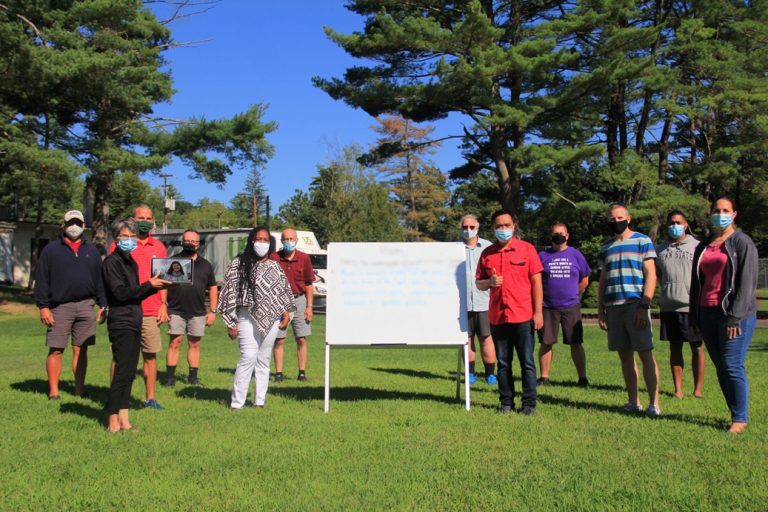
One of my favorite memories was our 2020 board retreat in the Poconos, where we gathered outdoors (because it was during the COVID-19 pandemic) to craft Mosaic’s mission and vision statements. We brainstormed and listened well to each other. These statements were not something any one person could’ve come up with on their own. Each person brought their identities, backgrounds, and perspectives to the table. When we reached unanimous agreement, it felt sacred and reminded me of the creation story: “God saw all that was made, and it was good.”
Through all the ups and downs, God has always been faithful. God shows up in different ways for different people, but always consistent with God’s character, creativity, and care for the flock.
If my view of leadership has changed, it’s in realizing that Anabaptists sometimes lean too far toward being “nice.” Good leadership needs balance, with neither authoritarian nor hands-off approaches. We often may err too much on the side of grace; we should also be ready to speak truth in love. People deserve clarity as well as compassion.
As I leave the board, my prayer for Mosaic is simple: that Mosaic can have unity amid our diversity. My encouragement to all within Mosaic is this: trust the process and the people God has called to lead. Keep asking your questions, keep engaging, and keep trusting that God is still at work among us. Many people see only a small piece of the work being done; there’s so much that happens behind the scenes through prayer, fasting, and faithful conversation.
Rodger Schmell
Rodger Schmell is the pastor of Deep Run West Mennonite (Perkasie, PA).
Mosaic values two-way communication and encourages our constituents to respond with feedback, questions, or encouragement. To share your thoughts or send a message to the author(s), contact us at communication@mosaicmennonites.org.


 The Assembly was centered on Psalm 133:1,3b, “How good and pleasant it is when God’s people live together in unity! For there the Lord bestows his blessing, even life forevermore.” The theme was Life Together, as the focus of the Assembly was that while these two conference may have split 170 years ago, they continue to do life together. A large part of the Assembly business this year was to look at whether these conferences would take the next step in their relationship, to look even more intentionally at reconciliation and what it would look like if they were to merge into one conference.
 The weekend began with Friday night worship led by Tami Good of Swamp Mennonite Church, which included a worship team of folks whose first languages were Indonesian, Spanish and English and who came from congregations in South Philadelphia, New Jersey, and Upper Bucks and Montgomery Counties. The opening prayer was given in Indonesian, Spanish, English and even Pennsylvania Dutch. Videos were shown that highlighted Souderton Mennonite Church’s
  The congregations in the Los Angeles area consist of Jemaat Kristen Indonesia Anugerah (JKIA) pastored by Virgo Handoyo, Indonesian Community Christian Fellowship pastored by Makmur Halim, and International Worship Church pastored by Buddy Hannarto. All three have had relationships with Franconia Conference for over a decade. The four congregations’ members are largely from Indonesia and joined with Franconia Conference pastors Aldo Siahaan of Philadelphia Praise Center and Beny Krisbianto of Nations Worship Center to share in a song. To learn more about these congregations check out their
  The joint Franconia and Eastern District Conference Saturday worship was a time of song,
  The core recommendation from the team is that Eastern District and Franconia Conference “enter a formal engagement process for the purposes of healing and reconciliation and with the intention of becoming a single, unified conference by November 2019.” In order to do this, the team recommended the forming of two teams: one to work intentionally at addressing the “spiritual and emotional components of reconciliation,” known as the “Healing and Reconciliation Team”, and the other being the “Identity Development and Structural Implementation Team,” tasked with managing “the process of forming a single unified conference, with particular attention to the structure, staffing, financial, and cultural realities of creating a single conference from the two existing conferences.”
 After a short break, the conferences gathered in separate rooms where their delegates recorded on flip chart paper their largest affirmations and concerns regarding moving forward with the recommendations. Present were David Brubaker and Roxy Allen Kioko, consultants from Eastern Mennonite University who had been hired in 2016 and were working with the Exploring Reconciliation Reference Team. Following this and some open microphone time for questions and answers, the delegates voted. With a 90% affirmation from Franconia Conference and a 99% affirmation from Eastern District Conference, both agreed to move forward with working at reconciliation and exploring more formally what a merged conference will look like.