• Skip to main content
  • Skip to primary sidebar
  • Skip to footer

Mosaic MennonitesMosaic Mennonites

Missional - Intercultural - Formational

  • Home
  • About Us
    • Our History
    • Vision & Mission
    • Staff
    • Boards and Committees
    • Church & Ministry Directory
    • Mennonite Links
  • Media
    • Articles
    • Newsletters
    • Video
    • Audio
    • Bulletin Announcements
  • Resources
    • Conference Documents
    • Missional
    • Intercultural
    • Formational
    • Stewardship
    • Church Safety
    • Leaders’ Resources
    • Request a Speaker
    • Pastoral Openings
    • Job Openings
  • Give
  • Events
    • Delegate Assembly
    • Youth Event
    • Conference Calendar
  • Mosaic Institute
  • Vibrant Mosaic
  • Contact Us
  • English

Mosaic Institute

Exploring the Many Stories of Mosaic Conference

July 30, 2026 by Cindy Angela

by Eszter Bjorkman

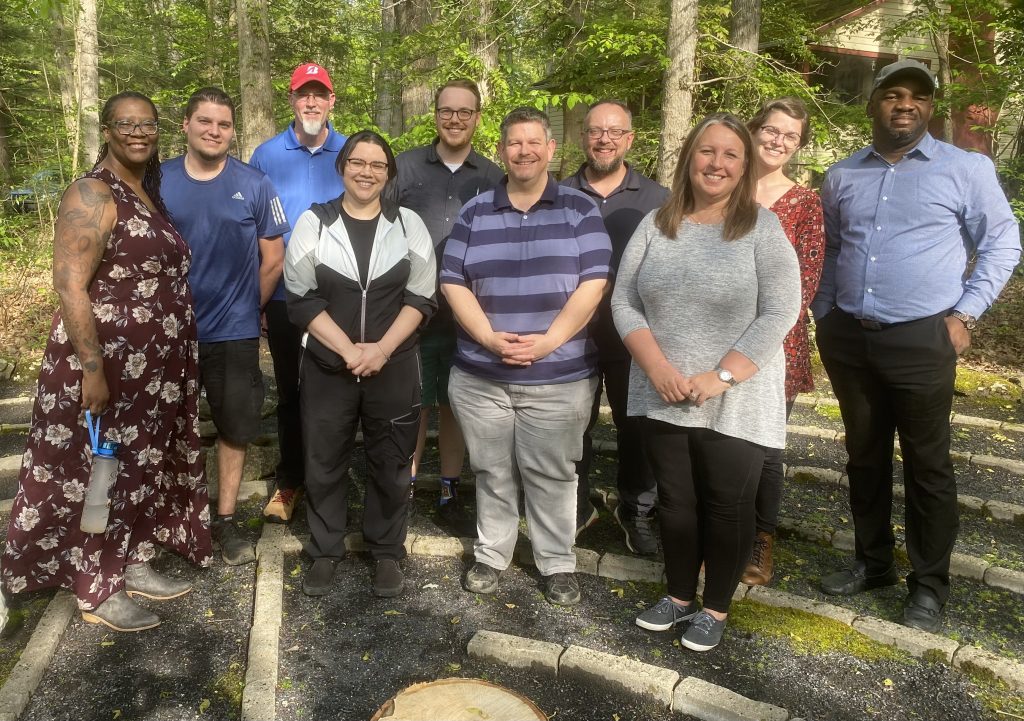
As part of Mosaic’s ordination process, pastors and ministry leaders must take four courses through the Mosaic Institute. My first course, titled “Introduction to Mosaic Conference,” was taught by Executive Minister Stephen Kriss and Leadership Minister for Formation Rose Bender Cook. This class focused on the origins of Anabaptism, the evolution of the Mosaic Conference, and what it looks like today.

The course included several assignments and experiences, ranging from Zoom lectures and readings to field trips and projects. One of the main elements was hearing each other’s “path towards Anabaptism,” encapsulated in our life stories. Many of these stories were heartbreaking, some even funny, but all unique. Even with just eight people in our group, we represented many different cultures and ethnicities. There is one thing that brought us all together: the way that Jesus has moved in each of our lives.

Most of these stories were told throughout the intensive portion of our class, in which we spent four days together in the Souderton and Philadelphia area for hands-on learning and relationship building. We began by meeting at Zion Mennonite (Souderton, PA), for dinner. Here we began learning about Anabaptism through Zion’s history in that community.
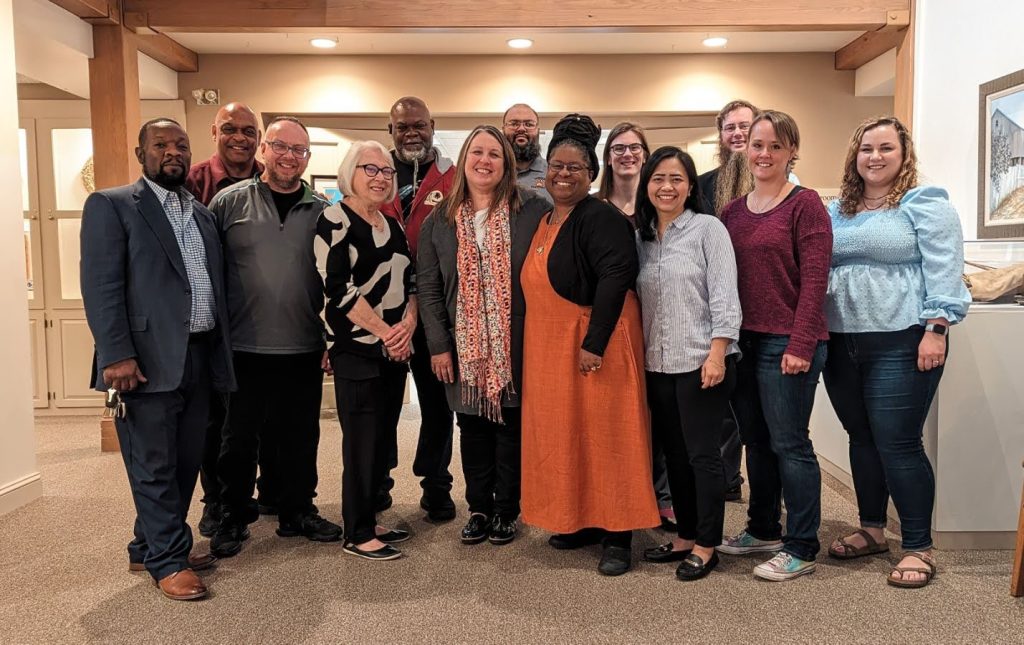
At the Mennonite Heritage Center in Harleysville, PA.

Our first full day began at the Conference-Related Ministry Mennonite Heritage Center (Harleysville, PA), led by Joel Alderfer and Regina Wenger. This is a phenomenal museum that outlines the complicated history of the Anabaptist movement and Mennonite people with preserved artifacts, alongside a glimpse of where Mennonites are today.

After a quick lunch at a Vietnamese restaurant, we went to the Conference-Related Ministry Penn Foundation (Sellersville, PA) and met with Chaplain Sue Howes. There, we learned about how this institution was founded: many drafted Mennonites worked in sanitariums, the mental hospitals of that time, in lieu of active military duty. When they saw the deplorable conditions of these “hospitals,” they bravely exposed the truth. The outcry in response allowed the establishment of the Penn Foundation, which was one of the first institutions to treat mentally ill people with dignity. The following day began at the Conference-Related Ministry Germantown Mennonite Historic Trust in Philadelphia where we stood at the site of the first permanent Mennonite meetinghouse in America. This community fought for justice and loving its neighbor, even as people seeking refuge in a foreign land. They created the first formal written petition against slavery, and though the petition never gained enough traction to have any effect, I was encouraged to learn that Mennonites have been standing up for justice since the beginning.
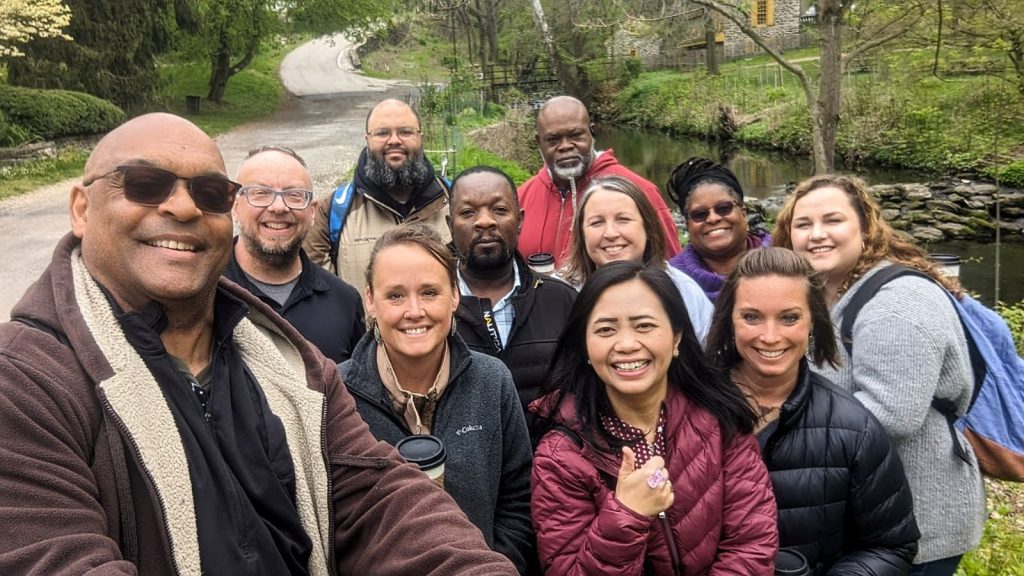
At Rittenhouse Town in Philadelphia.

We then journeyed to Rittenhouse Town, a small Mennonite village created around one of the first independent paper mills in the area. This paper mill allowed them to print their own Bibles without being taxed by Britain for the paper. The paper mill, and the community that formed around it, helped that area prosper and slowly become what the Philadelphia area is today, all owed to the Rittenhouse Mennonites.

Next, went to South Philadelphia to one of Mosaic’s Indonesian churches, the Philadelphia Praise Center (PPC), pastored by Aldo Siahaan. There we were blessed by a delicious homemade Indonesian lunch while we heard from a couple of Everence representatives about the financial resources available to Mosaic pastors. Following, Pastor Aldo told us about PPC’s incredible history. Learning about PPC provided a glimpse of the type of conference Mosaic strives to be.
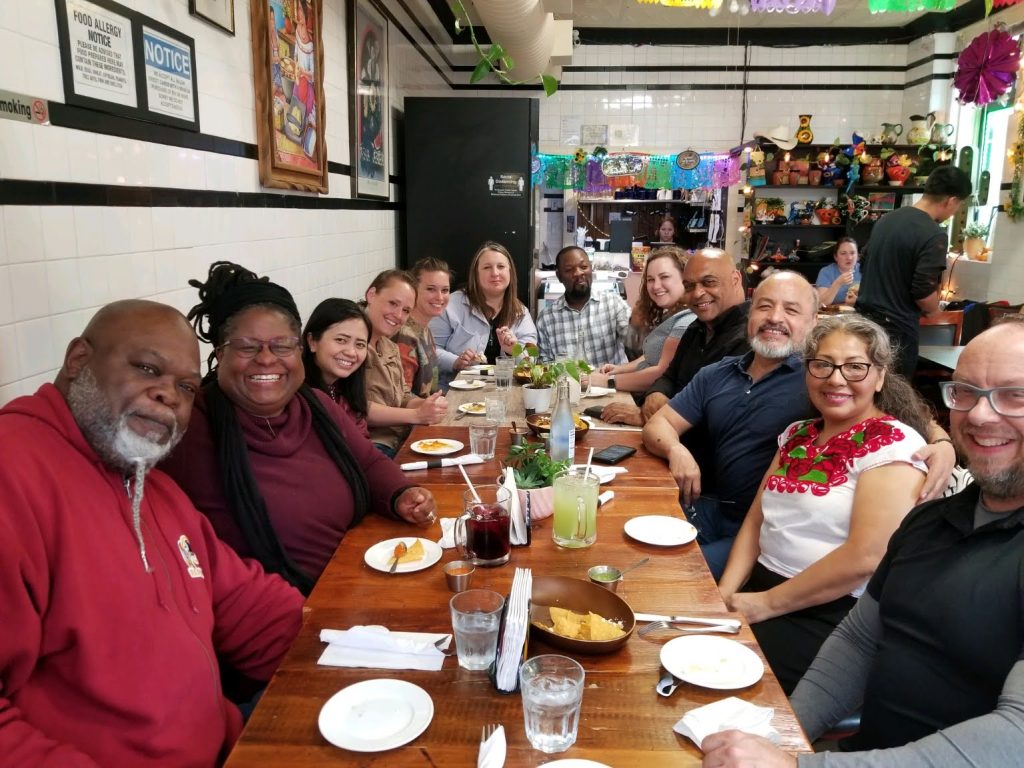
Food and fellowship with local pastors.

Following our time at PPC, we had dinner at a Mexican restaurant with the pastor of Centro de Alabanza de Filadelfia, a Spanish-speaking church that originally began with PPC but now worships in its own space.

At the Mosaic Offices in Landsdale, Stephen Kriss continued to teach us about Anabaptist history and the “polygenesis” theory of their origination. This is the idea that Anabaptism emerged in multiple places through shared commitments to believers’ baptism, discipleship, and nonviolence. Then, over a lunch of phenomenal Indian food, we heard from Ertell Wigham, the former pastor of Nueva Vida Norristown New Life, a bilingual, multiracial church. Despite their many differences, this community has continued to work towards unity and interculturalism; their church is such a powerful example of the body of Christ!

From the Mosaic offices, we made our way to FernRock Retreat, a beautiful place surrounded by nature and intentional opportunities for connecting with God, operated by Mosaic Pastor Sandy Drescher-Lehman and her husband, John. I spent over an hour walking and observing God’s beautiful creation, talking to Him out loud without any expectations or fear. After learning, thinking, and discussing almost non-stop for three days, this was a welcome breath of air. I am so grateful that Mosaic values sabbath time and understands how important quiet and rest are, not just learning. What a gift!

I confess that at first, I was not looking forward to this course. I had already taken Anabaptist history in seminary, so I did not see the usefulness in learning it again. Yes, I would get to meet new pastors, but I did not see the point of building relationships with pastors from all over the country that I would likely not see again. However, God humbled me quickly. I was moved by learning everyone’s stories. These stories, mixed with learning about the history of my ancestors, made it all come to life in a deeply personal and impactful way that I had never experienced before.

I began to see how my story as a Christian, as a woman, as a Mennonite, and as a member of Neffsville (PA) Mennonite fits into the larger story of God’s people. I was struck with a deep sense of God moving and speaking within me about my future and the future of Neffsville. Coming to the end of this course, I still have much to learn, but in the meantime, I am certain that I am exactly where God wants me to be. I am grateful to Mosaic for this experience and its continued support.

Learn more about Mosaic Institute!

The next Introduction to Mosaic course will be offered August-October 2026.  

Mosaic Institute is a conference-based, Anabaptist school of leadership for newly credentialed leaders, experienced pastors, Conference Related Ministry leaders, and lay leaders in Mosaic congregations and beyond. Courses are required for newly credentialed leaders but open to all.  

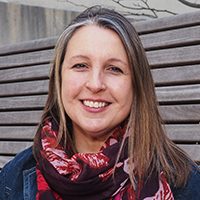
Eszter Bjorkman

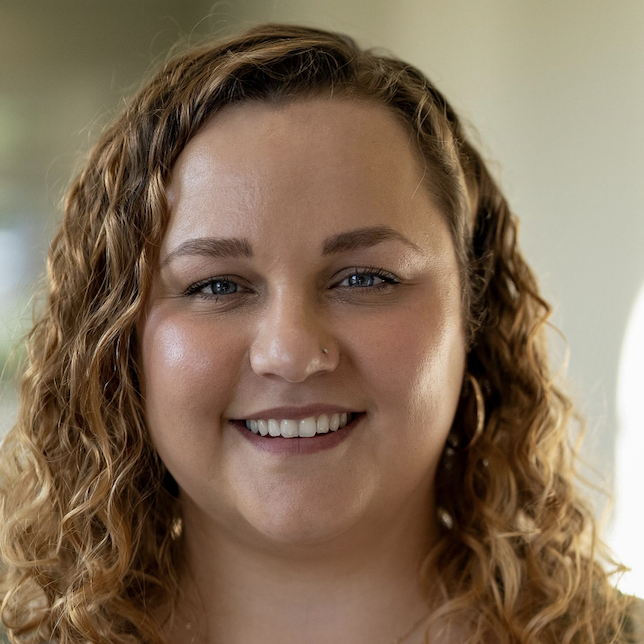
Eszter Bjorkman serves as Associate Pastor of Youth Ministry & Congregational Life at Neffsville Mennonite Church. Since she began there in 2022, she has enjoyed serving the youth ministry, supporting ministry teams, and preaching. She and her husband, Karl, live in Lancaster where they enjoy watching movies and petting their bunny, Totoro.

Mosaic values two-way communication and encourages our constituents to respond with feedback, questions, or encouragement. To share your thoughts or send a message to the author(s), contact us at communication@mosaicmennonites.org.   
Filed Under: Articles Tagged With: Eszter Bjorkman, Mosaic Institute

Mosaic Institute: Finding Our Place in God’s Story 

November 2, 2023 by Conference Office

By: Rose Bender Cook

All newly credentialed leaders in Mosaic Conference are required to take four courses from the Mosaic Institute. These courses introduce them to Anabaptist history and Mosaic Conference priorities as well as help foster collegial relationships across geography and culture. 

One of the assignments in the first course is called, “Great Cloud of Witnesses.”  Students choose from a list of noteworthy Anabaptists that spans 500 years (e.g., Felix Manz, Christopher Dock, Anne Allebach, Clayton Kratz, and James and Rowena Lark) and present a first-person monologue of their character.   

Over years of teaching this course, I have noticed that the students are less likely to choose from the list of names on the syllabus.  More often, they want to research people that connect their story to the larger Anabaptist story.  These are some recent questions students have asked me: 

  • “Can I research how the Anabaptist movement went to Indonesia?”  
  • “I want to interview Ransford Nicholson and learn about the Jamaican Mennonite Conference.”   
  • “I grew up in the beautiful village of Abiriba, Nigeria, and it had Mennonite doctors and nurses. Can I research how and why they came to that village?”  

As they research and share these new-to-me stories, I am learning history, too.   

During the course, students share their own pathway to Anabaptism. We also learn early Anabaptist history through original source documents and John Roth’s book, Stories: How Mennonites Came to Be.  We learn Mosaic Conference history by going to the Mennonite Heritage Center (Harleysville, PA) and by connecting with congregational leaders and local Conference Related Ministries.   

The students and I hear the story of God’s people in the past and develop relationships that help us imagine God’s future story.  As we learn about people and places like Menno Simons, the Germantown (PA) Meetinghouse, the formation of Norristown (PA) Nueva Vida New Life, we hear the testimony of God’s call to a life of peace and justice after living through genocide in Burundi; we learn what it means to be faithful to God’s call while organizing with the Poor People’s Campaign in New York; and, we hear about experiments of immigrants becoming pastors in predominantly English-speaking congregations.  

Though teaching the traditional curriculum is still important, a higher priority for the Mosaic Institute is that students find themselves in the Anabaptist story and in the even grander story of God’s church. 

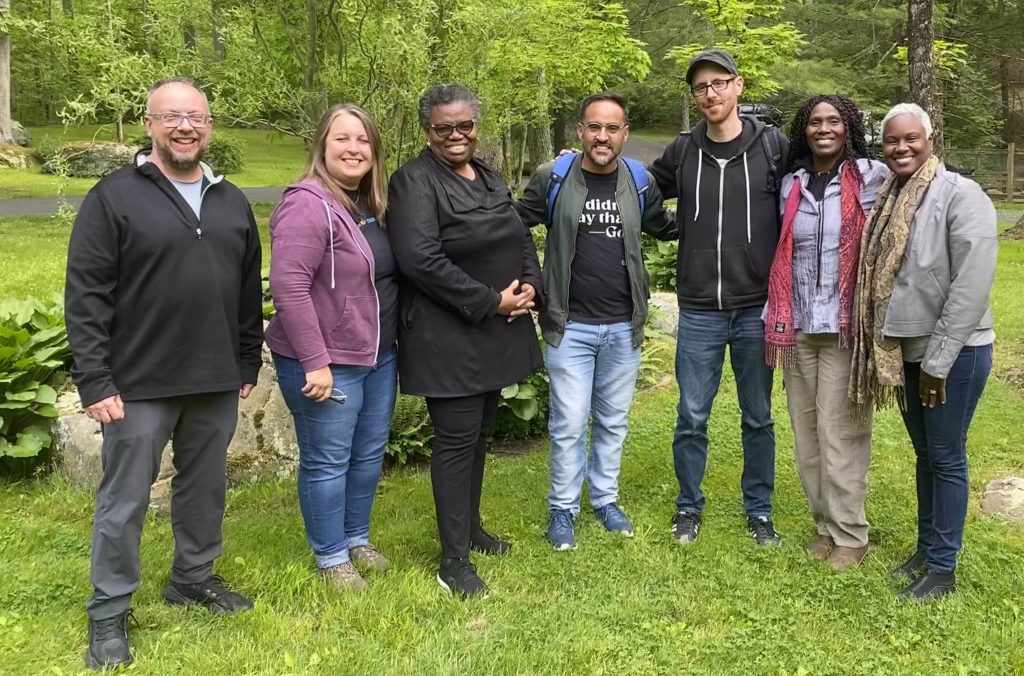
Ministers and leaders gathered for a Mosaic Institute course in May 2023. Left to right: Steve Kriss, Executive Minister; Rose Bender Cook, Mosaic Institute Director; Effiem Obasi Otah of Faith Chapel (CA); Marcos Acosta of Homestead Mennonite Church (FL); Joe Paperone, connected to Bethany Mennonite Church (VT); Mukarabe Makinto of Faith Chapel (CA), and Sherilee Samuels of College Hill Mennonite Church (FL).

Photo provided by Rose Bender Cook.

At Whitehall (PA) Mennonite Church, where I am one of the pastors, we are in a series called Build Your Church, Lord, and we have been asking members to pray this phrase daily.  I have been amazed (once again) by the church in Acts. In the face of persecution and divisive conflict, the church is still ultimately one of widening the circle of Jewish Christians, Samaritan Christians, Ethiopian Christians, and Gentile Christians.  The Spirit leads the way.  Each group finds its place in God’s story.   

In the current milieu of Christian nationalism and culture wars that seemingly define the issues that divide our congregations and our conference, my experiences with Mosaic Institute classes ground and remind me of the long and wide story of God’s people and God’s church.  I am convinced that our Conference name is both descriptive and prophetic. We are Mosaic, and we are becoming more so—in all the beauty and richness.   

Continue to build your church, Lord.  May your glory and your kingdom come on earth, as it is in heaven. Amen.


Rose Bender Cook

Rose Bender Cook is the Interim Leadership Minister for Formation and the Mosaic Institute Director. She is also a pastor at Whitehall (PA) Mennonite Church.

Filed Under: Articles, Mosaic Institute Tagged With: Mosaic Institute, Rose Bender Cook

What I Learned About Anabaptism from Mosaic Institute

August 11, 2022 by Conference Office

By Kevin Opett

“In essentials, unity. In nonessentials, liberty. In all matters, love.”

“In essentials, unity. In nonessentials, liberty. In all matters, love.” These words left an indelible mark in my understanding of Anabaptism after participating in the Introduction to Mosaic Class, offered by Mosaic Institute and led by Steve Kriss and Rose Bender Cook. 

As part of Mosaic’s credentialing process, seven classmates and I spent time on Zoom and in person learning about the development and contributions of the Anabaptist movement to the Christian story. We read books, traveled to rural and urban churches, visited historical places, and talked with memorable people who represent the diverse makeup of Mosaic.

The Introduction to Mosaic class at Fern Rock Retreat.
Back row:  Ramona Pickett (7 Ways Home Fellowship), Brandon Landis (Finland), Tracy Commons (Swamp), Scotty Meiser (Bristol Redemption), Steve Kriss (Mosaic staff), Susan Alloway (Bristol Redemption), Hilarion Chidi Ihezuoh(LA Faith Chapel); Front row:  Michelle Ramirez (Luz y Vida), Kevin Opett (Alpha), Rose Bender Cook (Mosaic Institute staff).
Photo by John Drescher-Lehman.

Our cohort was a microcosm of the conference: it included both life-long Mennonites and newcomers to the fold, Americans and immigrants, as well as representations of several racial/ethnic backgrounds. Each of us had our notions of Anabaptism challenged, expanded, and enriched.

We started out as strangers but ended up as brothers and sisters who care deeply for one another. We enjoyed deep discussions and sought to understand our different perspectives as we galivanted around Pennsylvania, to Souderton, Harleysville, Philadelphia, and Lansdale. On the final in-person day of the class, a sabbatical retreat at Fern Rock bonded us together as we sang praises to Jesus and shared what he is doing in our hearts.

I was fascinated to learn that Anabaptists were not always the “Quiet in the Land,” a people who kept to ourselves. Far from being docile, our forebears were radical, urban-based, and adamant that Christians are to spread the gospel far and wide. Relentless persecution from other Christian traditions led to a centuries-old retreat into isolation that only now seems to be turning the tide, as our story widens and deepens with new cultures and people adding their unique perspective to the Mosaic story. We are being reacquainted with the Great Commission to go and make disciples of the nations by the fresh movement of the Holy Spirit in our world. 

The course offered a solid foundation to understand the Mosaic vision of being a Conference where homogeneity is not a prerequisite to cooperation. Like a patchwork quilt, no two congregations look or function the same. Mosaic includes both rural, traditional churches as well as urban immigrant congregations. There are multiethnic and multilingual congregations. Some were established 100 years ago, while others are just starting out. This array of diversity makes Mosaic Conference unique and beautiful.  

The diversity enables a person like me, whose background resembles a denominational kaleidoscope, to feel welcomed and to thrive just as those who can trace their ancestry back to the earliest expressions of the movement. We can each find our place in Mosaic and mutually support one another as we strive to live out the teachings of Christ and share the Good News to the communities around us.  

On behalf of my classmates, Brandon, Chidi, Michelle, Ramona, Scotty, Susan, and Tracey, I wish to convey our sincere appreciation to all who made this class so rewarding. The time you invested in us and the stories you shared allowed us to experience such a meaningful time together. We hope we have been as much of a blessing to you as you have been to us!


Kevin Opett

Kevin Opett resides in the Philadelphia area and currently serves as pastor of Alpha Mennonite Church in New Jersey. You will usually find him toiling in the yard of his new house or cooking international cuisine when he is not engaged in ministry work. Kevin just celebrated 21 years of marriage to his beautiful wife, Petra. 

Filed Under: Articles Tagged With: formational, Mosaic Institute

Mosaic Institute Mailing List

December 22, 2021 by Cindy Angela

Fill the form below to be added to the Mosaic Institute mailing list!

Mosaic Institute Page

Filed Under: Forms Tagged With: Mosaic Institute

Healing from COVID-19

June 24, 2021 by Cindy Angela


No one has been immune to the COVID-19 pandemic. While some may have experienced great loss, all of us—including church leaders—have experienced some sort of trauma during the past 15 months.

To learn about healing processes for this trauma, twenty-five Mosaic Conference pastors and leaders gathered on June 11-12, 2021 for a hybrid workshop at Swamp (Quakertown, PA) Mennonite Church and via Zoom. Three experts in the field of trauma and trauma healing—therapist John Drescher-Lehman, LCSW; Dr. Leah Thomas, professor of pastoral care at Anabaptist Mennonite Biblical Seminary; and global peacebuilder Dr. Al Fuertes—shared their collective wisdom.

Three experts in the field of trauma and trauma healing— (from left to right) Dr. Al Fuertes, Dr. Leah Thomas and John Drescher-Lehman, LCSW.

Trauma results in a loss of connection, therefore the need to re-connect is critically important; we cannot just re-connect and ignore the trauma, however. Throughout the weekend, participants were reminded that healing from trauma happens best in community. In this unique time of trauma healing, when everyone has been affected by the pandemic, it is important to remember that leaders need to recover from our own trauma while also holding space for others to recover.

“The light God lit in us does not go out, even when we struggle with pain.”

When trauma occurs, it is very normal to either avoid and abandon or become hyper-focused on the emotional, spiritual, social, sexual, physical, or intellectual parts of our lives. During the opening session, candles were lit for each of these areas, and participants were invited to light their own candle from these flames, honoring the effect trauma has played in their lives during the pandemic. Drescher-Lehman reminded us, “The light God lit in us does not go out, even when we struggle with pain.”

Throughout the weekend, presenters reminded participants that if trauma is not addressed and honored, re-traumatization is likely to occur. As leaders, we want to ensure that our own trauma, and our collective trauma as a congregation, is processed in healthy ways, preventing further traumatization.

Thomas shared three keys for post-trauma healing: Calm, Connection, and Communication. We can create calm together through practices like communal prayer, singing, silence, appropriate touch, and familiar rituals/liturgies. To build connection, we want to work on authentic relationships with each other. In fostering communication, we want to be clear, kind, and transparent, setting boundaries, and being authentic and intentional. We also want to offer people choice, giving permission for them to participate or not, especially when recovering from trauma. Through all of these steps, it is important that we are compassionate with ourselves and each other.

The healing of trauma is also shaped by the intersection of a person’s culture and life experiences. In some ways, trauma is universal and there are core symptoms (avoidance, irritability, sleep issues) that happen to all persons who experience trauma. Culture can also greatly impact trauma, however, in how we describe it, how we present and process emotions, how we understand suffering and healing, and how a person makes meaning or heals from the trauma. Even within shared cultures, individuals can respond very differently to trauma, as their experience of trauma is shaped by their sense of self, personality, resilience, theology, and personal and/or familial history. As church leaders, it is important to pay attention to the three aspects (universal, cultural, and individual) of pastoral care to persons processing and healing from trauma.

“As I participated in the COVID healing workshop via zoom, one of the presenters asked us to find a place and a position that made us feel comfortable, whether sitting or lying on a couch. I closed my eyes and followed his instructions of breathing and visualization. I inhaled and exhaled and became more relaxed. I envisioned a bright day with a panoramic view of a big, green, grassy field. There was a rabbit and a dark image of a bird (probably representing me) on the left-hand side looking into the grassland.

As I processed this time, I realized I had been staying at home for over a year, not even going out grocery shopping. The visualization exercise encouraged me to go outside again, to heal in God’s creation of nature.”

– Wendy, workshop participant

One way that participants were guided to process the trauma of COVID-19 was through somatic spiritual exercises, such as breathing exercises and gentle yoga. “The body can tell us when we are in danger and unsafe, but the body can also tell us when we are safe and grounded,” explained Dr. Leah Thomas. As a result, paying specific attention to our physical bodies can help us identify areas in our lives that may need attention and healing.

As we move into the next phase of pandemic life, it is important to honor and acknowledge how each of us as individuals and as congregations survived. Taking time to honor the unique journey, giving time to grieve, and express gratitude for making it through, will all aid to post-pandemic healing and resiliency.

Filed Under: Articles Tagged With: Mosaic Institute, Sue Conrad Howes

Introducing Mosaic Institute

December 29, 2020 by Cindy Angela

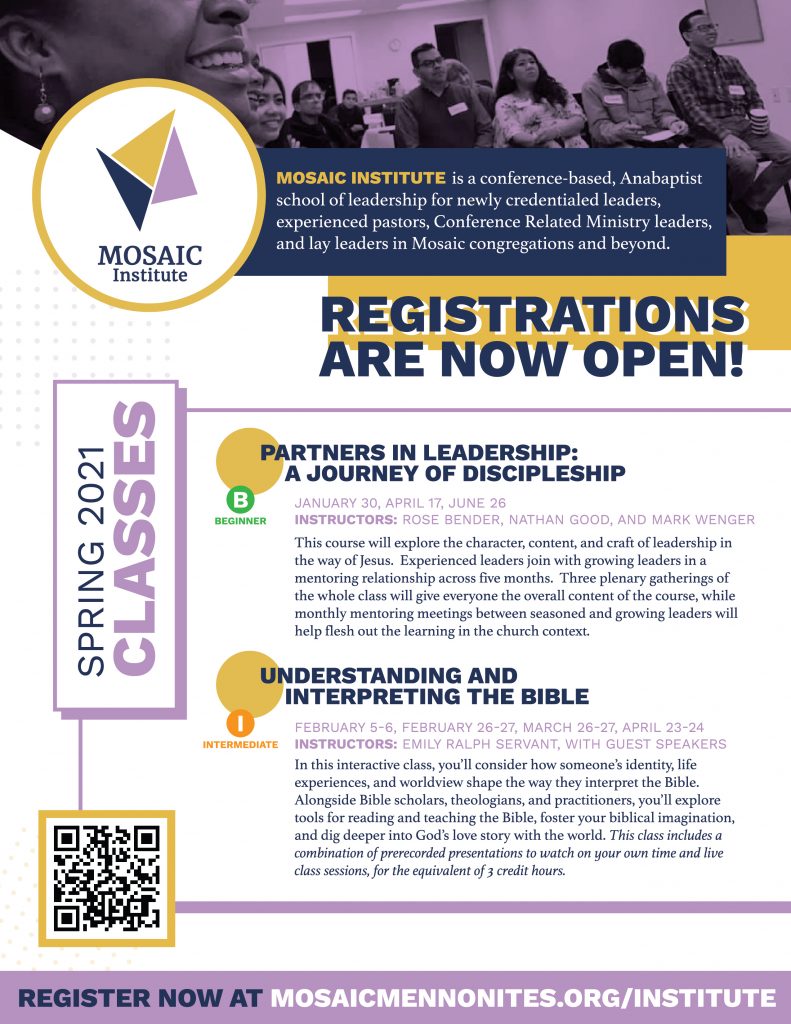
You are invited to join one of the first classes of our new Mosaic Institute!

  • Partners in Leadership is a mentor-model learning experience offered by Mosaic Institute, January 30 – June 26, 2021.  An experienced leader and less-experienced leader pair-up to meet twice a month.  Partners engage monthly topics and resources; they read Scripture and practice spiritual disciplines; they also attend three plenary gatherings.  The purpose is discipleship: in character, content, and craft of leadership.  Instructors: Rose Bender, Nathan Good, & Mark Wenger. Cost: $75 per person.
  • Understanding and Interpreting the Bible: In this interactive class, you’ll consider how someone’s identity, life experiences, and worldview shape the way they interpret the Bible.  Alongside Bible scholars, theologians, and practitioners, you’ll explore tools for reading and teaching the Bible, foster your biblical imagination, and dig deeper into God’s love story with the world. Held on Zoom, four weekends in February-April 2021.

View the brochure here, or find more information and register now at MosaicMennonites.org/Institute.

Filed Under: Articles, Uncategorized Tagged With: Mosaic Institute

Primary Sidebar

  • Home
  • About Us
    • Our History
    • Vision & Mission
    • Staff
    • Boards and Committees
    • Church & Ministry Directory
    • Mennonite Links
  • Media
    • Articles
    • Newsletters
    • Video
    • Audio
    • Bulletin Announcements
  • Resources
    • Conference Documents
    • Missional
    • Intercultural
    • Formational
    • Stewardship
    • Church Safety
    • Leaders’ Resources
    • Request a Speaker
    • Pastoral Openings
    • Job Openings
  • Give
  • Events
    • Delegate Assembly
    • Youth Event
    • Conference Calendar
  • Mosaic Institute
  • Vibrant Mosaic
  • Contact Us

Footer

  • Home
  • Contact Us
  • Delegate Assembly
  • Vision & Mission
  • Our History
  • Formational
  • Intercultural
  • Missional
  • Mosaic Institute
  • Give
  • Stewardship
  • Church Safety
  • Leaders’ Resources
  • Articles
  • Bulletin Announcements

Copyright © 2026 Mosaic Mennonite Conference | Privacy Policy | Terms of Use
Aligned with