
• Skip to main content
  • Skip to primary sidebar
  • Skip to footer

Mosaic MennonitesMosaic Mennonites

Missional - Intercultural - Formational

  • Home
  • About Us
    • Our History
    • Vision & Mission
    • Staff
    • Boards and Committees
    • Church & Ministry Directory
    • Mennonite Links
  • Media
    • Articles
    • Newsletters
    • Video
    • Audio
    • Bulletin Announcements
  • Resources
    • Conference Documents
    • Missional
    • Intercultural
    • Formational
    • Stewardship
    • Church Safety
    • Leaders’ Resources
    • Request a Speaker
    • Pastoral Openings
    • Job Openings
  • Give
  • Events
    • Delegate Assembly
    • Youth Event
    • Conference Calendar
  • Mosaic Institute
  • Vibrant Mosaic
  • Contact Us
  • English

Joe Paparone

Don’t believe the poverty narrative

September 17, 2026 by Cindy Angela

by Joe Paparone

Editor’s Note: This column was originally published in Anabaptist World and is reprinted with permission.

If you walked the Albany, N.Y., river­front park in the summer, you would not be surprised to find people enjoying cookouts and the playground. Once a month, you’d come across a larger cookout with banners that read “National Union of the Homeless” and “Homeless, Not Helpless.” On the surface this looks no different than any other group using the public park. You could stop for a burger, chat a little and be on your way. Everyone is welcome.

Stay a few minutes, and you’ll notice unusual details: people’s belongings in shopping carts, a familiar face you’ve seen panhandling at the exit ramp, someone else making sure the redeemable bottles are collected. There will be someone wearing a button or shirt reading “National Union of the Homeless” who will ask you about housing, healthcare and food insecurity. Someone might make a speech about housing as a human right.

You might gather that this isn’t a typical nonprofit.

At the National Union of the Homeless, we call these activities Projects of Survival. While they might look like other food distributions or neighborhood cookouts, there is education and organizing happening around issues of fundamental human rights.

In our organizing, we often partner with agencies that provide desperately needed services. We canvass outside of food pantries or set up tables and mini health clinics at community meals. These partnerships are invaluable: We have conversations about issues facing our community where people are already going to have a need met.

But it is also important to hold actions and organizing events independently. Our society teaches us that poor people are criminals or charity cases, dangerous or helpless. Even the most well-meaning people are susceptible to this deeply ingrained idea.

We must challenge this narrative. Central to our organizing is that we are the poor, organizing the poor. By organizing independently, even something as simple as a summer cookout, we are undermining the idea that poor people are incapable of making change.

Projects of Survival have a long history. The Vigilance Committees of the Abolition Movement are an example. Formerly enslaved Black workers were assisted materially, through daring efforts of Underground Railroad conductors. When they arrived at safehouses, frequently run by leaders of the Vigilance Committees, their stories and experiences were documented and shared. This provided valuable intelligence for the slavery-abolition movement, as well as challenging the racist slaveholder ideologies that insisted Black people were helpless, docile or that they enjoyed enslavement.

In 1969, the Black Panther Party developed a free Breakfast for Children Program, providing meals in poor communities, but most important, using those meals as sites of political education for the children and their families. More than simply offering a meal, the Panthers provoked agitating questions designed to organize for systemic change. Why are our children hungry? Who benefits from this situation? How can we organize together to change this?

The Panthers referred to these programs as “Survival Pending Revolution.” The FBI, intent on destroying the Panthers, recognized the Breakfast for Children Program as one of their most potent organizing tools.

In the late 1980s, chapters of the National Union of the Homeless took over vacant HUD housing, demanding safe and decent housing and an end to homelessness. They politicized the housing crisis and challenged the narrative of helplessness. Breaking into vacant HUD housing amid a homelessness crisis exposed the contradiction of poverty amid plenty and raised questions about the priorities of a society that would let people sleep and die on the street while available housing sat empty.

“People have to get over this being against the law,” said one leader, Ron Casanova. “I’m dying in the street. That should be against the law.”

Our faith communities are well-positioned to develop these kinds of programs. Many congregations have mission or service programs that involve food pantries, community meals or other activities where the poor gather to meet their immediate needs.

Organizing can start small, asking our neighbors questions that get to the root causes of poverty: Why are we poor in the wealthiest country in history? Who benefits from this? What do you think we can do about it?

The care and compassion offered in our congregations is a necessary ingredient in organizing. No amount of charity will end the system that produces poverty. Organizing among the poor can happen over shared food. Our survival depends on it.
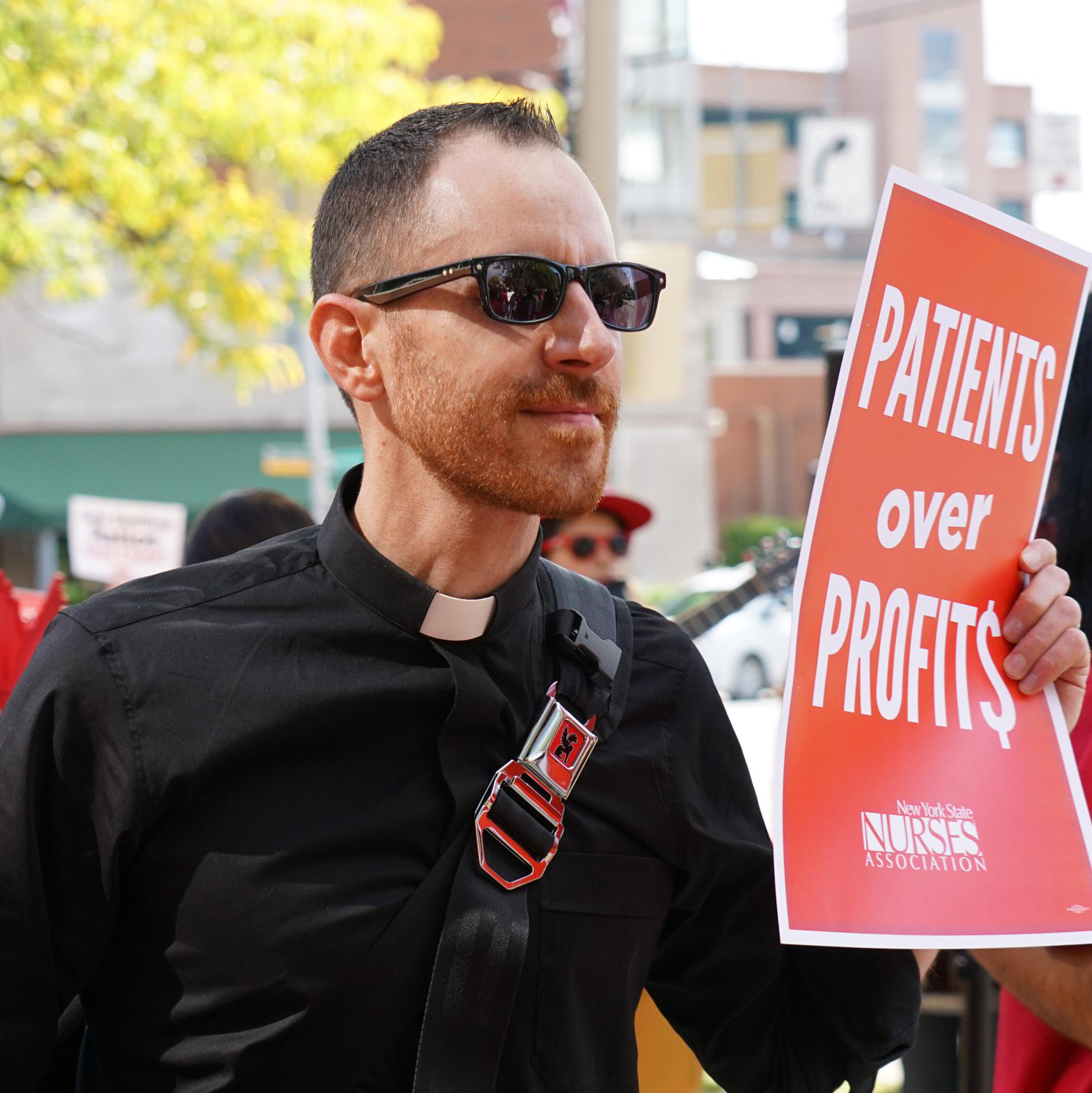

Joe Paparone

Joe Paparone is an organizer with the Nonviolent Medicaid Army, National Union of the Homeless, and the New York State Poor People’s Campaign. He is a credentialed leader in Mosaic Mennonite Conference and a member of Bethany Mennonite (Bridgewater, VT).

Mosaic values two-way communication and encourages our constituents to respond with feedback, questions, or encouragement. To share your thoughts or send a message to the author(s), contact us at communication@mosaicmennonites.org.   
Filed Under: Articles Tagged With: anabaptist world, Joe Paparone

We Won’t Stop till Homelessness Drops

December 11, 2025 by Cindy Angela

by Joe Paparone

Editor’s note: Originally published on November 24, 2025, in Anabaptist World, and reprinted with permission.    

I was helping at a drive-through food distribution. Before the line started, the Catholic Sister who coordinated things called all the volunteers together to thank them and pray. As she spoke encouragement, I thought, “It is good that we’re doing this. It’s infuriating that we have to.” 

I find this contradiction in every charity and service space, whether it’s the community breakfast where our Homeless Union organizes or in line with people signing up for Thanksgiving meal baskets: “I’m so glad you’re here. Isn’t it outrageous that we have to do this?” 

In the United States, we live in the wealthiest nation to ever exist, yet one of the most unequal societies on the planet. The people who maintain and benefit from these wealth disparities go to great lengths to obscure the underlying causes. 

The winter holiday season in particular is a space of contradiction. On the one hand, we are inundated with appeals for charity and care for those who suffer under this economic system. At the same time, the engine of commerce shifts into overdrive as firms seek to grow their profits by the end of the year and paint a positive financial picture for their shareholders. 

Into this confusing narrative, the National Union of the Homeless seeks to bring clarity through a “Winter Offensive.” Between Thanksgiving and Martin Luther King Day, Homeless Union chapters challenge these distorted narratives and assumptions through public action and political education. 

We seek to unveil the truth and level a moral indictment: It is outrageous that anyone should sleep on the street when there is more vacant housing than unhoused people. Any system that creates and maintains such levels of inequality must be abolished. 

When in the Homeless Unions we say “Power, Not Pity” and “Homeless, Not Helpless,” we provide a counternarrative: The poor are not objects to be manipulated but subjects of history and agents of change. 

We challenge a civic religiosity that would worship a homeless man on Sunday but step over one on Monday. When we interrogate the Gospel stories, we see Jesus, Mary and Joseph as refugees fleeing persecution, who could not afford adequate housing. 

Mary’s Magnificat, far from being merely a song of praise and worship, is a revolutionary call for a fundamental transformation of society, sorely needed now as much as in Mary’s day. Inspired by this, the leadership and collective action of the poor dispels surface narratives, and gives life and direction to a movement for dramatic social change. 

The Winter Offensive provides clarity, even in the name. We call it an offensive because in our economy, ruled as it is by the ultrawealthy, poor and working-class people are continually on the defensive. The ruling class controls not only the economic and political terrain but the mental terrain as well. Amid millions of poor people scrambling to survive, the misleading narratives promoted during this season represent an attack. Despite the good intentions of many who seek to be caring and compassionate toward their neighbors, the charitable acts promoted in this season, when divorced from action against the root causes of poverty, are a diversion. They are a safety valve for the system, relieving some of the economic pressure the system creates while easing mental pressure by enabling people to feel like they’ve done something. 

But this time of year is also when ruling-class narratives are most vulnerable. As more and more people are thrust into the ranks of the poor, the season’s saccharine-sweet, Hallmark-movie narratives will sour and turn to ashes in our mouths. 

When we are desperate for hope in confusing and dangerous times, we must follow the leadership of the organized poor, those who have the least to lose from ending the present system and the most to gain from its transformation. 

Last year, the first public action of the Albany Homeless Union was on Dec. 21, Homeless Memorial Day. On the longest night of the year, in biting wind and cold, at the front steps of the New York State Capitol Building, we built a memorial to people who’ve died due to poverty. Our leaders, most of whom had never spoken publicly before, shared their stories, struggles, poetry and demands that their rights to housing and healthcare be upheld. We committed to the struggle to end this unjust system. 

One leader brought a new chant: “We won’t stop till homelessness drops.” 


Joe Paparone

Joe Paparone is an organizer with the Nonviolent Medicaid Army, National Union of the Homeless, and the New York State Poor People’s Campaign. He is a credentialed leader in Mosaic Mennonite Conference and a member of Bethany Mennonite (Bridgewater, VT).

Mosaic values two-way communication and encourages our constituents to respond with feedback, questions, or encouragement. To share your thoughts or send a message to the author(s), contact us at communication@mosaicmennonites.org.   

Filed Under: Articles Tagged With: Bethany, Joe Paparone

Truth to Power

July 27, 2023 by Cindy Angela

Recently I participated in the Poor People’s Campaign Moral Poverty Action Congress, a three-day gathering of hundreds of poor and dispossessed organizers, advocates, and faith leaders from over 30 states. The Poor People’s Campaign: A National Call for Moral Revival is a re-launch of Rev. Dr. Martin Luther King Jr.’s final campaign in 1968, tragically cut short by his assassination. He called for a “revolution of values” and was beginning to organize the poor across all lines of division: race, geography, gender, and ethnicity, into what he called a “Nonviolent Army of the Poor.”  

Over 50 years later, the crises of poverty that King identified are in nearly every way worse in our country. The present iteration of the campaign launched in 2018, with six weeks of nonviolent direct action at state capitols, calling for an end to systemic racism, poverty, militarism, ecological devastation, and the distorted moral narrative of Christian nationalism. We’ve continued organizing by identifying, developing, and uniting leaders of the poor, and slowly but steadily building a movement.  

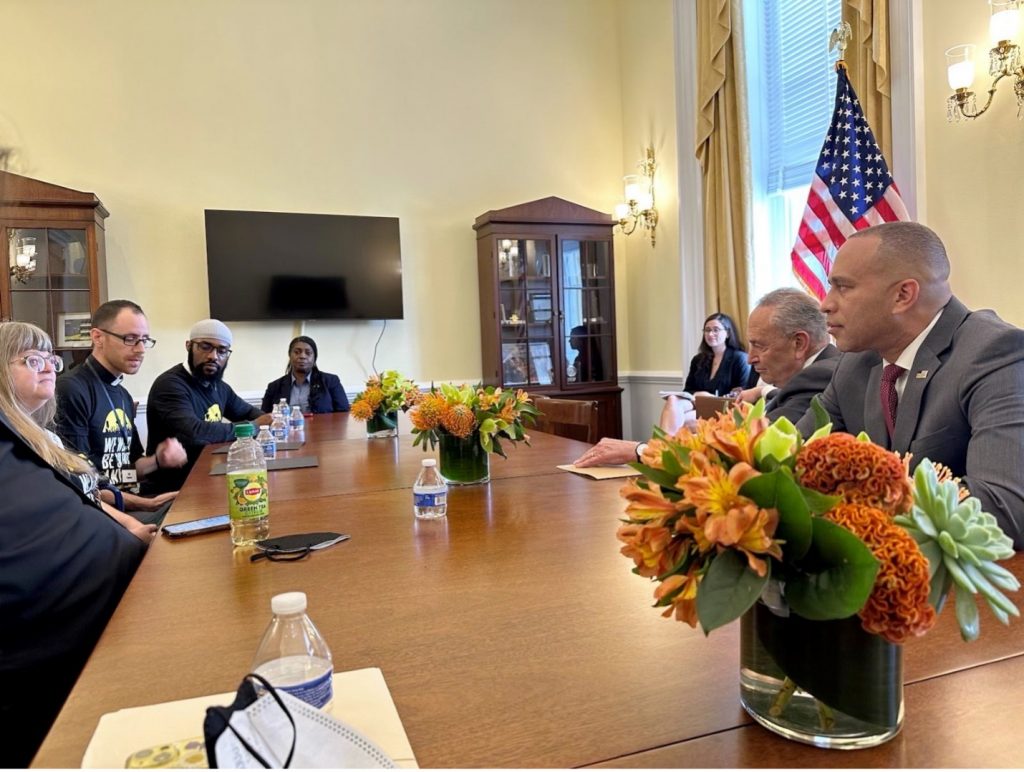
This day of the gathering, we descended on Capitol Hill in DC and met with every legislator in our states to deliver our policy demands. As a tri-chair of the campaign in New York, I, along with my fellow tri-chairs, Jamel Coy Hudson and Kelly Smith, had the opportunity to meet with US Senate Majority Leader Chuck Schumer and US House Minority Leader Hakeem Jeffries. We were joined by the National Poor People’s Campaign co-chairs, Rev. Dr. William Barber and Rev. Dr. Liz Theoharis.  

Rev. Joe Paparone (second from left), tri-chair of the New York State Poor People’s Campaign, and others recently met with US Senate Majority Leader Chuck Schumer (second from right) and US House Minority Leader Hakeem Jeffries (far right). Photo by Shailly Gupta Barnes.

As we prepared for the meeting, we had low expectations. We’ve been part of these kinds of visits before (though not with such prominent legislative leaders), and we suspected we would barely have a chance to speak and that the legislators would either be dismissive of us or defensive about their records. They might also fill the time with niceties and small talk.  

None of that happened. For nearly an hour, two of the most powerful leaders of the most powerful nation in the world listened to poor people.  

Jamel called on them to defend our democracy by protecting voting rights. I shared about members of my community who are essential workers and whose wages aren’t nearly enough to survive. Kelly put it best, saying, “We are not ashamed of being poor or afraid of being called poor. We know why we are poor–it’s not our fault. We are poor because of policy. We know deals are being made, and we are sick and tired of those deals being made on the backs of poor people.” 

We talked about how every day in that Capitol building, there are legislators putting forth policies designed to kill poor people, and we needed to hear, publicly from congressional leadership, what they were going to do about it.  

At the end of his life, Dr. King said, “If [poor people] can be helped to take action together, they will become a new and unsettling force in our complacent national life.” 

We are under no illusions about who these leaders are or what they might do. They were polite; they listened; they responded respectfully. We will meet with them again. We will continue organizing, developing, and uniting leaders from among the poor and dispossessed of society to build that new and unsettling force.  

One thing is certain, the most powerful people in the world will not be able to say they didn’t know we were coming.  

Filed Under: Articles Tagged With: Bethany, Joe Paparone

Primary Sidebar

  • Home
  • About Us
    • Our History
    • Vision & Mission
    • Staff
    • Boards and Committees
    • Church & Ministry Directory
    • Mennonite Links
  • Media
    • Articles
    • Newsletters
    • Video
    • Audio
    • Bulletin Announcements
  • Resources
    • Conference Documents
    • Missional
    • Intercultural
    • Formational
    • Stewardship
    • Church Safety
    • Leaders’ Resources
    • Request a Speaker
    • Pastoral Openings
    • Job Openings
  • Give
  • Events
    • Delegate Assembly
    • Youth Event
    • Conference Calendar
  • Mosaic Institute
  • Vibrant Mosaic
  • Contact Us

Footer

  • Home
  • Contact Us
  • Delegate Assembly
  • Vision & Mission
  • Our History
  • Formational
  • Intercultural
  • Missional
  • Mosaic Institute
  • Give
  • Stewardship
  • Church Safety
  • Leaders’ Resources
  • Articles
  • Bulletin Announcements

Copyright © 2026 Mosaic Mennonite Conference | Privacy Policy | Terms of Use
Aligned with