
by Jeff Wright
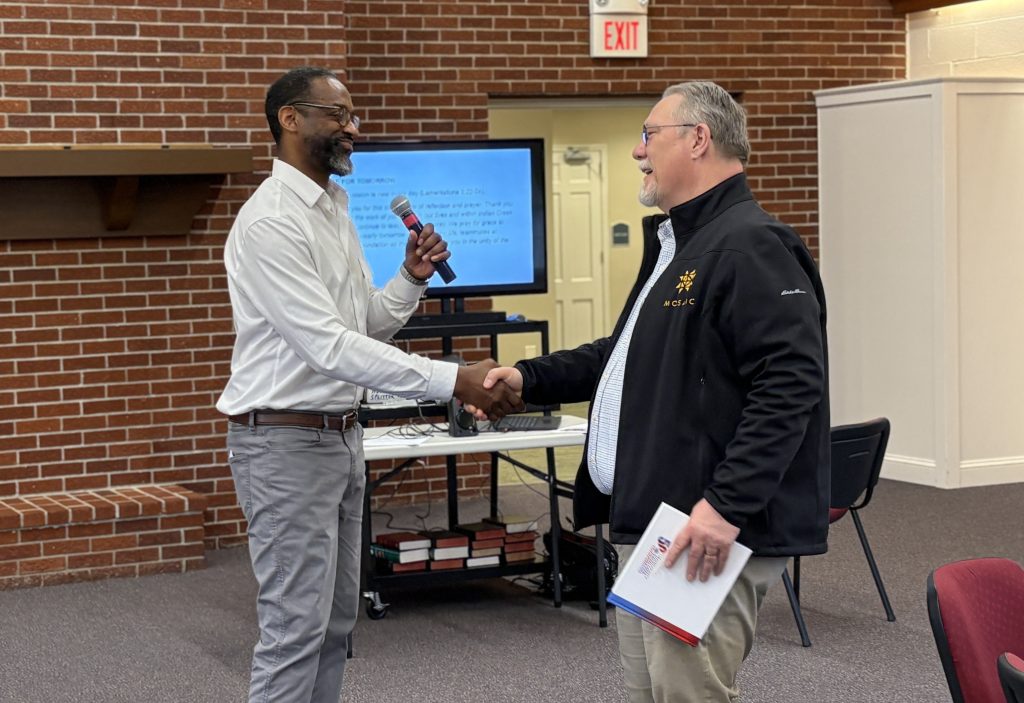
Editor’s Note: A longer version of this reflection was shared at the Conference-Related Ministry Indian Creek Foundation’s Monthly Prayer Fellowship on April 3, 2026 at Blooming Glen (PA) Mennonite.
On a rainy night in September 2004, I was in Atlanta at a gathering of Mennonite urban ministry leaders. For 12 years, I had been at the center of a whirlwind of action—developing leaders, teaching Anabaptist theology and urban missiology among immigrant church planters in Los Angeles, organizing incubation efforts for neighborhood ministries of relief and repair, preaching, fundraising, budgeting, and leading a constantly shifting staff team. It was a rich season of kingdom work. But strains were showing. Petty jealousies and passive aggression from those with greater access to resources left me stressed, in conflict, and unable to attend to what mattered most.
That night, I found out that Jacob had been unexpectedly born into our family. My son and his girlfriend had kept the pregnancy a secret. And there I was, away again, leaving my family in crisis – again.
But this was more than an unexpected birth. Jakie had suffered an umbilical cord prolapse, aspirated meconium, and endured perinatal asphyxiation and stroke. The result was severe, lifelong disability.
Things turned dark fast. An ambitious (and unfit) associate pastor publicly suggested that Jake’s birth was proof of how unfit I had been as a father and how Jake’s deficits were God’s judgement on me and my ministry. Jake’s arrival hastened the end of that season of my ministry.
I was broken. I felt ashamed–that I probably was unfit as a father and my ministry was a fraud–and there weren’t a lot of people that knew how to stand with my wife Debbie and me. In that season, I found solace in two places: siting in the NICU holding Jake, and in reading Ecclesiastes.
The book of Ecclesiastes is often called the “black sheep” of the Bible because it refuses to offer easy answers. For those connected to disability—whether through diagnoses like cerebral palsy or experiences of birth injury—the Teacher (Qoheleth) feels less like a philosopher and more like a weary friend who tells the truth. In Ecclesiastes 9:11–18, we find a profound meditation on the randomness of life and the unrecognized value of those the world considers weak.
The passage begins with a jarring observation: “The race is not to the swift, nor the battle to the strong.” This confronts the myth of meritocracy—the belief that effort guarantees outcomes. In the world of disability, that illusion collapses early. When a child experiences brain injury from lack of oxygen, it is not because they or their parents failed. It is what the Teacher calls “time and chance.”
By acknowledging that “evil times fall unexpectedly,” Ecclesiastes offers a strange validation. It removes the burden of “why” and “whose fault.” It loosens the grip of “why” and “whose fault.” The world is not a vending machine where good behavior yields predictable results. This creates space for grace. If success is not proof of virtue, then disability is not proof of failure. It is part of the hebel, the vapor, the mystery of human life.
The Teacher then tells of a poor wise man who saves a city, yet is forgotten. “No one remembered that poor man.”
This is a familiar reality in the disability community. Those whose bodies or communication differ from cultural norms often carry deep wisdom and perspective. Yet their contributions are overlooked because they do not match the world’s definition of strength or speed.
Ecclesiastes makes a radical claim: wisdom is better than might. The poor man’s insight surpasses the king’s power. The tragedy is not his poverty, but a world too blind to remember him.
Few remember Frank Lanterman. A concert organist turned conservative California state senator, he set out in the 1960s to uncover waste in state institutions. Instead, he found thousands of children and adults warehoused without dignity, stimulation, or care. At the time, parents had two options: keep a child at home without support or send them away to an institution, often for life.
Lanterman fought to change that system. He argued that the state had a moral and legal obligation to care for vulnerable citizens within their communities. His work led to the creation of California’s regional center system, making services for people with developmental disabilities a legal entitlement.
In a surprising turn, the bill was signed into law by Ronald Reagan. Through political wisdom and persistence, Lanterman convinced a similarly conservative governor to support an entitlement program in exchange for deinstitutionalization and local control.
Without that unlikely partnership between a “poor wise man” and a “great king,” I do not know what would have become of Jacob, his parents, or our family. Because of that work, Jacob has been able to live at home. His parents have built meaningful vocations in service to others. His brothers have grown up alongside him.
The passage concludes with a sober warning: “Wisdom is better than weapons of war, but one sinner destroys much good.” In medicine, we see how a single moment of oxygen deprivation can alter a lifetime. But in a social context, this “one sinner” is often the person who creates an inaccessible building, an exclusionary policy, or a stigmatizing comment. These small acts of “folly” can dismantle the “good” of a person’s hard-won independence.
And yet, the good endures. Systems like those Lanterman helped create continue to support families like ours, even amid ongoing pressures and threats.
For those connected to disability, Ecclesiastes 9: 11–18 is a call to radical candor. It gives permission to grieve the randomness that reshapes our lives. But it also calls us to remember the forgotten, to honor wisdom where the world does not look. In a world where the swift stumble and the strong fail, the measure of a life is not output or efficiency.
Jake Wright—bedfast, unable to speak, nourished through a feeding tube—demonstrates to his whole community that he is a young man with a soul, beloved by God. He laughs at the sound of singing or his grandpa preaching. This world is better because of both Jacob Gabriel Barriga Wright, and concert organist turned state senator Frank Lanterman. Thanks be to God for their hearts.


Jeff Wright
Jeff Wright is a Mosaic Conference Leadership Minister. He is also a member of the Missional Priority Team and the official old curmudgeon of the conference staff. When not reading, or cheering for his beloved Los Angeles Dodgers, he is serving as interim pastor at Blooming Glen (PA). He has dreams of batting 9th and playing backup catcher for the Mosaic Conference baseball team.
Mosaic values two-way communication and encourages our constituents to respond with feedback, questions, or encouragement. To contact Jeff Wright, please email jwright@mosaicmennonites.org.
The opinions expressed in articles posted on Mosaic’s website are those of the author and may not reflect the official policy of Mosaic Conference. Mosaic is a large conference, crossing ethnicities, geographies, generations, theologies, and politics. Each person can only speak for themselves; no one can represent “the conference.” May God give us the grace to hear what the Spirit is speaking to us through people with whom we disagree and the humility and courage to love one another even when those disagreements can’t be bridged.