
by Stephen Kriss
Slavoj Žižek, a Slovene philosopher, suggests that the Christian story is about comedy over tragedy. I have been caught up in this idea for years. Often the way we tell the story of our faith relies on the tragic, with a focus on death and sin more than life and resurrection. Žižek insists that what makes the Christian story real is its insistence on life over death.
Comedian Trevor Noah suggested in a recent interview that the church often lacks imagination. In many of our current realities, including what we see each day in the news, there is a strong pull to return to what used to be rather than to imagine a faithful and flourishing way forward. I do not believe in inevitable progress, a steady march toward something better. But I do believe that faith, hope, and love pull us forward toward God’s comedic conclusion: life over death, belonging over alienation, flourishing over failure, peace over violence.
The challenge for me, and for the church, is to trust God for that conclusion and to live toward it in our daily lives. This happens in tangible ways, like how we greet a stranger, and in more abstract ways, like our images of God and how we understand atonement.
Our Mosaic mission and vision remind us that the world is both broken and beautiful. Our life together reflects this tension. The diversity of who we are, and who we are becoming as God’s Mosaic people, stretches our patience and challenges our assumptions. The Anabaptist concept of discipleship calls us into a lifelong posture of learning to follow Jesus. It is not a one-time confession at baptism but a continual way of life.
John Paul Lederach suggests we need communities that are hubs, or evidence, of what is possible with the peaceable away of Jesus. (c.f. The Moral Imagination: The Art and Soul of Building Peace). In earlier generations, Mennonites described this as being “contrast communities,” visible expressions of the good news shaped by the Holy Spirit. In the Catholic tradition, Dorothy Day’s work among the poor manifests this model in all its loveliness and imperfection.
These days, we sometimes resemble the surrounding culture, shaped by political voices and economic realities. Yet there are practical ways to live into the upside-down kingdom, where the first are last and the last are first. There are also new ways still waiting to be imagined, grounded in our 500-year-old practices and responsive to a polarized, post-pandemic world.
Consider a few invitations that reflect resurrection life. Mutual aid that crosses boundaries, such as the Shalom Fund, offers care to vulnerable people across our communities. Generosity in the face of scarcity cultivates abundance instead of fear.
Love of neighbor that moves beyond words. This winter, I visited one of our newer immigrant congregations. The pastor shared during worship, “What I appreciate about being part of Mosaic is that we are not only about saying the right words. We put action behind those words.” When we wonder whether someone counts as our neighbor, Jesus’ answer is almost always yes. (Boundary work is a topic for a different article).
Investing in children, youth, and young adults expresses trust that faith will endure into the next generation. We are called to create open and meaningful spaces where young people can encounter the story of Jesus, ask hard questions, and grow in spaces that are safe enough to be brave. Whether through children’s time in worship, athletic coaching relationships, or programs like Mosaic’s summer Ambassadors (which once again this year is seeing record numbers of applicants), these investments reflect hope and the promise of new life.
The basic act of showing up for worship in a broken and beautiful community reminds us of comedy over tragedy. Gathering for worship with people who are similar to and different from us stretches and shapes us. Our worshipping communities are meant to both console the brokenhearted and to challenge the comfortable. The ways we show up together matter and should (I rarely use that word) change us.
Finding ways to move toward both/and rather than either/or. How do we allow the Spirit to break down barriers between us? In a time marked by division, both/and invites humility and possibly confidence. We are both progressive and conservative, citizen and alien, protestant and catholic1, careful and risk-taking. Living within these tensions opens us to transformation as we trust the wisdom of Scripture and the Spirit’s work among us.
Our invitation as followers of Jesus is to live in ways that are more than words, that mumble (when that is all we can manage) or proclaim boldly (when God provides the strength), that Christ is risen indeed. Life conquers death.
- protestant and catholic intentionally lowercase in reference to Walter Klassen’s Anabaptism: Neither Catholic nor Protestant, which he later suggested might have been better titled with “both/and.” ↩︎
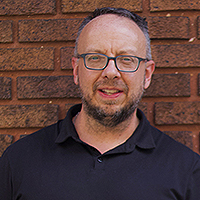
Stephen Kriss
Stephen Kriss is the Executive Minister of Mosaic Conference.
Mosaic values two-way communication and encourages our constituents to respond with feedback, questions, or encouragement. To contact Stephen Kriss, please email skriss@mosaicmennonites.org.
The opinions expressed in articles posted on Mosaic’s website are those of the author and may not reflect the official policy of Mosaic Conference. Mosaic is a large conference, crossing ethnicities, geographies, generations, theologies, and politics. Each person can only speak for themselves; no one can represent “the conference.” May God give us the grace to hear what the Spirit is speaking to us through people with whom we disagree and the humility and courage to love one another even when those disagreements can’t be bridged.