
by Zach Bower
Editor’s Note: This article was published in the Spring 2026 Lamplighter magazine and republished with permission.
Thirty years ago, Dock’s High School Social Studies Department began an experiment in learning that could not happen fully within the walls of a classroom.
Students would research complex social issues—poverty, justice, race, policy, and peacebuilding—and then travel to Washington, D.C., where those issues could be seen, heard, and experienced firsthand. What began in the 1995–96 school year as a new direction in the social studies curriculum has now shaped the experience of over 2,500 Dock students.
Today, the Social Issues class and culminating trip stands as one of the school’s most distinctive learning experiences, blending academic research, faith reflection, service, and shared community.
A Trip with Older Roots
The Social Issues Trip officially began in the 1995–96 school year, but the roots of the experience stretch back further.
Ron Hertzler (Bible and Social Studies, 1978-2023) explained that before there was a Washington, D.C. Social Issues Trip, there were earlier Dock efforts to help students engage urban settings more directly. He recalled that John Ehst (Bible, 1970-72) once led a group to Philadelphia in a program called City Church, designed to help students imagine the city as a place where church connections and meaningful learning could happen. Later, that idea grew into an elective class called Urban Seminar, where students lived with host families in Philadelphia and studied poverty and urban life more intentionally.
By the mid-1990s, Dock’s Social Studies Department began rethinking how these experiences might be more intentionally integrated into the curriculum. A committee studying both the senior trip and the social studies curriculum recommended a new direction. The Washington, D.C., trip that had previously served as a senior bonding experience would instead become the culminating experience of a junior course called Social Issues.
Students would spend the quarter researching a social issue of their choosing and present their findings to classmates. The trip to Washington would allow them to encounter the structures, institutions, and communities connected to those issues.
Dave Brubaker (Social Studies, 1989-2002), who helped shape the course in its early years, remembers the vision clearly. “The Social Issues course was modeled in part on the Urban Seminar course to engage students with complex societal challenges,” he shared. Dave also remembers that one of the most satisfying parts of teaching the course was “watching students wrestle with their chosen topics—researching data, navigating conflicting perspectives, and ultimately forming their own informed opinions.”
The trip itself was designed to deepen that process. Students visited soup kitchens, museums, churches, and policy organizations. They engaged with issues not as abstract ideas but as lived realities. “The immersive experience in Washington offers a broad range of opportunities,” Brubaker said, including service projects, visits to the Smithsonian museums, and conversations about public policy and faith. Brubaker feels that, “developing the Social Issues course and seeing it come to life was incredible. It was an enormous amount of work, but I felt supported the entire time by the administration and people involved, which made it possible to build something meaningful that could take root.”
Service, Reflection, and City Life
Throughout the years, the structure of the trip has changed. Early versions lasted nearly a week and included multiple days of service. Over time, scheduling pressures shortened the trip to the current three-day format. Yet the core purpose remains unchanged.
“The goals of group community formation, service learning, and Urban Seminar were met and are still met,” said Bible and Social Studies teacher Kirby King (1993-present). One of the most powerful elements of the trip continues to be the moments when classroom conversations meet real experience.
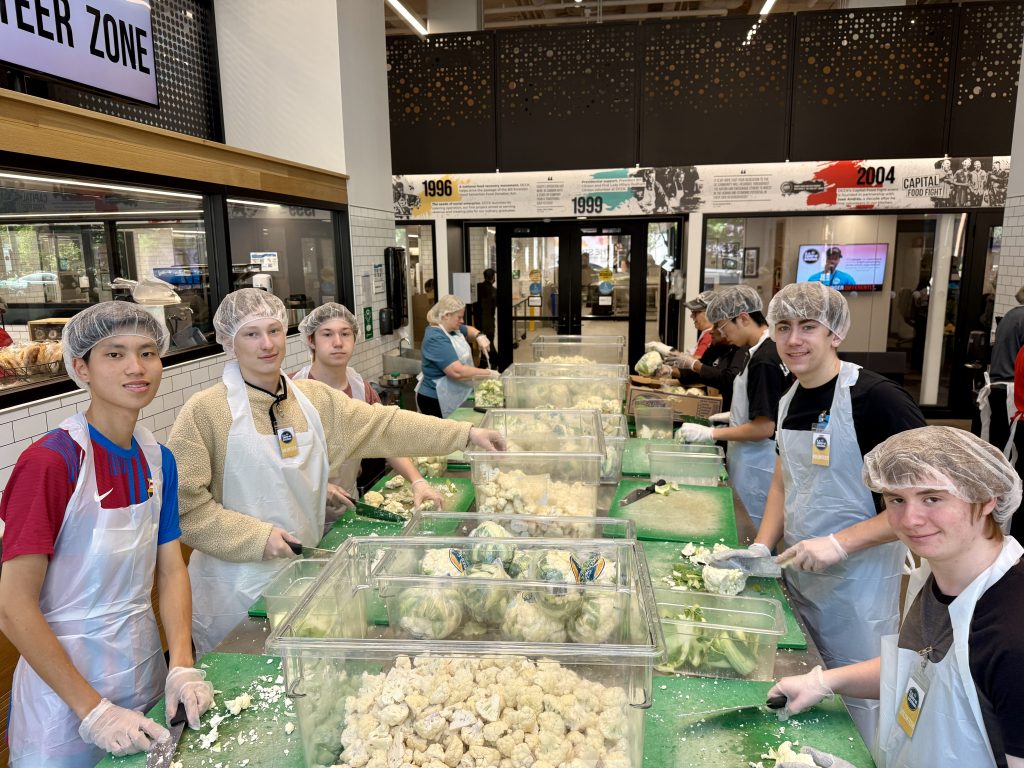
Service has always been a defining part of the Social Issues Trip, grounding students’ learning in real relationships and lived experience. Over the years, students have not only studied poverty and homelessness, but encountered it through the voices and stories of those directly impacted—whether hearing from speakers at organizations like the Coalition for the Homeless or engaging in hands-on service. A student on a recent trip shared, “The contrast between wealth and poverty was impossible to ignore. It made me think more critically about systems and inequality.” Service opportunities have taken many forms, from long-standing partnerships like DC Central Kitchen to newer experiences with groups such as Ward 8 Woods.
Visits to Arlington National Cemetery often prompt meaningful discussions among students about military service, peace, and Mennonite commitments to nonviolence. “How can we show respect and honor while still holding the need for non-violent responses?” King noted as a common question students wrestle with.
Bible and Social Studies teacher Caleb Benner (‘07) (2014-present) believes one of the trip’s greatest strengths is that it helps students think critically about how history is told and whose stories are emphasized. Visiting places like Georgetown, the Holocaust Museum, and the national monuments encourages students to ask not only what happened in the past, but why certain narratives receive more attention than others.
Worship experiences have also become a defining part of the trip. Many groups attended a contemporary worship service at the National Cathedral, and now currently at Mt. Zion United Methodist Church in Georgetown, where students encounter expressions of faith shaped by the history and experience of the African American church. These moments often lead to deeper conversations about culture, justice, and the ways faith communities interpret Scripture through their own lived histories.
On one recent visit to Mt. Zion Church, because of the weather, Dock students were nearly the only people in the sanctuary who were not directly involved in leading the service. That made the experience feel even more personal. Benner reflected that the sermon on that day used the parable of the bags of gold to talk about stewarding money in a way that helps break cycles of generational poverty—“not a message that we would hear in our churches,” he admitted, and precisely the kind of perspective that makes the trip valuable.
Community Building
Community building has always been a central goal of the Social Issues Trip—something that happens not through programming alone, but through shared experience. Students live together for several days, often alongside classmates they may not know well, navigating the city, and processing what they are seeing in real time. The trip creates space for relationships to deepen in ways that a typical school day rarely allows.
For Hertzler, another key part of the experience happens not in museums or monuments, but in the shared rhythms of the trip itself. “I believe that one of the most significant parts of the trip includes the opportunity for students to live together for three days,” he said. “Usually with persons they are unfamiliar with. This creates a connection that remains for the rest of their Dock experience.”
Those connections are often formed in the quieter moments—late-night conversations at the seminar center, shared reflections after a full day, or simply navigating unfamiliar places together. As one student recently reflected, “There is an inherent camaraderie that comes from passing time together in meaningful circumstances.” In many ways, the trip doesn’t just build understanding of the world—it builds a community that helps students carry that understanding forward.
Why It Still Matters
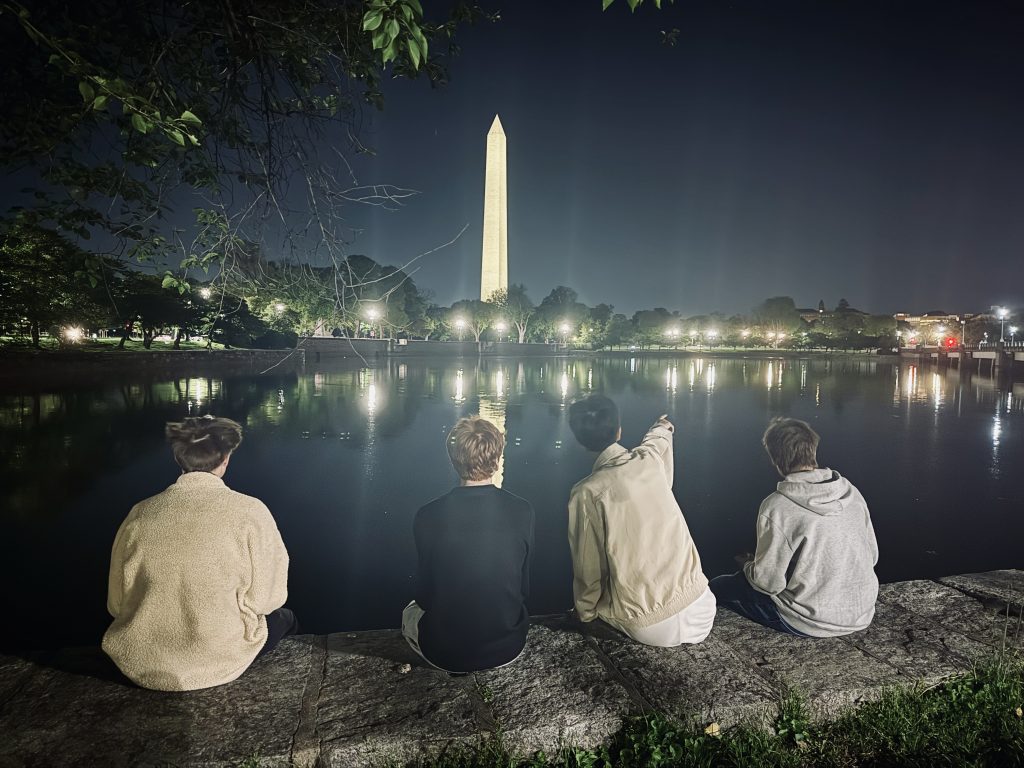
Over three decades, thousands of Dock students have walked through the memorials at night, ridden the Metro through the city, served those less fortunate, and stood in the halls of museums that tell difficult and powerful stories. Trips change over time. Students now carry smartphones. They stay connected to people back home in ways earlier classes never could. As Kirby King put it, “In some ways smartphones make it better (students don’t get lost) but in some ways it is not improved (students don’t get lost).”
Thirty years later, the Social Issues trip remains one of the shining stars of Dock’s curriculum. It reminds students that learning about the world is not only about gathering information. It is about encountering people, listening to stories, and asking faithful questions about justice, community, and the role each of us might play in shaping our communities.

Zach Bower
Zach Bower is a high school social studies teacher and Communications Associate at Conference-Related Ministry Dock Mennonite Academy, and a member of Salford (PA) Mennonite.
Mosaic values two-way communication and encourages our constituents to respond with feedback, questions, or encouragement. To share your thoughts or send a message to the author(s), contact us at communication@mosaicmennonites.org.
The opinions expressed in articles posted on Mosaic’s website are those of the author and may not reflect the official policy of Mosaic Conference. Mosaic is a large conference, crossing ethnicities, geographies, generations, theologies, and politics. Each person can only speak for themselves; no one can represent “the conference.” May God give us the grace to hear what the Spirit is speaking to us through people with whom we disagree and the humility and courage to love one another even when those disagreements can’t be bridged.