
Erin Odgers
eodgers1982@yahoo.com
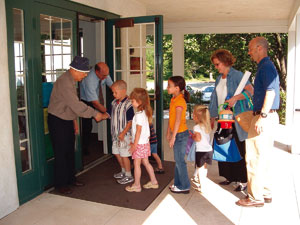 Two years ago, I moved to southeastern Pennsylvania after graduating from Messiah College. My first introduction to Anabaptist theology was during my time at Messiah. I was drawn to the focus on community, service, and nonviolent peacemaking, resulting in a desire to attend an Anabaptist church. Online I found an abundance of Mennonite churches in the area, and after visiting only two churches I found a congregation to attend regularly—Plains Mennonite. From the moment I walked in the door I was met with warm welcomes by congregants asking genuine questions to find out more about me and from where I came. Instead of relying on designated greeters and the pastor to welcome visitors, many members took it upon themselves to welcome me individually.
The hospitality did not end after the Sunday morning worship, which had been my experience at many other churches I have visited in the past. For the next two months I could count on an invitation to Sunday lunch by different members of the congregation, providing an the opportunity to learn to know each other on a deeper level and allowing me to gain a sense of inclusion in the congregation. I can remember some of the many invitations to lunch with Arlin and Esther Shisler and John and Marcia Parker, eating Vietnamese with Henry and Charlotte Rosenberger along with Larisa Friesen, an open invitation to Indian food at Paul and Rina Rampogu’s home, and discussing our experiences in other countries over lunch with Heather Hoover.
The congregation expresses this sense of community through community night meals held on six Wednesday evenings in the fall and spring. After dinner there is presentation on a selected topic that encourages the congregation to discuss ways to apply their faith to current issues in the local and global community. This spring’s topic was on mental illness and for two Wednesday evenings we watched a move on suicide and its effects on those with personal encounters.
The movie opened up discussion to a sensitive and often ignored topic that has affected members of the church. This enabled participants to express their feelings and experiences regarding suicide to others who have not experienced this pain on a personal level, gaining a better understanding of the issue. Not only did I experience community in this environment, but the congregation’s intentional effort to discuss real world issues provided a way to make Anabaptist faith relevant in the world and in my life.
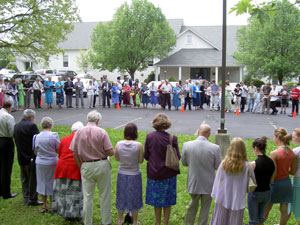 One struggle within a closely knit community is the tendency toward a sense of isolation. The longer I am a member of the Mennonite community within the Franconia Conference in southeastern Pennsylvania the more I find myself interacting only with other Mennonites. It is important that we understand the value of interacting with people from diverse backgrounds, including race, ethnicity, and religious expression, to break down barriers and increase understanding of each other combined with the recognition of Jesus’ call for his followers to be in the world acting as agents for reconciliation of human to human relationships and God to human relationships.
I would like to see individuals and groups in the church use the gifts that Anabaptism has to offer to the community through the building of intentional relationships with people from backgrounds different from our own. A few possibilities may be to attend cross-cultural events in the community, go to another country on a service trip, attend a multicultural church, or host a volunteer from another country. Finding ways to intentionally interact with people outside the Mennonite community can create a community that is more inclusive and less isolated, sharing gifts and learning within a world in need.
Erin Odgers is a 20something social worker who lives in Lansdale, PA. She is happy to be a part of the congregation at Plains Mennonite Church.
 Reaching Beyond the Mennonite Comfort Zone
While highlighting the Mennonite values that drew him to the denomination, Will Schirmer challenges the practices and underlying attitudes that make Mennonites appear exclusive to those on the outside in his book: Reaching Beyond the Mennonite Comfort Zone: Exploring From The Inside Out. The following is an excerpt from chapter 4, entitled A Close-Knit Community – How that Appears to Outsiders:
In the sixteenth through twentieth centuries, Mennonites lived in small communities throughout Europe and Russia. They were members of agrarian societies and held together by common religious belief and practice, common language, and at times, persecution. This strong sense of community migrated with the Mennonites over to the United States and Canada and had remained with them to this day.
A strong sense of community is not bad—there are many positives to it. However, those outside the community may perceive the community as one they can’t get in. Many people view Mennonites as they do the Amish—a person is born into the society; it is not something to be joined. Those who view matters from this perspective are primarily spectators—they have no interest in becoming part of the community. They make observations and draw conclusions from brief exposure.
Those who want to be part of the community—someone who wants to attend or join a Mennonite church, for example—see it differently. They are attracted to the sense of community and want to be a part of it. They want to share on the closeness that is already established. It’s this group of people, who want to belong, who often find it hard to be integrated into the Mennonite church community, mainly due to actions and words of some members.
Can a church create an atmosphere that causes people to feel separated? Can a church create an environment that enables people to overcome feelings of separation and assimilate them into the church fellowship?
—Excerpted from Reaching Beyond the Mennonte Comfort Zone by Will Schirmer, Cascadia Publishing House/Pandora Press (2003)
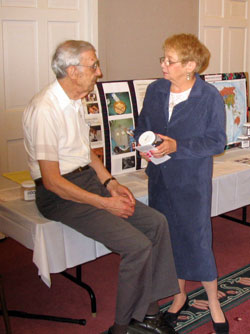 “Service stimulates the mind and unleashes God-given gifts and passions.†So says Dock Woods Community resident Claude Good, as he describes the vision behind a recent mission and service fair for Dock Woods residents.
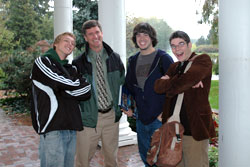 For as long as I can remember, Mr. Wiens would take students out to breakfast just to talk things over. I used to make fun of people that would actually agree to go out with him, thinking that it was kind of odd how the Vice Principal was hanging out with students. One day, Mr. Wiens popped me the big question. “Do you want to go to breakfast tomorrow?†Not wanting to get on his bad side, I agreed. The decision to go with Mr. Wiens to breakfast was possibly the greatest choice I have made so far in my high school career.
 In most cases, the assembled kits are distributed to thousands of people around the world, and the volunteers who pack the kits never meet the recipients. In March 2006, however, Mildred had an opportunity to participate in an MCC-sponsored delegation to distribute kits in Central America. The delegation went to Honduras to visit the Mama Project, a children and youth health and education program. Mildred saw a bundle of school kits being distributed and recognized that they were from Harleysville. “We were privileged to hand out the kits.†Mildred says, “Not all of us can to go Honduras, but this is a way to serve MCC and offer another kind of comfort.â€
 David Kochsmeier hosts Life With God Broadcast, a radio show playing 30 minutes of preaching, teaching, and a few hymns each week. David is usually the one preaching and teaching. I asked him what he considered the program to be.
 On September 16, 2006, the winner of Indonesian Idol 2005, Michael “Mike†Prabawa Mohede, visited Philadelphia. I had the privilege of interviewing Mike before he began practice with Philadelphia Praise Center’s worship team who joined him on his ministry tour stop in Scranton, PA. Mike was born into a Christian family and grew up in a relationship with Jesus. He shared how his faith was tested after his father “went to the eternal home†in 2001. Mike’s relationship with his father was very close and he not only lost his father but also a mentor. “God is always good,†he testified. “At that time I was ready to start my college years and the loss of my father made it seem that every door was closed but God worked in a different way. He opened many doors for me and I believe in every test there is always a purpose.â€