
by Ruth Baugher Palmer
Editor’s note: This reflection is drawn from the 2026 Souderton (PA) Mennonite Lenten Devotional Guide and reprinted with permission. The devotional, titled Breathing Light and Life: Stories Shaped by Jesus contains daily reflections on the Gospel of John, through Easter Sunday, and was written, illustrated, and edited by many members of the congregation.
Near the cross of Jesus stood his mother, his mother’s sister, Mary the wife of Clopas, and Mary Magdalene.
John 19:25
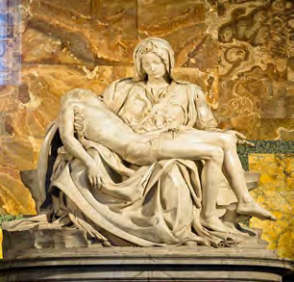
Scripture for Friday, April 3, 2026: John 19:23-42
What was this moment like for Mary, the mother of Jesus? Despite what we are told, death is not “a natural part of life.” Jesus’ murder on a cross held agony, terror, and final desperate gasps for breath. No – Death is an offense.
In early January, I was with my mother-in-law the night she died. I sang to her the old hymn, “Face to Face with Christ My Savior,” praying the Lord would take her gently. In the morning, she was gone. I felt relieved that our sweet Mimi got her wish to “just slip away.” Yet I felt outraged as I came to her deathbed that morning. Nothing left of her vibrant 93 years but a corpse – cold, rigid body and gaping mouth. The poem Dylan Thomas wrote for his dying father, “Rage, rage against the dying of the light,” was now personal.
My own dear grandmother passed away at 90. The pastor at her funeral looked out at our grieving family and said, “You had Helen a good, long time.” He seemed to be scolding us into thankfulness. As if gratitude for her life precluded grief at her death.
The morning of his mom’s death, my husband walked around her house saying, “The absence of her presence is so big.” Why does every death—even those of “natural causes” seem wrong? Why does the death of someone in their nineties still feel too soon?
Ecclesiastes 3 declares, “To everything there is a season…a time to be born, a time to die,” yet later in the same chapter we find the missing clue: “God has made everything beautiful in its time. He has also set eternity in the human heart.”
There we have the human condition—burden, beauty and mystery. Could it be that we weep at a 90-year-old grandmother’s dying and are appalled at seeing a lifeless body because we know—deep in our bones—that we weren’t meant to die? Rather, we were created in the image of our eternal, relational God—and meant to live in a garden forever in sweet communion with God and each other. St. Paul declares, “The last enemy to be destroyed is death.” (1 Cor. 15:26). Death is not “natural,” and deep in the human heart we know it.
So yes, I will weep for loved ones lost—the severing of the bonds of love. And I will rage at death’s robbery. But I will not despair. For I know the grave does not get the last word.
Easter is coming.
Ruth Baugher Palmer
Ruth Baugher Palmer is Vice President of Program Development at Lakeside Educational Network and attends the Movement and Meditation ministry at Souderton (PA) Mennonite.
Mosaic values two-way communication and encourages our constituents to respond with feedback, questions, or encouragement. To share your thoughts or send a message to the author(s), contact us at communication@mosaicmennonites.org.
The opinions expressed in articles posted on Mosaic’s website are those of the author and may not reflect the official policy of Mosaic Conference. Mosaic is a large conference, crossing ethnicities, geographies, generations, theologies, and politics. Each person can only speak for themselves; no one can represent “the conference.” May God give us the grace to hear what the Spirit is speaking to us through people with whom we disagree and the humility and courage to love one another even when those disagreements can’t be bridged.